Today is an important day in Buddhism.
It's a day for us to reflect upon the immeasurable,
Supreme virtues of the Buddha,
Dhamma,
And Sangha.
This means Apamano Butto,
Apamano Dhammo,
Apamano Sangho.
It is a day when our great teacher the Buddha,
Out of metta,
Goodwill,
And great compassion,
Gave a Dhamma teaching,
Pointing directly to the truth,
For those with the spiritual maturity to receive it,
For Venerable Anya Kodanya,
Who awakened to the Dhamma.
This is considered a vast and immeasurable act of supreme compassion.
Venerable Anya Kodanya was one whose Barami,
Spiritual faculties,
Were fully developed.
He listened attentively,
Opened his heart to the flow of the Dhamma,
And had a deep and marvellous realisation within his mind,
Clear and unmistaken.
On that day,
All five of the Panjavagya monks were present,
But Venerable Kodanya was the first of them whose mind became steady and who gained a true understanding into the Dhamma.
He realised that whatever is of the nature to arise is also of the nature to cease.
He had long been seeking the Dhamma and had attained deep states of concentration,
Of jhāna and samāpatti,
Absorptions and psychic powers,
Yet he had not realised the Dhamma on his own,
Because he was a disciple of the Buddha.
But upon contemplating the Buddha's teaching,
That is,
Into the nature of all things that arise must also pass away,
He finally saw and understood the truth.
And with that,
The triple gem,
The Buddha,
Dhamma and Sangha,
Was complete in the world,
Right there in the Isipatana Deep Park in the Kingdom of Varanasi.
Today marks the anniversary of that event,
But it is not merely a remembrance of the past,
It is also an opportunity for each of us in the present.
It's a day when our hearts can once again turn the wheel of Dhamma,
To set it in motion anew.
Why?
So that we may shift our perspective on life,
So that we may see what we've overlooked throughout the year,
So that the Dhamma may arise within us,
Offering insights that can transform the way we live and how we relate to our own hearts.
By turning our minds in accordance with the wheel of Dhamma,
We can experience true happiness.
If we look back to the day when the Buddha realized and saw the Dhamma,
Attaining enlightenment,
On the day of Visakha Puja more than 2,
500 years ago.
After the Buddha's enlightenment,
The Buddha remained in bliss for seven weeks.
Then he made a great decision,
To teach beings,
To help free them escape the cycle of samsara,
The endless round of birth and death.
This was the fulfillment of his aspiration in becoming a Buddha,
For the benefit of all sentient beings.
The Buddha gave his first teaching on what we now call a Salaha Puja day,
Which is the full moon of the eighth lunar month.
This was the Buddha's very first teaching,
In which someone was able to clearly see as the Buddha did,
To truly see the Dhamma.
To see the Dhamma means to see the true Buddha in one's heart.
At first,
People may perceive the Buddha as merely a physical being,
A form.
But the pure and formless nature of the Buddha's realization,
His true essence,
Remained unknown to others at that point.
However,
Venerable Anya Kodanya was the one who understood and saw,
Whoever sees the Dhamma,
Sees the Tathagata,
The Buddha.
This realization led to the arising of the Sangha,
Completing the triple gem in the world.
Now,
In our time,
We live in the digital age.
We have the ability to research and find information easily.
In today's world,
We even have tools like artificial intelligence.
But in our search for happiness,
For the meaning of life,
And for what is still missing,
Those answers must still be found within.
So we must understand,
A Salaha Puja day is not only an important day in Buddhism,
But it's also a day that reminds us to turn inwards.
To awaken and realize the truth within ourselves.
That we are each a single citta,
A mind,
With the potential to awaken to Buddha nature.
Just like Venerable Anya Kodanya and the other four of the Pancavagya monks,
Making a total of five.
After that first awakening,
Others also began to awaken.
Their hearts began to stir from their long slumber.
Do you see?
There is sleep.
There is delusion.
The opposite of awakening.
There is the arising of insight in the Dhamma.
We are born into this world.
We know,
We understand,
We perceive the world and all its matters.
But in terms of the Dhamma,
We remain asleep and deluded.
We still believe,
This is me,
This is mine.
If one awakens,
One will see,
This is not truly me or mine.
It is me in only a temporary sense.
As Venerable Ajahn Chah once taught,
One who sees the Dhamma,
Sees oneself.
And one who sees oneself,
Sees that what we take to be self,
Is in fact not self.
Such a person is said to have seen oneself.
To see both rupa and dhamma,
Material and mental phenomena,
For what they are.
We mistakenly take it to be me and mine.
We don't really see it as it is.
We are still deluded.
But once we see according to reality,
Then we truly become one who sees oneself.
We see that what we are clinging to,
As material and mental phenomena,
As being me,
Is actually anicca,
Impermanent,
Dukkha,
Unsatisfactory,
Anatta.
It is not our self.
It is owned by nature.
What we are doing is stealing from nature.
Claiming what naturally exists as being ours.
So this is the cause for suffering to arise.
And we have been deluded like this for a long time.
But when we come to see that this is not truly us,
That is when we truly become one who sees oneself.
This is a profound insight.
One well worth deep reflection.
When we contemplate and come to truly understand,
The mind gathers inwards.
Through our accumulated merit and spiritual maturity,
We begin to see in this way.
We see a turning point within our own minds.
We begin to perceive the world from another angle,
As it truly is.
We see that all things are impermanent,
Unsatisfactory and not self.
We witness their arising,
Their brief existence and their passing away.
Right before our eyes.
This is insight arising.
We had never seen in this way before.
But once this vision becomes clear and undeniable,
We begin to let go of the mistaken views we previously held.
What we call delusion.
This is known as sakiyaditi,
The false view of self.
The clinging to me and mine.
Now we see it clearly.
From this rapture arises and concentration arises.
We see clearly that what the Buddha taught is real.
It is true.
It's completely reliable.
And faith becomes firm.
One who sees in this way is called a sawaka,
A noble disciple of the Sammasambuddha,
The perfectly self-awakened Buddha.
The Buddha nature arises in that person's heart.
Therefore all of us can begin this learning.
Even if we have not yet seen the Dhamma clearly,
We have already started.
It's like being a student beginning to learn a subject.
We've enrolled,
We've started studying and we've begun to gain knowledge.
Whether it's medicine or any other field,
We're learning and understanding is gradually growing.
One day we will graduate.
We too will become doctors,
Just like those from earlier generations who have already learned and practiced.
As they grow old and pass away,
New doctors arise.
In the same way,
The knowledge that makes one a doctor still exists.
Just as the Dhamma still remains in this world,
Ready to guide our hearts and minds.
It is here to help every single mind open the door to its own Buddha nature.
And since we have been born as human beings,
We have the rare and precious opportunity to learn,
To grow and to develop the wisdom to truly understand.
Even a child as young as seven years old,
The brain is fully developed and can learn the Dhamma and realize the truth,
Just like Lady Wisaka,
The great lay disciple.
Therefore,
Let us not waste this opportunity.
When such a meaningful anniversary returns,
It serves as a reminder,
A chance to awaken our mindfulness,
To return to learning,
And to gain clear understanding within our own heart.
And what is it that we are to learn?
The Buddha taught the four noble truths,
The truths of reality.
The first of these is dukkha,
Suffering.
We often think of suffering simply as sadness,
Grief or emotional pain.
But in truth,
Dukkha,
Suffering,
Is simply this.
Things not being just right,
Not aligning with our heart,
Not matching with our wrong expectations.
When we have wanting of various things,
Or our minds are constantly restless and struggling,
Then they are not at peace.
It is suffering every day.
Even small things become minor irritations that go against our preferences.
And every single mind experiences this conflict.
It is all suffering.
Driving to work,
For example,
Has problems with traffic,
Vehicles and other drivers.
Or being at the workplace and dealing with various situations,
It all stirs up our emotions.
There are small sufferings and big sufferings.
They arise just like that.
And this causes our hearts to twist away from the truth.
Because we lack sati,
Mindfulness and bhanya,
Wisdom.
We should often ask ourselves,
Am I suffering today?
Do I really know what suffering is?
Or is it that we don't truly understand suffering?
Because we've been running away from it,
Avoiding it,
And so we've never truly studied it.
Therefore,
Knowing that suffering is bound to arise,
We should train ourselves.
How do we deal with it?
How do we respond to suffering?
The Buddha taught sati,
Mindfulness.
This mindfulness is the path we follow.
It becomes our protection,
Keeping the mind from falling into suffering.
From being swept away by it,
Whether it's great or small.
You might think of mindfulness like a kind of tool.
A protective tool.
Like an antivirus software that prevents harmful viruses from corrupting important data.
We must be aware in time.
Like we have to recognize early on that the virus has already arisen.
That is greed,
Anger and delusion.
These are the forces that come in and damage the heart.
These days we might better understand it if we call them viruses.
In the past,
They were simply known as greed,
Anger and delusion.
But now if we add the word virus,
It might make the concept clearer.
These viruses invade and corrupt our minds.
The minds that were calm and peaceful.
And it makes them clouded and defiled again and again,
Continuously.
Therefore even though the Buddha has already passed away into Parinibbana,
The Dhamma remains as a powerful tool.
But only if we apply it.
We don't have to wait for special days like a Salahat Puja to begin using it.
Even when we're at home,
We can practice it.
At work,
While waiting for the bus,
Riding the bus or the train to work,
We can still practice Dhamma.
This is important.
This is the turning of the Dhammacakka,
The Dhamma wheel,
Spinning within our own hearts.
The Buddha set the wheel in motion.
He passed it on to Venerable Anya Kudanya.
And it has turned from his heart and has been passed down ever since,
From heart to heart,
All the way to the present day.
And every one of us has the ability to continue turning that wheel.
But the question is,
Will we turn it?
Or will we surrender to suffering again and again,
Refusing to rise and face the truth?
We must begin to change.
And so listening to the Dhamma,
Becoming aware of the Dhamma,
This gradually transforms our mind,
Little by little,
Step by step.
This is a training of the mind,
Turning it towards goodness and towards the practice of Sila,
Morality,
Samadhi,
Concentration and Panna,
Wisdom.
We do this through the reflection that I will not abandon myself,
Even when I make mistakes.
Everyone must have a starting point.
A point from which true understanding and realization can begin.
Just like learning in school,
There's always a place where we begin the journey towards mastery.
We must be diligent.
We must persevere.
If we want to become doctors,
We must not stop striving.
We hold the firm intention,
In this life,
I will achieve this.
And when we graduate,
We can truly become good doctors.
There are many doctors in the world.
But to be a good doctor,
One who has goodwill and compassion,
And who upholds moral integrity,
That is something higher.
Like the great doctor,
Jivaka Komarapacca,
In the Buddha's time.
So,
Let us ask ourselves,
Today marks the anniversary of the Buddha's first turning of the Dhamma wheel.
Where then is our own Dhamma wheel turning right now?
Has our anger,
Greed and delusion turned less?
When we compare it to last year,
Has our effort and diligence improved?
These are the things we should reflect and contemplate on.
It shouldn't just be about following tradition.
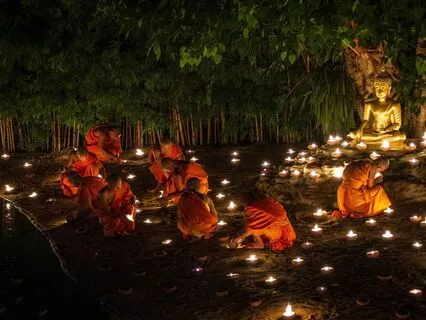
Coming to join the candle procession,
Chanting and then calling it a day.
Then only next year will we come back to chant and make merit.
And a year passes by like this.
Yes,
We do gain merit,
But it's only a little.
Just a small amount.
But if we study more deeply,
If we actually practice more,
Come to know suffering,
Develop mindfulness and contemplate sincerely,
Then we begin to see and understand.
And through that,
We can truly transform ourselves far more than we did from last year to this year.
That is what really matters.
Lighting a candle and offering light in homage.
Let it be a symbol for reflection.
Let it ignite our own hearts.
Let it be a moment where mindfulness arises.
And may we strive to open and awaken our hearts one day.
We must get to know this truth.
And to gain this insight before this body,
This physical form we rely on falls apart.
May we come to know or realize the Dhamma of the Buddha.
If a practitioner truly commits to the path in this way,
One day they will come to know and see clearly.
The mind will awaken brilliantly.
There may be a sense of wonder so profound that one cannot sleep for three days and three nights.
Rapture arises and deep concentration follows.
One might wonder,
What is this?
It's as if one has entered another world.
A world previously unknown and unseen.
The heart is completely fulfilled.
There's no need for food or drink.
One is sustained by joy and rapture alone.
It's like the beings in the Brahma realms who live on rapture as their food.
This is what it's like.
The joy in the Dhamma.
The contentment that fills the heart.
So now that we've arrived at this important day,
Let us all take it as an opportunity to learn and sincerely practice.
May all of you be blessed with happiness and progress,
Both in worldly life and in the Dhamma.
May you all grow in blessings.