A happiness we can depend on.
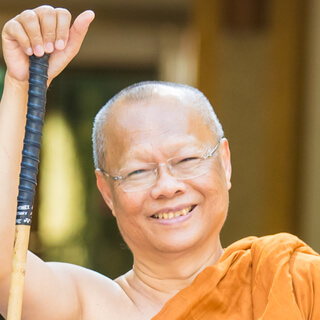
A collection of short Dharma teachings by Venerable Ajahn Anand.
What is this?
This is a path that leads not only to happiness,
But to inner peace as well.
It starts with restraint and practicing meditation.
When the mind is still,
That's when this pure happiness arises.
It doesn't depend on external things at all.
We don't need to use any external stimulus to experience it because it's a peace and happiness from within.
And when we use this to let go of our attachments,
We experience an even more profound happiness yet.
Practice and you will see for yourself that this is the right way.
About happiness.
The Buddha admitted that the various comforts that come from material gain and development are a true form of happiness,
But they're only temporary.
The kind of happiness we get through having money,
Property,
Relationships,
And the experiences associated with that is temporary.
And for that reason,
There is suffering hidden within.
We gain happiness,
But then lose it again,
Leading on to a cycle of the mind wanting more,
Wanting to experience again,
Wanting to hold and to cling.
And that brings suffering.
If people never reflect on that,
Then they tend to get caught into this habitual cycle.
But Buddhism is helping us to look within that process,
To see the suffering that comes with attachment to material happiness,
And to realize our potential to find something more deeply satisfying.
Working for inner wealth.
Even though we're busy,
Even though we have families,
We should make time for the practice.
We're practicing to find internal wealth,
The wealth that comes through seeing the Dharma.
Maybe we spend 40 hours a week or more finding external wealth,
Money,
And the resources to live,
But we need to also make time to develop this internal wealth,
Which is our way to true happiness.
Whenever we have free time,
We can devote it to raising the level of our mindfulness and understanding.
Ultimately,
We're aiming to develop mindfulness and observe the truth at all times,
Whether standing,
Sitting,
Walking,
Or lying down.
And if we put an effort in this way,
We'll come to see that the Dharma the Buddha taught is actually very close by.
The first noble truth.
The Buddha encouraged us to awaken to the way things are,
To see into the truth of things.
He taught us to contemplate the full noble truths,
And the first noble truth is that there is dukkha,
Stress and suffering.
This is a part of life.
We have unhappy states of mind,
Pain in our bodies,
Situations where we don't get what we want,
Worry and fear,
Sorrow and anguish,
Separation from the things and the people that we like and love.
Just from all the difficulties of living in the world,
From work and family affairs,
We'll meet with stressful situations and different conditions that bring up a sense of discontent in the mind.
All of these different experiences we call dukkha,
Suffering.
And this is where we have to learn to see it as just suffering,
As a noble truth,
That it's like this.
If we have faith in the Buddha's teachings,
Then we have a way to deal with these problems,
The suffering that we encounter.
The teachings encourage us to practice,
To try to overcome all these different unwholesome tendencies that are fed by delusion and misunderstanding,
And that keep goodness and happiness from arising in our mind.
We have to contemplate these tendencies in order to see them clearly and let them go.
Because if we follow them,
It always leads to suffering.
If we follow greed,
It leads to suffering.
If we follow anger,
It leads to suffering.
If we follow delusion,
It leads to suffering.
Whenever we follow these mental defilements,
They'll pull us towards suffering and pull down the level of our mind.
But they don't end there.
They don't just arise and pass away.
The more we give in to them,
The more they'll grow,
Becoming established in our mind and feeding off our lack of understanding.
The only thing these mental defilements are really afraid of is virtue,
Concentration,
And wisdom.
This is the path of practice that the Buddha gave us,
The path that directly leads to the abandoning of greed,
Anger,
And delusion.
In the beginning,
We can find accepting our suffering difficult,
But just be aware of it,
Be mindful of it,
Know that suffering is like this.
We can suddenly understand,
Ah,
Life is just this way.
This isn't to judge it or get emotional about it,
But just to know it's this way and couldn't be any other.
Like when we experience problems at work,
We know that it's natural for problems to come up,
That this is to be expected.
When we have this kind of awareness of the inevitability of difficulties,
It keeps the mind peaceful.
We know that this is just the way things are,
And don't suffer needlessly over them when they arise.
Something we can depend on.
When we decide to devote our free time to the practice of Dhamma,
Then we use this time to chant,
Recollect the teachings,
Meditate,
And develop peace within our heart.
We set aside our concerns about work and family,
And bring the mind to the object of its attention.
By establishing mindfulness on the feeling of the breath going in and out,
We're developing awareness of the present moment.
And when we sustain our attention like this,
Not letting it stray anywhere else,
The mind will start to calm down and become concentrated.
As the mind calms down,
It experiences rapture,
A sense of inner satisfaction arising through the act of mindfully focusing on an object.
Along with this sense of inner satisfaction,
Joy will arise as the mind becomes interested in its meditation object.
Sometimes we might even experience a deep inner happiness and contentment of the sort we've never felt before.
It's an internal happiness that arises through the result of our own efforts,
Having trained the mind to focus its attention on one object.
It doesn't arise from contact with external things in the usual way that we talk about happiness.
Before experiencing this,
We might never have realized that the practice of continual mindful awareness could bring such a sense of satisfaction.
But if we wish for a peaceful mind,
We have to understand that true peace and happiness can only be found within.