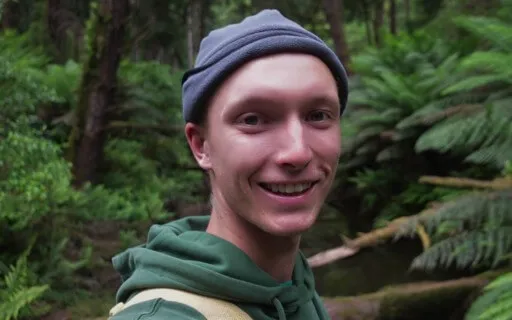
I'm walking in the fields around my parents house in Brittany between Ren and Nantes.
I've only been back at my house,
At my parents house for a few days now after two years of absence.
Living overseas in Australia and Melbourne.
And as lovely as it has been to see my family,
To see my sisters,
They've grown so much I can't believe it.
It's also been quite challenging.
You know in two years I've changed a lot.
I've been exposed to new ways of thinking,
To new cultures,
New traditions.
My own behaviour has changed a lot also.
And I've developed my own practice and have defined my values more clearly.
And so when I came back here there was a certain period of adaptation with my family,
With my parents.
And I saw myself kind of judging them.
I saw myself thinking I knew better.
Assuming that I could help them with everything.
And I adopted the role of the saviour.
Adopting that role,
Putting on the suit and deciding that I was going to save them from their suffering.
And obviously it didn't go very well.
It didn't go very bad either.
But it became obvious quite quickly.
And it shone light on something that I've been trying to bring more attention to lately.
And that is the difficulty I have with witnessing suffering.
And this first became apparent about a month and a half ago.
When I was living on this Hare Krishna farm in the old ways near Melbourne called Hare Krishna Valley.
And I was sharing the ashram with this girl called Meg and my friend Mukunda.
And I was hanging out the washing in the back and I accidentally stepped on an ant.
Which I was usually so careful not to do.
And as I turn around and see this small being just squirming,
Just searing with pain,
Just twitching with pain.
I kind of didn't know what to do.
And out of what I thought was compassion I decided to kill it.
To end its miseries right?
It made sense at the time.
I mean there is this ant right there and it's just twitching with agony and I can end that.
So that's what I did.
And as I walked back into the ashram I was curious to have Mukunda and Maggie's perspective.
And Maggie's perspective was quite challenging to mine which I thought was really interesting.
The first thing she said was,
Why do you assume that you know what's best for this being in that moment?
How do you know this being wasn't going to get better?
Or how do you know that the pain it's going through isn't necessary for its healing?
And I thought that was really interesting because it's not something I'd ever challenged my views on.
Or it's not a way I'd ever challenged my views.
And then she said,
Why didn't you just stay with it?
Help it.
Why didn't you try and help it?
And suddenly it became apparent.
It became dead obvious that I hadn't killed it to end its suffering.
I had killed it to end mine.
My own inability to be present and still in the witnessing of some other beings suffering is what had pushed me to deal with the issue radically by ending the issue.
By just finishing it.
That was not an act of compassion.
It was out of empathy.
I was feeling what that ant was feeling,
Relatively speaking.
And so I had empathy for it.
And hence dealt with it in the most direct way that seemed,
You know,
The most appropriate and direct way.
But in reality it was my own suffering I was dealing with.
It was my own suffering I was trying to end.
Whereas a really compassionate,
A truly compassionate act is to be present with that other being suffering.
Even though it makes you suffer.
That's a truly compassionate act.
And so my sensitivity and my inability to deal with that other being's pain had pushed me to deal with this situation in a certain way.
And it's exactly what I've noticed myself doing once I came back home recently.
I saw my family,
Or at least I perceived my family to be suffering.
And hence I immediately adopted the role of the saviour to try and deal with the issue,
Deal with the situation.
Rather than being fully present and still and offering that to the family.
And that would have been an infinitely more precious gift than me adopting a role and inserting myself in a dynamic and in a situation in which I was not invited in,
Or welcomed in,
Or useful in.
It would have been infinitely more precious to just bring my stillness.
To be a pillar of support.
To offer a space.
Maggie also shared with me something really valuable that I remembered.
It was like people don't need you to fix their issues.
They need a space.
They'll fix their own issues.
They'll come up with their own solutions.
They just need the space.
The room,
The silence.
And so I'm really grateful I've gone through this with my family.
Because first of all,
It's with my family.
It's a safe place where I can go through these kind of experiences and we can talk about it and realise what's happening and get past it.
And we still love each other.
Because in the past that exact behaviour has really destroyed relationships.
And so I'm really grateful I've gone through this and it's making me more aware of my own behaviour.
And it's really something that's crucial for me to become aware of.
Especially if I want to learn to help people and to be there for them.
I hope you appreciated me sharing and I hope to speak to you soon.
Take care.
I wish you well.