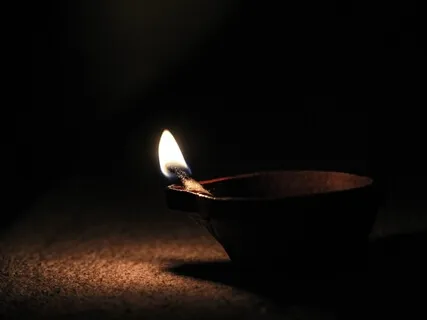
The world is a flame.
The world is a flame with the fires of greed,
Anger and delusion.
What is the world?
The world is these five senses and the mind base,
The mind base,
The Jitta.
When consciousness,
Vinayana,
Comes together with perception,
Sannyā,
Or mental fabrication,
Sankhāra,
We call it Jitta.
This coming together,
This aggregating is Jitta.
The world,
The way we see the world,
The way we perceive the world,
The way we fabricate about the world.
Greed,
Anger and delusion.
Because of delusion,
Because of ignorance,
We're bound up with attraction and aversion.
Clinging and craving,
Craving for becoming,
Bhava tanhā,
For the liking quality,
Attraction.
Craving for non-becoming,
Vipāvā tanhā.
Craving for things to end,
Aversion,
Both caused by the primary cause of ignorance.
Duality itself,
Like and dislike.
To the eye gate we see forms,
Beautiful and ugly,
And because of that attraction and aversion arise.
We call this the worldly eye.
Through the ear gate we hear sounds and have a like or dislike for them.
Through all the sense gates and through the mind gate there is attraction and aversion,
Like and dislike.
Duality that takes us away from equanimity.
The duality which is the result of ignorance.
The mind is caught up in the world-be-dhammas,
The eight world-be-dhammas.
Caught up,
Bound up with,
Attached to pleasure and pain,
Praise and blame,
Fame and disrepute,
Gain and loss.
These eight dhammas come and go,
They are out of our control.
They are dependent on cause and condition.
When the causes and conditions are ripe,
The dhammas come,
The phenomenon happens.
We can't change it.
When you get caught up in it,
When the jitara is caught up and bound up with it,
Travels along with it,
Is attached to it,
Along with that attachment comes dukkha,
Comes satsva.
Whether we like it or not,
These eight world-be-dhammas will happen.
Pleasure happens and pain happens.
There is sukha and there is dukkha.
Just sitting here,
Pleasure and pain happens.
You can't command the pain to go away.
You can't command pleasure to come.
Pleasure and pain happen dependent on cause and condition.
Praise and blame come and go.
Your conduct might be flawless but still you'll be blamed by others.
Maybe the conditions will be ripe and you'll be praised by others but praise ends.
It's impermanent,
It's anicca.
When it ends,
You're blamed.
Fame and distribute arise and fall away.
Duality arises,
Changes and falls away.
All things that are dependent on causes are by their very nature dualistic.
Because by their very nature they're dualistic,
By their very nature they're impermanent,
They're subject to change,
They're unreliable.
Because they're unreliable,
Any clinging to them,
Whether it be clinging to their arising,
Becoming or clinging to their falling away causes pain,
Causes suffering,
Causes dukkha.
That which is me or belongs to me is the direct cause of dukkha.
The worldly eye,
The eye which sees duality,
Beautiful and ugly,
Experiences things in this way we call it.
Lokkhiya of the world,
Of duality,
Of the world,
Of suffering.
The training is to step beyond the world,
To transcend the world,
Transcendent of the world,
Beyond,
Be of the world or lokuttara,
To be beyond and above the world.
How do we become beyond and above the world?
Well,
By eradicating ignorance.
Ignorance is when we are caught up in duality,
Caught up in attraction and aversion.
Because we're ignorant to the true nature of things.
The true nature of things is that they're going to end.
They are impermanent.
When you train yourself to see this impermanence continuously,
Things start to lose their flavor.
It's easy to detach from things when you just see them as ever changing.
What is there to get caught up into?
So we start to awaken the eye,
The lokuttara eye,
The eye which is beyond the world,
To see beyond the worldly way,
To get beyond the flames of greed,
Anger and delusion which burn us.
Because the world is a flame and the world is these five senses in the mind gate,
Five senses in the jita.
A flame with ignorance,
A flame with attraction,
A flame with aversion.
A worldly eye,
A worldly ear,
All the way through the senses and the worldly mind.
Only when the knowing quality is lifted up,
Transcendent,
Lokuttara,
Beyond the world,
Is it free from the fires of greed,
Anger and delusion and therefore free of suffering.
So the first step in the practice,
The first attainment,
We call the arising of the Dharma eye or the awakening of the Dharma eye.
This is the first time,
The initial big moment when awareness recognizes the way things are.
The eye,
The seeing quality begins to see impermanence and begins to see not self.
When this happens it's a shock to the system.
Something that hadn't been seen previously is now clear.
That which was foggy is now clear.
The awakening of the Dharma eye.
In the sutras this usually happens when people are listening to a Dharma talk.
It gets explained and it dawns on somebody,
Ah,
All things,
All conditioned things are impermanent.
The most important word here is all.
Not just the ones we don't like.
All conditioned things are impermanent.
All conditioned things are not self.
All conditioned things are suffering.
Seeing is clearly is called the awakening of the Dharma eye.
But that's just a moment of clarity.
It's not actual attainment.
We must practice further until we continuously see in this way.
After the sudden moment of realization we have to cultivate the awareness so that it dwells beyond the world.
Lokuttara yad,
Knowing beyond the world.
The world is not this world.
The world is the five senses and the mind.
If you take the five senses and the mind away what do you experience?
There's no world.
There is no experience,
No world outside of the five senses and the jita.
We step beyond it,
Above it,
Transcendent,
Lokuttara.
So when the eight worldly dharmas or the eight worldly winds come blowing in to disturb your mind,
To disturb the jita,
Pleasure and pain arise.
Praise and blame,
Observe them.
Simply observe them for what they are.
They are conditions that come,
Exist and fall away.
They are conditions that will end.
They are out of your control.
They are not a problem.
But when the mind gets caught up with them,
We get attached to them and we desperately cling.
We cling to the way we want things to be.
We cling to the way things are and we try to change them.
We are not happy with the way it is so we try to push it away.
Clinging to non-becoming,
Wanting things to end,
Wanting things to stay,
Wanting things to end.
I like this one,
I really want it to stay but it changes.
Now I don't like the way it is.
Now it's pain,
I really want it to end.
Now there's pleasure,
I really want it to stay.
So when there's pleasure,
There's the suffering of wanting it to stay and when there's the pain,
There's the suffering of wanting it to end.
Either way,
There's dukkha.
Pain is a wealthy dharma.
It simply happens separate to us.
Free from our control,
There is pain.
But dukkha is that which we add to pain.
Dukkha is the suffering because of pain.
Pain will happen because there is a body.
Dukkha does not need to happen.
We don't need to suffer.
There are four methods to try and make dukkha go away,
To make dukkha end.
One,
We flee the dukkha,
We run away from it.
We get up and we leave.
We adjust our posture.
We disassociate with those that cause us dukkha.
We quit the job,
We run away from our stresses.
Two,
Is we try to move the dukkha.
Instead of us running away,
We try to push the dukkha away or move it.
The third way,
We wait for the dukkha to end.
Because everything is impermanent,
It will end.
These three ways do not cut it.
These three ways do not lead to the ending of suffering.
When you run away from it,
It arises again.
When you push it away,
A new one arises in an old place.
When you wait for it to end,
There is another brother,
More dukkha coming along because dukkha keeps happening.
The fourth way is to extinguish dukkha.
Not to let dukkha extinguish,
But to extinguish dukkha.
How do we extinguish dukkha?
By eradicating the fire of illusion,
Of delusion,
Of ignorance.
By seeing the way things are.
By having sati,
By having mindfulness.
So that the knowing quality can see.
We can see the way things are,
Then we can let go.
We know,
We see,
We let go,
We practice vipassana in this way.
Then we begin to cultivate equanimity.
By knowing the way things are,
By seeing their natural up and down,
Their natural duality,
And then letting go of it.
Simply dropping it because,
Well,
That's its own nature.
Of course it's going to come,
Arise,
Fall away,
Good,
Bad,
Beautiful and ugly.
Pleasure and pain,
Praise and blame and so on.
Duality is the way things are in the world.
So we have the knowing quality and we lift it up to be lakuttara,
To be transcendent,
To be beyond the world,
Therefore free of the sufferings of duality.
This is the knowing.
When this knowing penetrates through,
All the way through till we see the ultimate reality of anatta,
Not self.
We see that there is nothing worthy of being called me or mine.
The very nature of this change in duality proves that there is no essence.
If there was an essence,
By its very nature it would be unchanging.
We can't find anything like that so we see clearly anatta.
Seeing anatta we can penetrate through and see emptiness.
Sunyata.
Emptiness is the anatta state of phenomena.
All things are by their very nature empty.
If you look closely at them you see their non-existence.
If you look very closely at something through a very powerful microscope you can see the matter flicking in and out of existence.
It's empty.
Our physical body is made up of 99.
99% empty space.
Only because of our ignorance we see it as substantial.
If you look closely enough at anything you see its emptiness.
So we see we begin to penetrate through to see,
To know to see and to penetrate through to not self.
What is nirvana?
Nirvana is the extinguishing of the cause of suffering.
To extinguish the cause of suffering.
Cause of suffering is clinging to this duality of the world.
So we have to cultivate equanimity.
In meditation we just did we cultivate equanimity based on space,
Resting the mind on the object of a kasa of space.
Because space has equanimity.
Because the mind,
The nature of the mind is empty.
Space is empty.
Because mind and space are so similar,
Cultivating meditation on space gives you a chance at recognizing the nature of mind.
The only difference between space and mind is knowing.
Mind has no form,
It's much like space.
If you try to find the house of your mind you can't find it.
Does the mind have a shape,
A color,
Does it have form?
No,
It's like space,
It's empty.
But it has knowing.
This jnana,
The quality of knowing is the essence of the consciousness element.
But the knowing gets mixed up with the world,
With these five senses and the jitta.
When it's mixed up with the world it's a flame with ignorance and therefore it suffers.
So the training is to lift this knowing quality,
To lift the jnana beyond the five senses and beyond the jitta so it becomes the kutara,
Transcendent of the world.
Training from the first eye of the world,
The eye,
Lokkhiya eye,
To lift it up to the kutara eye and to penetrate all the way through to not self and emptiness through to the eye of nibbana.
This is the practice.
From the awakening of the dharma eye and cultivating through until we realize deeper the true nature of things.
And through this realization we can relinquish the defilements.
When we relinquish the initial defilements we call it the realization of sotibhatana,
Stream entry.
This level is characterized by being free from the coarse defilements and by having a true understanding of the dharma because the dharma eye is now ripe.
For a stream enterer the knowing quality is clear,
Empty,
Clear,
Pure,
Like the sun in the sky.
But sometimes it's clouded by defilements.
In the same way the clouds block the sun.
The sun is always there but sometimes it's blocked.
The mind of a stream enterer has recognized dharma and recognized and realized nibbana.
Because of that it always has freedom.
But the stream enterer still gets caught up with the defilements.
Not like a worldling.
A worldling is always caught up with the defilements.
They never see clearly.
Always defiled.
And when they're angry or upset their emotions are strong and potent.
And the stream enterer can still become defiled.
They still have these defilements in the mind.
But when they arise they're not strong and they don't last long.
So the clouds come and they go.
When they go the mind is bright,
Clear and pure again.
But a worldling is always clouded.
The five senses and the jitta are always clouded with greed,
Anger and delusion.
They're always aflame.
So we train the mind in order for the dharma eye to awaken.
We train the dharma eye in order for stream entry to be achieved.
By knowing,
Seeing,
Letting go,
Penetrating through to not-self.
Knowing and letting go.
Seeing the way things are.
Seeing the normalcy of the way things are.
Because the world is aflame.
Not just today's circumstances.
Not just the way things are for me.
Not just the way things are for my family.
All of it.
All of it is aflame with greed,
Anger and delusion.
All of it is subject to this duality.
The duality which causes suffering very directly.
In fact what we want,
If we think about it,
We all want something.
We want the non-dual.
We want things to stay.
We want them to be permanent.
We want happiness that doesn't fall away and isn't replaced with sadness.
We want gain but we don't want loss.
We want fame but we don't want disrepute.
We want praise but we don't want to be blamed.
We want pleasure but we don't want pain.
Or maybe we have some other strange education and we take a twisted kind of pleasure in aversion and we're attached to pain.
We like to be blamed.
It's still the same thing in another mask.
It's simply delusion making us cling.
Clinging to becoming that which we want to exist.
Bhava Tanha.
And clinging to non-becoming.
That which we want to end with Bhava Tanha.
So we learn to walk the middle way.
The middle way of equanimity between these two.
Not being moved by gain and loss.
Not being moved by pleasure and pain.
Allowing the known quality to stay in the center,
The middle way between duality.
Between positive and negative.
Not getting caught up in the positive leading up self to rebirth in the heavenly planes.
Not getting caught up in the negative leading to rebirth in the lower planes.
Walking the middle way,
The path of equanimity.
With equanimity we can see clearly the way things are.
When we don't have equanimity we can't see the way things are.
So we cultivate samadhi as a skillful means to increase equanimity in the mind stream.
When the mind becomes still equanimity is easier to achieve.
So samadhi is a skillful means.
When nobody has ever become awakened during samadhi it is impossible to become awakened during stillness.
Awakening by its very nature is a breaking through,
A breaking out of the world.
How can that movement happen from stillness?
So it's a mistake to think that in deep meditation bang the lights come on you need to become awakened.
It doesn't happen like that.
Meditation is a cause.
Meditation is a condition.
It allows the mind to become empowered.
It allows the mind to develop deeper equanimity.
So that when we have equanimity we can see things clearly.
Seeing them clearly we can see them with wisdom,
See the way things are.
And from the deep understanding awakening can happen.
In the sutras people become awakened.
During a dasana,
During dharma talks listening to the Buddha.
Contemplating things,
Seeing things,
Walking,
Sitting,
Talking.
Awaiting never in stillness.
Although stillness is cultivated in practice,
All the way to developing the jhanas.
Awaiting does not happen in stillness.
It is a movement.
If stillness was enough a kona would be good.
Or we could simply take a bat and hit ourselves and we'd be still.
That would be great if only it was that easy.
It's not that easy.
Stillness does not cut it.
If it did well let's just sleep.
Koma stillness is a cause so that the mind can rest and achieve equanimity.
The pinnacle of samadhi is the fourth jhana characterized by single pointedness and equanimity.
All other samadhi practices leading up to that state.
We work through supreme bliss and then let it go to achieve equanimity.
Because even with the extreme bliss states we become deluded.
Only with equanimity upeka can we see clearly.
Upeka can be achieved by samadhi practice with the fourth jhana and it can be achieved by vipassana practice.
The equanimity of vipassana is the equanimity of panya of wisdom which leads directly to awakening.
The equanimity of samadhi of the fourth jhana is not the awakened state but rather similar.
The experience is similar.
Because the jhana suppresses the hindrances and suppresses the kalasis,
The defilements of the mind.
So in that state we have a pleasure free from the kalasis.
A taste of what it tastes like to have true equanimity.
However because it's a meditative state and it's dependent on cause and condition it falls away with those causes and conditions.
When we get up off the mat once again the mind gets caught up in the eight worldly dhammas.
Duality takes hold and the jhita becomes a flame with ignorance once again.
That's why we must practice clear seeing,
Seeing the way things are,
Using wisdom to break through and see not self.
When we penetrate through continuously seeing not self,
When mindfulness,
When sati becomes constant,
Becomes mahasati,
When it's always there and we continuously see not self and emptiness then we can penetrate through to nirvana.
That continuous seeing keeps us continuously in upeka,
In equanimity.
In equanimity which arises because of wisdom.
So it can happen speaking,
Doing,
Listening,
Whatever we do in the four postures it's timeless in that way.
In that way it is truly superior to the equanimity that we gain from samadhi.
They are much the same thing but one is completely dependent on cause and condition and one can transcend cause and condition.
Transcending cause and condition it becomes okhutarab beyond the world,
Beyond cause and condition.
Since birth and in every life cycle we've been chasing happiness dependent on cause and conditions.
Healthier,
More beautiful,
Richer,
Better food,
More comfort,
More pleasure,
More praise,
More fame,
More gain.
The worldly dhammas trying to make the sense gates the way we want them,
Trying to make the ditta happy with the way things are.
But does it work?
It doesn't work.
If you look at yourself you see that when you were a child you were chasing after happiness and failing.
As a teenager,
As a young adult all the way through we've been doing it.
We try countless ways,
We try countless hobbies,
We try countless partners,
We try countless experiences and they all fall short.
They fall short because happiness cannot be found in the world.
We can find it but then it falls away because it's dualistic,
It's very nature is impermanent,
It falls away.
The fault is not in trying to find happiness,
The fault is in our method of trying to find happiness.
We've been using this method since time which is beginningless.
Everyone around us has been using this method since time which is beginningless but nobody has achieved it because it doesn't work.
It can't work.
In order to find happiness which is ultimately reliable it has to be a happiness which is not dependent on cause,
Which is not dependent on condition.
If it's dependent on cause and condition it is destined to fall away following its nature,
It's of the world.
The only happiness which is reliable is the happiness which is free from cause and condition.
To find that which is unfabricated,
Not made,
Not fabricated by causes,
Nibbana,
The unfabricated,
The freedom,
Freedom from cause and condition.
When you realize that which is free from cause and condition,
That which is dependent on cause and condition naturally becomes unattractive.
We don't have a version towards it but we simply see well it's going to fall away,
It can't be relied upon.
The more we see that the less we have a taste for it and we develop a taste for the unfabricated.
And what is the taste of the unfabricated?
The unfabricated has the taste of freedom.
All Bodhodharma has the taste of freedom,
It is of one taste.
And that is what we practice for,
We practice for the happiness of utter freedom.
To be free from the desire for happiness.
When we stop chasing after happiness then we can begin to be happy.
The very desire for happiness is a suffering,
Very wanting is a suffering.
The very separation,
The dualistic view of seeing happiness and unhappiness,
Seeing happiness and sadness,
Pleasure and pain,
That's a suffering.
Instead let your mind rest on that which is unfabricated,
The knowing quality which is always there,
Emptiness.
Empty knowing,
The nature of the knowing quality,
The nature of Nibbāna.
Empty and pure,
Clear,
Empty,
Pure and clear.
Because it's empty,
Pure and clear,
Out of that sukha and pithy pleasure arises.
And it's not the pleasure which is dependent on cause and condition.
It's only dependent on the unconditioned.
And the unconditioned being free from condition is permanent,
It is the immortal element.
The immortal element is emptiness and knowing,
The knowing quality,
The very essence of consciousness,
Empty cognizance.
It's always there.
The Pāsana is learning how to see it,
Learning how to see,
How to recognize,
How to experience that which is okutara,
That which is beyond the world of these five senses in the jita.
Learning how to rest in that one is completely free from suffering and learns to find the happiness which is completely reliable.
It's completely reliable because it's not dependent on cause and condition and it will not fall away.
It can be relied upon.
It is the other shore.
Starting with the awakening of the Dharma eyes,
Seeing the fault in the world,
Seeing truth,
Seeing duality,
Seeing impermanence,
Seeing suffering,
Seeing not-self.
Cultivating equanimity with samādhi,
Cultivating equanimity with vipassana,
Clear seeing,
Knowing seeing,
Letting go,
Penetrating through to anatta,
To not-self,
Through to śūnyatā,
Through to emptiness and breaking through to the experience of nibbāna,
Of unbinding,
Being unbound from the world,
Separated from,
Detached from the world,
Detached from the five senses in the jita,
Unbound,
Nibbānid.
The extinguishing of the cause of pain,
The cause of suffering,
Freedom,
Free from the world,
Beyond the world transcendent nibbāna.