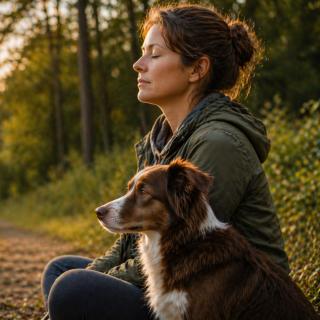
Welcome to Mindfulness and Dogs,
The podcast for dog guardians walking the path of reactivity with heart,
Courage,
And compassion.
I'm Biggie,
Dog trainer,
Coach,
And long-time student of mindfulness.
After many years with my own reactive dog,
I discovered that real change doesn't start with training the dog.
It starts with me and you.
In this show,
We'll explore practical,
Force-free tools,
Grounding practices,
And compassionate strategies to help you and your dog find more calm,
Connection,
And confidence on your walks together.
Because calmer walks don't start with a quick fix.
They start with you.
And your calm is your dog's safe place.
Hi,
Welcome to the show.
This is Mindfulness and Dogs,
And my name is Biggie,
Coach,
Dog trainer,
And long-time student of mindfulness,
With a big heart for the messy sides of living with dogs.
And if your dog is one of those sensitive souls who get uncomfortable at a great many things out there in the world,
You know exactly just how messy it can get.
And once your dog starts to growl,
Bark,
Or lunge at whatever makes them uncomfortable,
It is very hard not to be swept up in this wave of emotion.
There is a way,
Though,
To be attuned to your dog without absorbing their stress.
You can notice their signals with compassion while staying centered in your own body.
It is possible to support your dog through challenges and support yourself in the process.
But before we dive in,
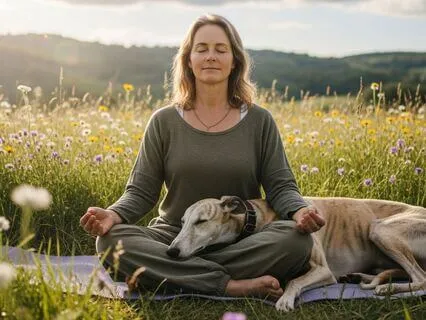
Let's just be here for a minute.
Wherever you are at the moment,
Try to soften your shoulders.
Let the space between your ears and your shoulders increase.
Relax your jaw,
And let a slight smile appear on your face.
Feel your eyes growing soft,
And the corners of your mouth turn upward ever so slightly.
Enjoy this just a little while longer.
Now,
Today I want to tell you about a client of mine.
She's a mother of two small children,
She works part-time and runs a horse stable on the side.
Her husband is away on jobs in different countries quite often,
So there's a lot of pulling at her from all sides.
And additionally,
She has this adoringly gentle 50 kg Greek sheepdog named Bob.
This client,
Let's call her Jenny,
Is my favorite ever client.
Not only did she ask for a consultation the very first week the dog came to live with her and her family,
But she has also been proactive in addressing any potential behavioral issues before they could arise.
This is all the more astounding as Jenny is a first-time dog guardian.
I've been supporting Jenny and Bob for years now,
And it has been pure joy to watch them grow together.
Bob is around five now,
And under Jenny's gentle guidance he has grown into a self-confident yet relaxed dog who is well able to regulate himself and knows when to withdraw to a safe place if things get too much for him.
But it's not always been this way.
Larger dogs usually take longer to mature,
Both physically and mentally,
And so Bob's adolescence has dragged on quite a bit,
And with it his own particular brand of reactive behavior.
Reactivity on a leash is a phenomenon that can have its roots in the frustrations of adolescence.
When humans get wary of dog-to-dog contact as the dog gets bigger,
All of a sudden the play with other dogs they have been accustomed to gets prevented by the leash and by their human's fear of escalation.
It's a classic case of good intentions that have gone awry.
In Bob's case there was yet another element.
Greek Sheepdogs are a guardian dog breed.
They have a tendency toward territorial behavior,
And with Jenny and Bob living on a farm outside their village,
Their daily walks take them through the fields around the farm.
By hundreds,
By now probably thousands of repetitions,
Bob has learned that his territory extends considerably beyond the limits of the actual farm.
So when,
During his early adolescence,
He developed a reactive behavior pattern toward other dogs while out and about in his own domain,
We had to consider a mixture of motivations.
I won't go into all the management measures and training we put in place.
This podcast is not the place for that.
What I want to emphasize is a particular situation Jenny told me about a couple of months ago.
She was on a walk with Bob around their usual haunts when he spied another dog in the distance.
He tensed his muscles,
Started to lean forward and stare at the other dog.
In short,
He prepared himself for a loudly barking escalation.
In our time together,
Jenny has taken all of my Mindfulness for Dog People impulses and ran with them.
She has practiced breathing,
Grounding,
Being aware of her own emotions and letting go of expectations,
You name it.
So that's what she did.
She stood there,
Breathing,
Holding the leash loosely and calmly told Bob,
I've got you.
You're safe.
Over and over again.
Basically,
She modeled a desired state of being for her dog in a very challenging situation.
And guess what happened?
It took Bob a bit.
But he turned around,
Looked at Jenny,
Received an encouraging smile,
Looked back at the other dog once more,
And finally turned away to sniff in the grass.
I got Jenny's exuberant WhatsApp message a few minutes later and we celebrated together.
Granted,
This wasn't the first time Jenny and Bob practiced this.
But that's exactly the point.
They practice.
And while practice doesn't make perfect,
It does make better.
I can still feel the joy for both of them as I'm telling you their story.
Now,
Let's have a look at what can happen to you when you're on a walk with your reactive dog and you see another team in the distance.
It's one of those oh-shit moments,
Right?
Maybe you hold your breath or you start to breathe shallowly and fast.
Maybe your hands tighten on the leash or even pull it taut.
Could it be that your whole body grows tense?
Adrenaline spikes in seconds?
And perhaps you feel trapped and panic-stricken.
You desperately look for a way,
Any way out.
Sounds familiar?
I bet it does.
This happens millions of times each day all over the world.
You are not alone.
But you are here,
Now,
Listening to me.
And that means you are aware of what's happening to you and maybe even of how this impacts your dog.
There's one thing I want to make absolutely clear before we continue.
This is not about guilt.
You are not the cause of your dog's reactivity.
I repeat,
You are not the cause of your dog's reactivity.
But there is a game of emotional ping-pong happening between the two of you.
Have you ever heard the word co-regulation?
It sounds complicated.
But it basically means that our autonomous nervous systems are constantly talking to one another.
If you come into a room full of people,
You can immediately tell the mood in the room.
You can either feel good vibes or lines of tension and apprehension.
Same with our dogs.
That means we are both mammals with a pretty similar neurological setup.
This is why co-regulation works between humans and dogs,
Too.
We can regulate or dysregulate one another.
You can either pick up on your dog's frowned nerves or you can use your own nervous system to calm them.
Self-regulation,
The ability to soothe yourself,
Is learned by having it modeled for you.
Remember when you were afraid as a child and the person who took care of you rocked you and spoke to you soothingly?
This soothing is co-regulation.
Also,
This is how we learn to do it for ourselves.
And you can do the same for your anxious,
Reactive,
Sensitive dog.
By calming yourself,
You model calmness for your dog.
Like on a plane in case of emergency,
You put your own oxygen mask on first before helping those around you.
Let's practice that and we'll start in the calm moments.
If you go for another walk with your dog today or tomorrow,
Try to stay aware of their body language.
Observe them.
Maybe they're sniffing,
Digging or just ambling along.
And then check in with yourself.
How do you feel?
Are your feet fully connected to the ground?
How's your breathing?
How's the tension of your muscles?
Perhaps you need to regulate yourself a bit.
Breathe out slowly.
Feel your feet.
Wiggle your toes.
Loosen your joints.
If your dog is looking at you,
Smile at them with a soft gaze and tell them,
I see you.
I've got you.
Let's move through this together.
And repeat those phrases inside your head,
Even if your dog is not looking at you,
And particularly when the situation gets challenging.
It's a loop.
Practice it over and over again until it becomes second nature.
Your calm,
Slow,
Supportive presence will help your dog find back to their own kind of calm.
Your calm is your dog's safe place.
That's it for today.
I'm curious to learn how the episode resonated with you.
Talk to you again soon.
Bye for now.