Wherever you are on your meditation journey,
It's important to stay flexible about your approach.
Trying out different postures for different forms of meditation practices is skillful and useful.
So finding a quiet space and starting with your sitting posture.
Remembering that there is a mind-body connection and a thought to have in mind is that your posture and how you hold it can determine the experience of your meditation.
I like to think of it as being like a violin,
Where if the string is too stiff and tight it screeches and if it's too loose and floppy it yowls.
A balanced body nurtures a balanced mind.
So depending on your flexibility,
You may choose to sit cross-legged on the floor,
Perhaps in a lotus posture.
However you sit,
Ensure your hips are higher than your heels by sitting on a cushion or a pillow.
You can use cushions or a meditation bench to get comfortable in most floor positions.
You may choose to sit upright in a chair.
If you do,
Make sure your feet and your heels in particular can touch the ground comfortably.
Your back upright and supported if necessary.
Wherever and however you sit,
Seek balance and stability and aim for approximately a 90 degree angle between the head and the knees.
So gather your attention to your whole body,
Getting a sense of the current balance and stability.
Keeping the shoulders back and relaxed.
The back upright.
The head and neck in a central balanced position in line with your spine.
Allowing the jaw to soften and open slightly.
The chin slightly tilted down.
The face itself relaxed.
Ears over the shoulders and eyes gently closed.
The inner gaze straight ahead and slightly down behind the eyelids.
If you'd rather keep the eyes open,
Then just lower the gaze to the space in front of your feet and let your gaze soften and gently unfocused.
In some traditions,
The hands are said to nurture dispositions.
For example,
Hands downward facing on the thighs can enhance the stabilising or grounding sense.
And hands upward facing can enhance the ability to be open to whatever unfolds in the meditation.
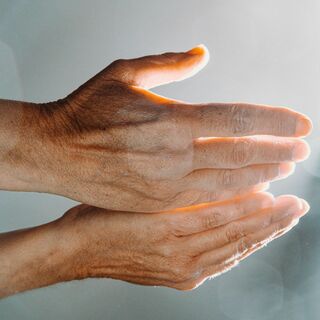
The standard hand position is the non-dominant hand cupping the dominant hand with the thumbs slightly touching.
This is said to promote a sense of calm steadfastness.
Experiment and take time to find the positions that suit your own meditation practice.
Gather awareness to the whole of your body now,
Making any adjustments necessary to your sitting position.
Note the sense of dignity in this posture.
There's a saying by Lao Tzu that encapsulates this time of meditation,
This way of being in and with life as it happens,
And it's to sit like a mountain and flow like a river.
So,
As you sit,
Allow yourself to become aware of the flow of your life at this moment,
And in particular,
Notice the breath.
Some people notice the breath most through the nostrils,
But most notice the movement of the abdomen and the belly.
Just go to where you feel comfortable and settle your awareness there.
Pay attention to the feeling of the sensations of the breath in the body there.
As you sit with your attention on the breath,
Thoughts,
Sounds and sensations of the breath in the body,
The sensations will appear and disappear.
That's normal.
Simply let them be there because they are there,
And then let them go.
Not holding on to them,
Nor pushing them away.
Just noticing and letting go,
Noticing and letting go.
Without judgement,
Without angst.
Just noting and letting go and allowing your breath to be a gentle anchor.
Paying attention to the breath,
Coming in and passing down the throat,
Expanding the chest and lifting the belly,
Then following the breath as it flows,
Noticing the collapse of the belly,
The sinking of the chest as you exhale.
Not trying to change the breath in any way,
Just allowing yourself to breathe naturally and as you do,
Noticing the movements of the body as you follow and be with the flow of the breath.
Conscious awareness of flowing with the breath into the body,
Out of the body and noticing the space between the breaths where nothing happens.
Surfing the breath as you breathe in and as you breathe out,
Noticing and letting go of any thoughts or feelings,
Any sounds or sensations.
Just noting and letting go as you continue to pay attention to the breath on this river of life.
And as we close this practice,
Take a moment to acknowledge and congratulate yourself in taking this time for your own inner nourishment.