What helps you focus more?
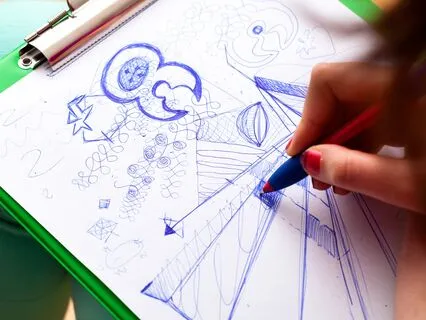
Mindless doodling or sketchnoting?
When you're in a lecture or a meeting or even while at home listening to a podcast,
Do you ever find your hand picking up a pen and moving on its own?
Or do you intentionally start to draw pictures while you're actively listening?
Does your attention start to wander or do you find yourself attentive and focused?
Think about those lines looping,
Shapes repeating.
That's doodling.
The other kind of mark making is where you're capturing ideas as images or words.
That's sketchnoting.
Both can look similar from the outside,
But inside the brain they do slightly different things.
The two ways to draw your attention.
Doodling is often spontaneous,
Marks made without clear purpose.
It can be soothing,
Rhythmic,
Almost meditative.
Think spirals,
Waves,
Shapes,
Eyes or even just etching shades.
It usually doesn't have a connection to what you're listening to.
Sketchnoting on the other hand ties what you draw to what you're hearing or reading,
Turning ideas into quick symbols,
Arrows or even tiny diagrams.
It's part listening and part visual translation.
Both involve movement and flow,
But one helps you rest your mind while the other helps you organise it.
The science of gentle engagement.
Psychologist Jackie Andrade's 2010 study found that simple doodling like shading shapes while listening to a dull recording helped people remember almost 30% more information.
Why?
Because the hands quiet movement kept the mind from drifting too far.
It occupied just enough mental bandwidth to steady attention.
Later research like the Spencer,
Mueller and Fenske 2023 experiments complicated that story however.
They found doodling didn't always help and sometimes didn't change focus at all.
So what gives?
It turns out that the type of drawing and its relationship to the material matters more than the act itself.
How sketchnoting works differently.
When you sketchnote you're engaging two systems at once,
Verbal and visual.
That's called dual coding and it helps your brain build richer memory pathways.
By turning information into little pictures,
Arrows and drawings you're not just hearing but you're also processing.
Cognitive psychologist Alan Paveo first proposed this dual coding idea decades ago and modern learning science still backs it up.
When students make visual notes they tend to understand and retain material more deeply.
Not because they're better artists but because they're making meaning through drawing.
So if doodling keeps you present,
Sketchnoting helps you connect.
A spectrum not a competition.
It's not really doodling versus sketchnoting.
It's more of a spectrum of attention.
At one end it's mindless movement where your hand anchors your focus through repetition.
On the other it's mindful mapping where your hand organizes your thoughts as they unfold.
Both can support focus but in different states of mind.
When your energy dips,
Doodling can gently hold you in place.
When your curiosity sparks,
Sketchnoting can give that curiosity shape.
Try this next time you're listening to something long,
Perhaps a lecture or a podcast or an audiobook and experiment with both.
For the first 10 minutes just doodle.
Let your hand make patterns without thinking.
Then switch.
Start sketchnoting.
Keywords,
Arrows,
Little icons that relate to what you're learning.
Afterwards notice what helped you stay more present and which helped you remember more clearly.
You might find that doodling calms your nervous system while sketchnoting stimulates your intellect and both are forms of focus.
Drawing,
Whether it's structured or aimless,
Is a kind of conversation between your hand and your attention.
Neither type is a waste.
One grounds you in stillness while the other moves you towards understanding.
So instead of asking which is better,
Ask what kind of focus do I need right now?
Stillness or clarity?
Your hand often knows before your mind does.