This is S.
D.
Hudson Magic Jane Eyre
Chapter 12 The promise of a smooth career,
Which my first
Calm introduction to Thornfield Hall seemed to pledge,
Was not belied on a longer acquaintance
With the place and its inmates.
Mrs.
Fairfax turned out to be what she appeared,
A placid-tempered,
Kind-natured woman of competent education and average intelligence.
My pupil was a lively
Child who had been spoilt and indulged,
And therefore was sometimes wayward,
But as she
Was committed entirely to my care,
And no injudicious interference from every quarter
Ever thwarted my plans for her improvement,
She soon forgot her little freaks and became
Obedient and teachable.
She had no great talents,
No marked traits of character,
No peculiar
Development of feeling or taste which raised her one inch above the ordinary level of childhood,
But neither had she any deficiency or vice which sunk her below it.
She made reasonable
Progress,
Entertained me for a vivacious,
Though perhaps not very profound affection,
And by her simplicity,
Gay prattle,
And efforts to please,
Inspired me in return with a degree
Of attachment sufficient to make us both content in each other's society.
This par
Parenthes will be thought cool language by persons who entertain solemn doctrines about
The angelic nature of children and the duty of those charged with her education to conceive
For them an indulterous devotion.
But I am not writing to flatter parental egotism,
To
Echo Kant,
Or prop up Humbug,
I am merely telling the truth.
I felt a conscientious
Solicitude for Adele's welfare and progress,
And a quiet liking to her little self,
Just
As I cherished towards Mrs.
Fairfax a thankfulness for her kindness and a pleasure in her society
Proportionate to the tranquil regard she had for me and the moderation of her mind
And character.
Anybody may blame me who likes when I had fervour,
But now and then when
I took a little walk by myself in the grounds,
When I went down to the gates and looked through
Them along the road,
Or when while Adele played with her nurse and Mrs.
Fairfax made jellies
In the storeroom,
I climbed the three staircases,
Raised the trapdoor of the attic,
And having
Reached the leads,
Looked out afar over sequestered field and hill,
And along dim skyline.
I longed
For a power of vision which might overpass that limit,
Which might reach the busy world,
Towns,
Regions full of life I had heard of,
But never seen.
But then I desired more practical
Experience than I possessed,
More of intercourse with my kind,
Of acquaintance with variety
Of character,
That was here within my reach.
I valued what was to be good,
And what was
Good in Adele,
But I believed in the existence of other and more vivid kinds of goodness,
And what I believed in,
I wished to behold.
Who blames me?
Many,
No doubt,
And I shall
Be called discontented.
I could not help it,
The restlessness was in my nature,
It agitated
Me to pain sometimes.
Then my sole relief was to walk along the corridor of the third
Alley,
Backwards and forwards,
Safe in the silence and solitude of the spot,
And allow
My mind's eyes to dwell on whatever bright visions rose before it,
And certainly there
Were many and glowing,
To let my heart be heaved by the exultant movement which,
While
It swelled in its trouble,
Expanded it with life,
And best of all,
To open my inward ear
To a tale that was never ended,
A tale my imagination created,
And narrated continuously,
Quickened with all of incident,
Life,
Fire,
Feeling,
That I desired and had not in my
Actual existence.
It is in vain to say human beings ought to be satisfied with tranquillity.
They must have action,
And they will make it if they cannot find it.
Millions are condemned
To a stiller doom than mine,
And millions are in silent revolt against their lot.
Nobody
Knows how many rebellions,
Besides political rebellions,
Ferment in the masses of life
Which people earth.
Women are supposed to be very calm generally,
But women feel just
As men feel.
They need exercise for their faculties,
And a field for their efforts as
Much as their brothers do.
They suffer from too rigid a restraint,
Too absolute a stagnation,
Precisely as men suffer,
And it is narrow-minded in their more privileged fellow-creatures
To say they ought to confine themselves to making puddings and knitting stockings,
To
Playing on the piano and embroidering bags.
It is thoughtless to condemn them or laugh
At them if they seek to do more or learn more than custom has pronounced necessary for their
Sex.
When thus alone,
I not unfrequently heard Grace Poole's laugh,
The same peal,
The same
Low ha-ha-ha,
Which,
When I first heard it,
Thrilled me.
I heard,
Too,
Her eccentric murmurs
Stranger than her laugh.
There were days when she was quite silent,
But there were others
When I could not account for the sound she made.
Sometimes I saw her,
She would come
Out of the room with a basin,
Or a plate,
Or a tray in her hand,
Go down to the kitchen
And shortly return,
Bearing a pot of porter.
Her appearance always acted as a damper to
The curiosity raised by her oral oddities.
Hard-featured and staid,
She had no point
To which interest could attach.
I made some attempts to draw her into conversation,
But she seemed to person a few words.
Her
Monosyllabic reply usually cut short every effort of that sort.
The other members of the household—John and his wife,
Leah the housemaid and Sophie
The French nurse—were decent people,
But in no respect remarkable.
With Sophie I used
To talk French,
And sometimes I asked her questions about her native country,
But she
Was not of a descriptive or narrative turn,
And generally gave such vapid and confused
Answers as were calculated rather to check than encourage inquiry.
October-November-December passed away.
One afternoon in January Mrs.
Fairfax begged a
Holiday for Adele because she had a cold,
And as Adele seconded the request with an
Ardour that reminded me how precious occasional holidays had been to me in my own childhood,
I accorded it,
Deeming that I did well in showing pliability on the point.
It was a fine,
Calm day,
Though very cold.
I was tired of sitting still in the library
Through a whole long morning.
Mrs.
Fairfax had just written a letter which was waiting
To be posted,
So I put on my bonnet and cloak,
And volunteered to carry it to Hay.
The distance,
Two miles,
Would be a pleasant winter afternoon walk.
Having seen Adele comfortably seated in her little chair by Mrs.
Fairfax's parlour fireside,
And giving her the best wax doll,
And a story book for a change of amusement,
With a kiss
I set out.
The ground was hard,
The air was still,
My road was lonely.
I walked fast till I got
Warm,
Then I walked slowly to enjoy and analyse the species of pleasure brooding for me in
The hour and situation.
It was three o'clock.
The church bell tolled as I passed under the belfry.
The charm of
The hour lay in its approaching dimness,
In the low gliding and pale beaming sun.
I was a mile from Thornfield,
In a lane noted for wild roses in summer,
For nuts and blackberries
In autumn,
And even now possessing a few coral treasures in hips and haws,
But whose
Best winter delight lay in its utter solitude and leafless repose.
If a breath of air stirred it made no sound here,
For there was not a holly nor an evergreen
To rustle,
And the stripped hawthorn and hazel bushes were as still as the white-worn stones
Which coursewayed the middle of the path.
Far and wide on each side there were only fields,
Where no cattle now browsed,
And the
Little brown birds which stirred occasionally in the hedge looked like single russet leaves
That had forgotten to drop.
This lane inclined uphill all the way to Hay.
Having reached the middle I sat down on a
Stile which led thence into a field.
I did not feel the cold,
Though it froze me keenly.
It was attested by a sheet of ice,
Covering the causeway.
From my seat I could look down on Thornfield.
The grey embattlemented hall was the principal
Object in the vale below me.
Its woods and dark ruggery rose against the west.
I lingered
Till the sun went down amongst the trees and sank crimson and clear behind them.
I then
Turned eastward.
On the hilltop above me sat the rising moon,
Pale yet as a cloud,
But brightening momentarily.
She looked over Hay,
Which,
Half lost in trees,
Sent up a blue smoke from its few chimneys.
It was yet a mile distance,
But in the absolute hush I could hear plainly its thin murmurs
Of life.
My ear too felt the flow of currents.
In what dales and depths I could not tell,
As there were many hills beyond Hay and doubtless many becks threading their passes.
That evening,
Calm betrayed alike,
The tinkle of the nearest streams,
The sour of the most
Remote.
A rude noise broke on these fine ripplings.
At once so far away and so clear,
A positive
Tramp-tramp,
A metallic clatter,
Which effaced the soft wave wanderings.
This din was on
The causeway.
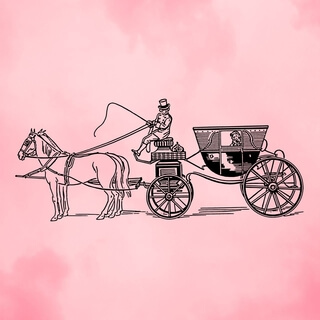
A horse was coming.
The winding of the lane yet hid it,
But it approached.
I was just leaving the stile,
Yet as the path was narrow I sat still to let it go by.
In
Those days I was young and all sorts of fancies,
Bright and dark,
Tenanted my mind.
I remembered
Certain of Bessie's tales wherein figured and north of England's spirit called at
Your trash.
In the form of horse,
Mule or large dog,
It haunted solitary ways and sometimes
Came upon belated travellers as this horse was now coming upon me.
It was very near but not yet in sight,
When in addition to the tramp-tramp I heard a rush
Under the hedge,
And close down by the hazel stems glided a great dog whose black and white
Colour made him a distinct object against the trees.
It was exactly one mask of Bessie's
Jatrash,
A lion-like creature with long hair and a huge head.
It passed me,
However,
Quietly
Enough.
The horse followed a tall steed and on its back a rider.
The man,
The human being,
Broke the spell at once.
Nothing ever rode the Jatrash,
It was always alone,
And goblins
To my notion,
Though they might tenet the dumb carcasses of beasts,
Could scarce covet
Shelter in the commonplace human form.
No Jatrash was this,
Only a commonplace traveller
Taking the shortcut to Millcote.
He passed and I went on,
A few steps.
Then I turned.
A sliding sound and an exclamation of,
What the juice is to do now?
And a clattering tumble
Arrested my attention.
Man and horse were down,
They had slipped on the sheet of ice
Which glazed the causeway.
The dog came bounding back and seeing his master in a predicament
And hearing the horse groan,
Barked till the evening hills echoed the sound,
Which was
Deep in proportion to his magnitude.
He stuffed around the prostrate group,
Then he ran up
To me,
It was all he could do,
There was no other help at hand to summon.
I obeyed him
And walked down to the traveller,
This time struggling himself free of his steed.
His
Efforts were so vigorous,
I thought he could not be much hurt.
Are you injured,
Sir?
I asked.
I think he was swearing,
But I am not certain.
Can I do anything?
I asked again.
You must just stand on one side,
He answered.
He rose
First to his knees,
Then to his feet.
Then began a heaving,
Stamping,
Clattering process,
Accompanied by a barking and baying which removed me effectively some yard's distance.
I was in the mood for being useful,
Or at least officious.
I now drew near to him again.
If you are hurt and want help,
Sir,
I can fetch someone,
Either from Thornfield Hall
Or from Hay.
Thank you,
I shall do,
I have no broken bones,
Only a sprain,
The man said.
Something of daylight still lingered and the moon was waxing bright.
I could see him plainly.
His figure was enveloped in a riding cloak,
Fur collared and steel clasped.
Its details were not
Apparent,
But I traced the general points of middle height and considerable breadth of chest.
He had a dark face with stern features and a heavy brow.
His eyes and gathered eyebrows looked
Ireful and thwarted just now.
He was past youth,
But had not reached middle age.
Perhaps he might
Be thirty-five.
I felt no fear of him,
And but little shyness.
Had he been a handsome,
Heroic
Looking young gentleman,
I should not have dared to stand thus questioning him against his will,
Or offering my services unasked.
I had a theoretical reverence and homage for beauty,
Elegance,
Gallantry,
Fascination,
But had I met those qualities incarnate in masculine shape,
I should have known instinctively they had neither nor sympathy with anything in me.
And should have shunned them as one would fire.
If even this stranger had smiled and been good-humoured to me,
If he had put off my offer
Of assistance,
I should have gone on my way and not felt any vocation to renew inquiries.
But the frown,
The roughness of the traveller set me at my ease.
I retained my station when
He waved me to go and announced,
I cannot think of leaving you,
Sir,
At so late an hour
In this solitary lane till I see you are fit to mount your horse.
He looked at me when I said this.
He had hardly turned his eyes in my direction before.
I should think you ought to be at home yourself,
Said he,
If you have a home in this neighbourhood.
Where do you come from?
From just below,
And I'm not at all afraid of being out late when it's moonlight.
I will run over to Hay for you with pleasure if you wish it.
I'm going there to post a letter.
You live just below?
Do you mean at Thornfield Hall?
Yes,
Sir.
Whose house is it?
Mr.
Rochester's.
Do you know Mr.
Rochester?
No,
I have never seen him.
He is not resident then.
No,
I have never seen him.
He is not resident then.
No.
Can you tell me where he is?
I cannot.
You are not a servant at the hall,
Of course.
He stopped and ran his eye over my dress,
Which as usual was quite simple.
A black merino cloak,
A black beaver bonnet,
Neither of them half fine enough for a lady's maid.
He seemed puzzled to decide what I was.
I'm the governess.
The governess,
He repeated.
Do you take me if I had not forgotten the governess?
In two minutes he rose from the stile,
His face expressed pain when he tried to move.
I cannot commission you to fetch help,
But you may help me a little yourself if you would be so kind.
Yes,
Sir,
I said.
Try to get hold of my horse's bridle and lead him to me.
You are not afraid?
I should have been afraid to touch a horse when alone,
But when told to do it,
I was disposed to obey.
I put down my muff on the stile and went to the tall steed.
I endeavored to catch the bridle,
But it was a spirited thing and would not let me come near its head.
I made effort on effort,
Though in vain.
Meantime,
I was mortally afraid of its trampling me.
The traveler waited and watched for some time,
And at last he laughed.
I see,
He said.
The mountain will never be brought to Muhammad.
So all that you can do is to aid Muhammad to go to the mountain.
I must beg of you to come here.
He laid a heavy hand on my shoulder and,
Leaning on me with some stress,
Limped to his horse.
Now,
Said he,
Releasing his lip from a hard bite,
Just hand me my whip.
It lies there under the hedge.
And make haste with a letter to Hay and return as fast as you can.
A touch of a spurred heel made his horse first start and rear.
Then it bounded away and the dog rushed in its traces.
All three vanished,
Like heath that in the wilderness the wild wind walls away.
I took up my muff and walked on.
The incident had occurred and was gone for me.
It was an incident of a moment.
No romance,
No interest.
Yet it marked with change one single hour of a monotonous life.
I did not like re-entering Thornfield.
To pass each threshold was a new experience.
To cross the silent hall,
To ascend the darksome staircase,
To seek my own lonely little room,
And then to meet tranquil Miss Fairfax and spend a long winter evening with her
And her only was to quell wholly the faint excitement awakened by my walk.
I lingered at the gates,
I lingered on the lawn,
I paced backwards and forwards on the pavement.
The shutters of the glass door were closed.
I could not see into the interior and both my eyes and spirit seemed drawn from the gloomy house.
To that sky expanded before me,
A blue sea absorbed from taint of cloud,
The moon ascending it in solemn match,
Her orb seeming to look up as she left the hilltops from behind which she had come.
Little things recall us to earth.
The clock struck in the hall.
I turned from moon and stars,
Opened a side door and went in.
The hall was not dark,
Nor yet was it lit,
Only by the high hung bronze lamp.
A warm glow suffused both it and the lower steps of the oak staircase.
This ruddy shine issued from the great dining room,
Whose two-leaf door stood open and showed a genial fire in the grate,
Glancing on marble hearth and brass fire irons,
And revealing purple draperies and polished furniture in the most pleasant radiance.
It revealed,
Too,
A group near the mantelpiece.
There was a cheerful mingling of voices,
Amongst which I seemed to distinguish the tones of a dell.
I hastened to Mrs.
Fairfax's room.
There was a fire,
But no candle and no Mrs.
Fairfax.
Indeed,
All alone,
Sitting upright on the rock and gazing with gravity at the blaze,
I beheld a great black-and-white,
Long-haired dog,
Just like the Jatrasha of the lane.
It was so like it,
I went forward and said,
Pilot,
For that was his name,
And the thing got up and came to me.
I caressed him and he wagged his great tail.
Leah entered.
What dog is this?
I said.
He came with a master.
With whom?
With master.
Mr.
Rochester,
He's just arrived.
Indeed,
And is Mrs.
Fairfax with him?
Yes,
And Miss Attella,
They're in the dining room,
And John is gone for a surgeon,
But master has had an accident.
His horse fell,
And his ankle is sprained.
Did the horse fall in Hay Lane?
Yes,
Coming downhill.
It slipped on some ice.
Bring me a candle,
Will you,
Leah?
I asked.
Leah brought it.
She entered,
Followed by Mrs.
Fairfax,
Who repeated the news,
Adding that Mr.
Carter,
The surgeon,
Was come,
And was now with Mr.
Rochester.
Then she hurried out to give orders about tea,
And I went upstairs to take off my things.