Welcome to Restful Journeys.
In this track,
I will be reading the short story,
An Unknown Warrior,
By Susan M.
Uhr.
Please find a comfortable place to sit or lie down and relax.
Take a few moments to clear your mind and allow yourself to listen to these words and help you become calm.
Let's begin with the short story,
An Unknown Warrior.
Snow was falling over London.
A great blur of zig-zagging flakes.
The embankment was deserted,
The streets half-filled.
In the Houses of Parliament,
Long windows etched themselves in the light.
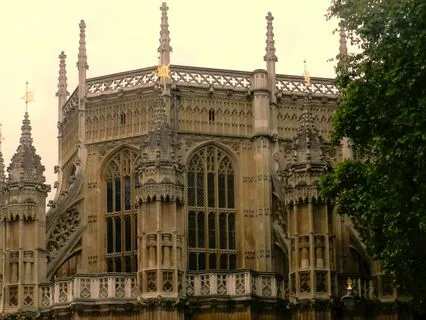
Westminster Abbey was almost obliterated by the downfall.
Its time-stained crevices had filled like cups with drifts of snow.
Out of the obscurity and the snow,
A soldier approached Westminster.
He paused a moment on the opposite side of the street to peer at the great pile before him,
And in his eyes was the half-incredulous amazement of one who finds himself at home again after strange unhappy wanderings.
For an instant,
The Abbey seemed subtly changed,
Vague,
Intangible,
Unearthly.
It was the drifting snow,
Of course,
That obliterated the stains of time in its multitudinous delicate crevices.
The drifting snow that was like a veil about his vision.
The zig-zagging flakes momentarily blinded the soldier,
Confused him.
For an instant in the falling snow,
He saw the Abbey white and stainless,
Like a transcendent chalice lifted to the sky.
Then the soldier passed through the high pointed portal.
The padded doors fell to behind him,
Dim and quiet.
The great nave stretched away into the gloom.
After a moment,
The soldier raised his bared head.
His eyes,
Grown accustomed to the twilight,
Lifted to the rose window above the altar.
He had taken off the heavy coat he wore.
Shorn of its bulk,
He seemed extremely young,
Boyish,
Childlike even.
There was something of childhood in the hidden,
Secret happiness in his eyes.
Something of childhood in the furtive way he fingered the column at whose base he stood.
Then quickly withdrew his hand.
As one touches a flower,
His gaze fondled the dim Abbey.
Presently,
He moved slowly down the splendid nave,
Pausing now and then to drink in with thirsty eyes the beauty about him.
In a distant chapel,
Candles,
Like captive fireflies,
Were flickering amid the gloom of drooping banners and the furled flags of forgotten wars.
The vastness of Westminster,
The stateliness,
Lifted him as wings lift.
It had always been so throughout his childhood.
The Abbey had held for him the beauty and romance that other boys find in sport,
In girls,
In love.
He was remembering how often,
And often as a child,
He had brought lunch with him and spent whole days exploring the Abbey,
Its great naves and chapels,
Its crypts and tombs.
And it was still the same.
War had not changed the Abbey.
The soldier now was standing before the chancel at the high altar.
His face lifted to the rose window that glowed above it,
And suddenly,
Like light,
Transcendent happiness was about him.
War had not changed him either.
The thought that was like light about him bore him in an ecstasy of thanksgiving to his knees.
His prayer was incoherent,
A feeling of infinite,
Lifted happiness.
To have gone from college,
Physically untrained for war,
Psychologically unprepared,
To have spent three years in the mud and blood,
And to have remained unchanged.
War had not changed him.
War was an interruption,
A suspension,
A holding of one's breath.
The things for which he had lived,
Poetry and beauty,
Still were first.
Irrevolently and with overwhelming longing,
He remembered the casual eyes of men who dwell in peace.
He remembered English lanes that call out to be trod,
Violets like music in the grass,
The cloistral qualities of libraries that first faint tremble in the trees of spring,
Moonlight like snow upon the night.
And then,
A tremendous symphony,
The poems he had loved,
Broke over him.
For an interval,
He was breathless,
Remembering the unbearable beauty of Shakespeare's sonnets,
Chaucer like a daisy in the grass,
The music of Milton,
Shelley's luminous wings,
Wordsworth whose dwelling is in the light of setting suns.
Poetry,
English poetry.
He felt abased and purified and lifted.
In a sudden flash,
He rebelled his England as the land of poets.
Not of shopkeepers,
Sailors,
Empire buildings,
But of poets,
The winged voices of the race.
There were Ireland,
Of course,
And India,
And Egypt,
And opium,
Dreadful ills.
He shuddered imperceptibly.
But these things,
In the final analysis,
Were not England.
England was the poets whose voices sing,
Always of freedom.
England was the barons at Runnymede,
Magna Carta.
England was America,
Too.
The pilgrims who planted a dream upon the wilderness,
And that still prophetic voice speaking today above the roar and belch of war to the heart of the world.
England was Westminster,
Shakespeare and Wordsworth and Wilson.
Cloud-capped towers and visions splendid,
Men too proud to fight.
Then the young soldier thought of his king.
Instinctively his eyes lifted,
His hand rose to the salute.
Not as a kindly middle-aged man,
Slightly shrunken with mediocrity,
Did the young soldier think of his king.
To him,
He was a knightly,
Shining figure,
Splendid with romance.
Medieval mysticism,
Crusaders faring forth to holy lands.
The glamour of Elizabeth's bright reign.
All the lesser poets like fugitive and falling stars upon the night.
These things were England to the young soldier,
Were his king.
King and country.
The phrase lifted him again in exultation.
King and country.
It was for that he was a warrior.
It was for poetry and peace.
Tranquility,
Like the silence here in Westminster,
Where dreams unfold.
War was a cloud that would pass from before the shining beauty of life.
Others would know it again.
Others.
Bitterness and grief for a moment assailed him.
He had felt life poignantly.
A poet does,
Most poignantly,
Perhaps.
The man,
Not quite a poet.
Beauty had been so vividly acute.
The laughter for Scythia in the spring.
Summer's perfumed,
Star-sown lights.
The flaunting flags of autumn.
The thrill like military music on the wind.
These things to him were happiness.
As sharp and pain.
And winter,
Too,
With its largo of snow.
It was winter now,
And snowing.
As the exultation of his mood subsided,
The soldier found his downcast gaze caught by an insignia on the overcoat that hung across his arm.
The number of a regiment.
A division.
The symbols seemed to him suddenly,
Utterly divorced from himself.
Alien.
War was not possible.
The war was not.
It could not be that yesterday he had been in France.
Tomorrow he would be there again.
Incredulity swept him.
In the silence and the solitude.
In the twilight of Westminster.
The thing that he had left.
The thing to which he must return.
Seemed impossible.
An unreality delirium.
He thought suddenly of death.
It was the first time he had thought of death since he had entered the Abbey.
It seemed incredible that men were dying at that instant.
Killing each other with terrible guns.
When the quiet here was so profound.
For an instant,
One of those moments of distorted sensation assailed him.
A familiarity with what occurs.
The silence was acute,
With soundless words.
In the shadow about him,
Crowded unseen presences.
The pounding of his heart was louder than a drum.
And suddenly he knew that he had never been surprised.
Always the things that had come to him had been foreseen.
Suddenly,
He knew that he had always known that this would happen to him.
War and death.
For an instant,
He closed his eyes against memory.
Against war,
Presentiment.
Like terrible and bitter waters,
Despair engulfed him.
He was conscious of a fumbling,
Stillborn gesture after the youth that he had lost.
The beauty forgotten.
The poems he would not write.
He had meant to be a poet.
Always,
As a child,
A youth,
He had meant to be a poet.
And write phrases like the,
Vision splendid in sleep in Westminster with the mighty dead.
A strangling agony was in his throat.
He felt betrayed.
War had betrayed him.
Fate had.
Now,
He would never be a poet in sleep in Westminster.
He was only a soldier.
A warrior.
An unknown warrior.
The terrible and bitter waters.
The strangling agony at length subsided.
He felt spent.
Exhausted.
Devoid of emotion.
And after a moment,
He rose from his knees.
He was remembering why he had come back to England on this strange leave.
He was remembering he must hurry if he were to stand again amongst the mighty dead.
The look of childhood.
The look of hidden,
Secret happiness returned to his face as he turned away from the high altar and traversed the transept.
When at last he had come to the poet's corner,
He paused.
He relaxed.
He drew a deep breath as one who has indeed come home.
Above him,
In the stained glass windows,
Myriad colors gleamed.
It was lighter there than any place in the Abbey.
Than any place in England.
The young soldier thought,
Any place in the world.
England's poets.
He found himself again among them.
It was a trist he kept.
As he stood there,
The twilight and the storm and war,
All the weary weight he carried,
Vanished from about him,
Like a rush of purifying waters.
Poetry and beauty swept his soul.
It was for this he had come home.
Hot,
Unexpected tears in his eyes startled the young soldier.
Poetry.
He had not until today really thought of poetry,
For three hideous years of war.
Poetry.
The very word was the loveliest in the language.
Unexpectedly,
He remembered his bookshelves,
His volumes of poems,
Certain pages,
Words themselves were before his eyes.
Witherers fled the visionary gleam.
Where is it now?
The glory and the dream.
Like a deep-toned organ,
The music of Wordsworth Ode was about him.
Our birth is but a sleep and a forgetting.
The words suggested phraseless things.
They lifted him.
He soared upon their beauty.
Suddenly,
Illusion swept him.
Vision swirled upon the dark.
About him,
The dim distances leaped into light.
The great abbey was ablaze with candles.
Through its windows gleamed the sun.
A thronging multitude that was gathered beneath the drooping banners and the furrowed flags of forgotten wars.
Upon the silence pulled the slow beat of funeral music as a vast procession passed,
An insubstantial pagan tree behind a flag-draped bier to where the mighty dead of England sleep.
Illusion crowded upon the young soldier,
Blinded him,
Dazzled him.
Life had been too stabbing to last,
Poetry too poignant,
And now it did not matter.
His life,
His death,
His poetry.
Another race hath been and other palms are won,
A flag-draped bier.
Like great protecting wings about his soul,
Presentiment enfolded him.
Peace comes after war,
Death after life,
And always to the poet come poetry and beauty.
A shining something,
Like light,
Was about him,
Was in his eyes and soul.
Unsung songs,
A voiceless poet,
A soldier,
An unknown warrior,
Sleeping in Westminster with the mighty dead.
The swirling visions vanished,
Illusion fell away,
The young soldier sank to his knees.
For an instant his head was bowed in prayer,
Thoughts too deep for tears.
The vision he had seen had blinded him and humbled him and healed.
Gradually his eyes refocused to the dark,
But the shining something,
Like light,
Remained in his soul.
In the stained-glass window the colors had blurred together,
But still a lantern in the hand of a figure,
Grown shadowy and dull,
Retained its fire.
The soldier watched it fade,
And then he rose and moved away.
Beyond a transparent dimming window he glimpsed a gargoyle,
Vague with snow.
The great knave as he traversed it was a well of darkness.
Out of the silence came the muffled sound of a padded door.
In the vestibule a ragged newsboy flitted past him like a bat.
His face and the papers under his arm made white plots in the gloom.
Hello,
A soldier in the abbey.
The boy drew up at his side.
Paper,
Sir,
News from the front.
The soldier looked about him tentatively as one waking from a dream.
In the shadows the newsboy's face was strangely white and he had eerie eyes.
The man wondered what he was doing in the abbey.
It's the quieter after the streets.
The boy volunteered as if in answer to the unspoken thought.
His strangely white face and his eyes fascinated the soldier,
Hypnotized him.
It's quieter too after the guns.
The boy was pirouetting from one foot to another.
Yes,
The soldier said.
He wanted to tell the boy to come here often.
He wanted to tell the boy about poetry and beauty,
The intimations of immortality.
I come to the big shows they pull off here too.
The child said unexpectedly.
For an instant his illusion recurred to the soldier.
A vast crowd,
Lights and banners,
Funeral music,
A flagged draped beer.
But I likes it better when it's dark and quiet,
Like now.
The newsboy's eerie eyes refocused to the soldier's vision.
It had come to him that this boy,
Other boys,
Loved the abbey as he had.
For an instant he realized the linked chain of life.
He saw a passing torch.
Then he got into his overcoat,
Shrinking a little as one does who leaves home for the darkness and the cold.
The young soldier passed out from Westminster.
Snow was falling over London,
A great blur of zigzagging flakes.
Fallen asleep.