Welcome to the Rest and Digest podcast.
If you're just joining us,
This podcast is for anyone with a digestive disorder and it focuses on something called GI psychology.
GI psychology is the science of the interaction between the digestive system,
The nervous system,
And the mind.
Stress and anxiety are both linked to having worse GI symptoms and GI psychology explains why this happens.
I'll be guiding you through the most current thinking in the field of GI psychology as well as practical ways you can put tools to use in your own life.
A quick disclaimer here at the beginning,
The information in this podcast is not a form of medical or mental health treatment or a substitute for treatment.
This is just for educational purposes.
My name is Dr.
Scott Rauer and I'm a clinical psychologist and I also personally have a chronic digestive disease called Crohn's disease.
In the first episode,
We explored what GI psychology is and how it can help you to manage your digestive disorder.
In this episode,
We'll be focusing on a specific type of relaxation practice that's one of the most universally used tools within the field of GI psychology.
This relaxation practice is a type of breathing called diaphragmatic breathing.
We'll break this episode down into two parts.
In this first part,
I'll fill you in on why this type of breathing and relaxation practice is worth doing and in the second part,
I'll guide you how to do it step-by-step.
So let's just start by zooming out and talking about the field of GI psychology.
So this is a legit evidence-based part of health psychology and it's practiced in some of the best medical centers across the world.
Most people with a GI disorder though,
They don't get access to this kind of information because there's just not many mental health providers trained within GI psychology.
But if you were one of the lucky few that got access to a GI psychologist,
You'd have probably have to wait a number of months to get your first appointment and on that first appointment,
There's a very good chance that the psychologist would teach you this exact breathing practice we're focusing on today.
And the reason why is because it's a simple and effective intervention for most GI disorders and you can get started with it right away.
There are many reasons why this practice of diaphragmatic breathing helps with most GI disorders and explaining all these reasons is something we'll do on this podcast.
For this episode though,
We'll stick to one of the easiest parts for people to see in their own experience and that's the link between stress and symptoms.
All chronic health conditions are made worse by stress but GI disorders are especially sensitive to the negative effects of stress.
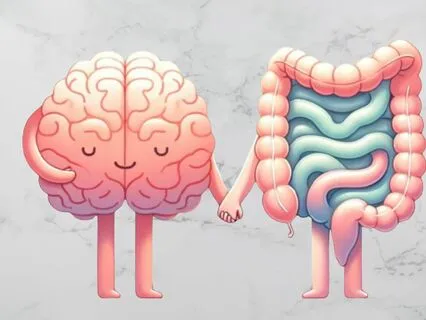
And the reason why this is the case is due to what's called the gut-brain connection.
This is a concept that I introduced in the last episode so if you haven't listened to that already,
It would be a good idea to check that out after this episode maybe.
So the gut-brain connection or what's called the gut-brain axis in medical literature,
It describes how the digestive system and the brain are deeply connected.
Because of this connection,
People that have a GI disorder are more likely to develop issues with anxiety and depression.
And on the flip side,
People that struggle with anxiety and depression are more likely to develop a GI issue over time.
Dysregulation in one end of the connection tends to create dysregulation on the other and that creates a vicious cycle.
The more GI symptoms you have,
The more vulnerable you become to stress and the more stress that you have,
The higher the chance of having more or worsening GI symptoms.
This is called the GI stress cycle.
So this brings us back to diaphragmatic breathing.
When we do this particular type of breathing,
It's a direct way of breaking the cycle and it's doing that down at the level of the nervous system.
Breathing this way helps our body to come back to a state of regulation by stimulating a part of the nervous system called the vagus nerve.
And that vagus nerve activates our hardwired rest and digest response.
The rest and digest response is kind of like the opposite force of the famous fight or flight response,
Which is part of getting caught up in that whole stress cycle.
So before we move on to the practice,
Let me summarize what I'm saying on why this breathing practice in particular is an effective tool for a GI disorder.
So anyone with a GI disorder is vulnerable to this GI stress cycle where stress and GI symptoms make each other worse.
This form of breathing,
Diaphragmatic breathing,
Is an effective way to stabilize that gut-brain connection and to break that cycle.
It does this through many levels.
One of them is through directly influencing the nervous system,
Activating the vagus nerve and the rest and digest response in the body.
Now let's move on to the practice.
I'll guide you through the steps of diaphragmatic breathing to show you how to do it correctly.
So the rest of this episode will be a short guided breathing practice.
You'll likely get the most out of this if you can listen while laying down and using headphones or earbuds if possible.
You can also do this practice while sitting in a chair,
But it's not something to do while multitasking.
You really probably won't get nearly that much out of it as if you could be laying down or sitting down and just focusing on this.
So if you need time to finish something up,
You can just hit pause now until you're ready to do this practice.
I'll just give a little pause here.
All right,
So let's start by just closing the eyes if that feels comfortable and just let your body breathe itself without trying to change anything at all.
In a moment,
We'll add in a gentle pacing sound to follow on the inhale and to follow on the exhale.
And this will help us to do the first step,
Which is just to let the breathing slow down.
And here now is that tone to follow.
Breathing in and breathing out.
See if you can just slow things down and match this pace.
There's no need to breathe deeply or to move a lot of air.
Instead of breathing deeply,
Just let the breathing slow down and just breathe easily.
This is a pace of about five and a half breaths per minute.
And to put that in context,
When you're breathing and not really paying attention to it,
Most people are in the range between 12 and 20 breaths per minute.
So you might feel like you could go slower than this pace that we're doing right now,
But slower isn't necessarily better.
There's a reason why I'm having you go at this specific rate of five and a half breaths per minute,
And we'll get into that in a future episode.
It has to do with the vagus nerve and increasing something called your vagal tone.
So now that we've slowed down,
Let's move on by placing one hand on your chest and one hand down on your belly.
As you continue to breathe this pace,
Just notice if the top hand or the bottom hand is moving more.
If you notice the bottom hand is moving more than the top hand,
Then great.
You're using more of the diaphragm muscle than your chest muscles to breathe.
If the top hand is moving just as much or more than the bottom hand,
See if you can begin to shift the breathing so that on the inhale the belly is raising and inflating like a balloon,
And on the exhale the belly is falling and deflating like a balloon.
If this feels awkward or unfamiliar,
That could be totally normal,
But with continued practice you can retrain your body to breathe how it was meant to breathe.
Just continue to let the belly rise on the inhale and fall on the exhale.
When we're stressed,
We tend to breathe from our chests with the shoulders rising and falling,
And there tends to be a good bit of tension there.
And if this happens for long enough,
Our bodies begin to forget how to breathe in this better,
More natural way.
There are three steps to this process,
And we've covered two so far.
The first step is just to slow the breathing down.
The second is to allow the breath to come in down low from the belly,
And to go out from down low from the belly.
And the final step is to let the out-breath be longer than the in-breath.
And the pacer in the background is already guiding you to do that.
The in-breath is about four and a half seconds,
And the out-breath is about six and a half seconds with this tone.
On these next out-breaths,
Make sure you're taking the whole length of that out-breath tone to breathe out,
And not ending your out-breath before the tone ends.
Really taking the whole time of the tone to breathe out.
So these are the three parts.
Breathing slowly,
Breathing down low from the belly,
And with a longer out-breath than in-breath.
The last thing I'll share in this episode is that this is a relaxation practice,
In the sense that breathing in this way activates the rest and digest response in the nervous system.
At the same time though,
If you're not feeling relaxed inside,
You're likely not doing anything wrong.
For people that experience anxiety,
And especially people that have had trauma in their history,
Often what can happen is that when things calm down and get quiet,
It can get loud and uncomfortable on the inside.
And if that's happening for you,
That's likely actually a good indicator of needing this type of regulation,
This type of regulating practice even more.
So it can be just uncomfortable for a period,
Especially at the beginning.
All right,
I'll stop the breath pacer here,
And you can take your time to come back.
This is how you do the practice of diaphragmatic breathing.
What's left now is to continue to learn more about why creating a regular practice of this type of breathing is so helpful for managing a GI disorder.
And if you'd like to continue learning and building skills,
Please hit the subscribe button.