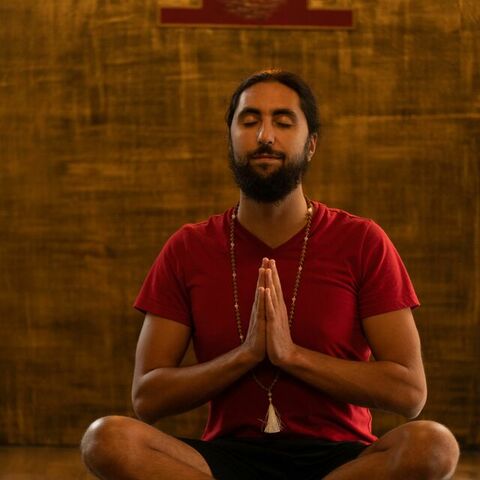
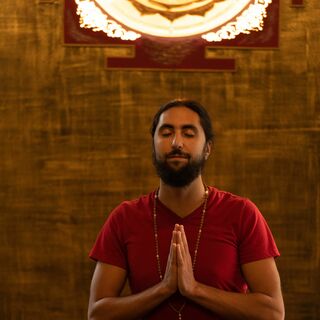
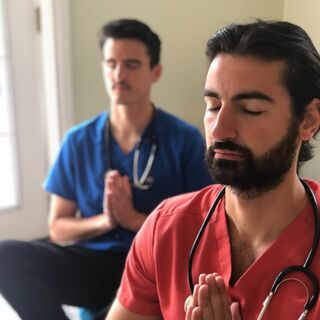
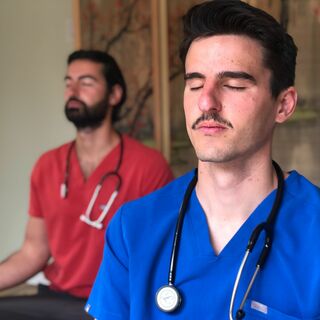
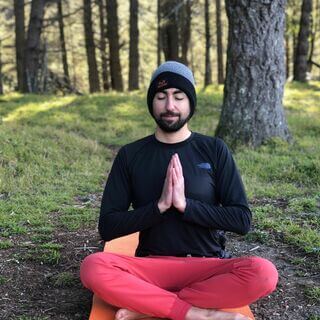
My name is Raphael and today's meditation is designed for health care workers.
The aim of today's practice is to regulate the nervous system after working with patients.
It can be hard to slow down after a long 8 or 12 hour shift in the hospital or field.
As health care workers we are constantly moving,
Focused,
And juggling multiple patients.
We are on the go,
Talking with people,
Hearing bells,
Yells,
And putting out fires.
When the shift is over and it's time to relax,
There is no doubt that it can be difficult to shut down this active part of the brain.
So here today we will deepen the breath,
Calm the nervous system,
And give you a well-deserved break.
To begin,
Find a comfortable seat with a tall spine.
Shoulder blades together.
If you prefer you can sit on a chair or lie down on the floor.
Begin by slowly rolling the shoulders up and back a few times in a circular motion.
Release any tension that could be stored in the shoulders and neck.
At times during your shift you are literally carrying the world on your shoulders so to speak.
Unburden that weight.
Switching directions.
Back to forward.
Calming the body to ease the mind.
And release.
Bringing the hands to a restful position.
Relaxing on the thighs.
Palms facing up or down.
And trying to find stillness with the body.
Start by simply observing your breath.
Tune in with the body.
Bring the attention within.
Inhale fully and consciously through the nose.
Expanding the belly.
Exhale H-A- Again,
Inhale deeply through the nose.
Exhale through the mouth with a sound of release.
Breath is long and heavy.
Few more at your own pace.
Signaling the mind to relax through the breath.
When we sit to practice meditation it is normal for the monkey mind to be active.
The monkey mind is the part of the brain that is constantly jumping from thought to thought.
Never resting.
Ever wreaking havoc on your peace of mind.
By calming this monkey mind through our breath we are giving our nervous system a break from the constant stimulus.
Also if your mind is consumed by restless and persistent thoughts,
Forgive yourself.
Especially after a shift in the hospital or the field.
Our mind is most likely in this monkey mind state.
That is the only way we can juggle all the tasks we need to complete at work.
But now we are not at work.
It is time to release that active,
Hyper-focused state of mind so you can rest.
A few more breaths using the awareness point of the breath to calm the monkey mind.
In through the nose.
Exhale SH.
As if you're telling the mind to be quiet.
Telling that monkey mind to stop.
Again in through the nose.
Full deep breaths.
SH.
Good.
Now we will practice a technique called three nine six.
It is a breath practice that will help regulate your breathing.
Calming the mind.
Listen closely.
To practice we will inhale for three counts through the nose.
We will hold for nine counts.
And then we will exhale through the nose for six counts.
If nine counts is too much of a hold,
Adjust as needed.
So together inhale for three counts.
One two three hold two three four five six seven eight nine.
Exhale nose two three four five six.
Again inhale through the nose.
One two three hold two three four five six seven eight nine.
Exhale through the nose two three four five six.
Continue with this technique.
Inhaling for three through the nose.
Holding the breath up to nine counts or less.
Exhaling through the nose for six counts.
Focusing on the technique to calm the mind from the anxious thoughts.
From the thoughts of the day.
Good focus.
Continue.
When the mind drifts,
No problem.
Bring it back to the technique.
If your mind is replaying scenes from your shift,
Good or bad,
That is part of processing.
Just guide your attention back to the technique.
Do not get frustrated if you can.
It is hard for the mind to be completely still.
Accept that.
Practice.
Develop the skill.
Regulate the nervous system.
Three more rounds at your own pace.
In for three.
Hold for nine.
Out for six.
You can release the technique if you'd like.
Paying attention to the inhales and exhales.
Natural deep rhythm.
Breathing through the nose.
In and out through the nose.
Understanding that when we are stressed,
When the monkey mind is overactive,
The brain becomes overstimulated.
The breath becomes inefficient and tight.
Heart rate shoots up.
Cortisol and adrenaline flood the system.
A relaxed nervous system needs a deep breath.
Use the power of the deep breathing to lower the heart rate.
Signal to the mind that it is time to chill out.
A few more rounds of breathing.
Try to be here.
Witness the breath.
Efficient breathing is deep and full through the nose.
Exhalation long and releasing,
Typically through the nose,
But it is also alright to release through the mouth.
Calming the mind after a shift in the hospital or field is all about focusing the breath.
Giving the mind a break from sensory overload.
When the monkey mind is active,
Simply observing the thoughts and then focusing on the breath will reduce that stimulus on the brain.
Remember,
The goal of meditation is not to stop thought altogether,
But to bring the attention towards a stable anchor point.
Away from thoughts.
Towards the breath.
If you would like to continue meditating,
Simply observe the breathing in and out for a few more minutes.
Otherwise,
Gently bringing your awareness back to the space you are inhabiting.
Mindfully move your arms or legs as needed.
Staying a few more moments with the eyes closed.
Noticing if the body feels more relaxed.
When you feel ready,
Open your eyes,
Taking in your surroundings slowly.
Allowing your eyes to wash over the space without too much analysis.
Simply notice the scene around you.
Taking in any color,
Smell,
Or anything else coming to your attention.
Do your best to practice restful habits the rest of your day.
Remember to be present and save worrying for work about tomorrow.
I hope this meditation was helpful and I look forward to sitting with you again.
Until next time,
Rest up before your next shift.