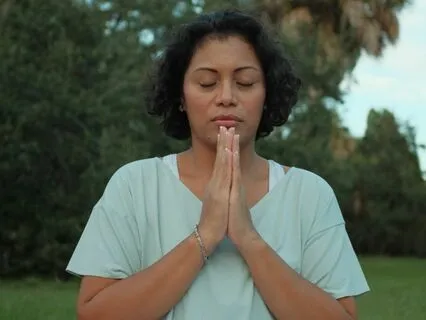
Hi this is Maricela.
I wanted to teach you how to use the RAIN meditation practice for pain flares.
Now RAIN stands for,
R is to recognize the difficult emotion,
Sensation or feeling that you have currently in your body.
The A stands for allowing,
Allowing for the present moment to be here just as it is.
The I in RAIN is to investigate with tenderness and care what is the emotional reaction that's currently here in your experience with pain.
The N for RAIN stands for nurturing and providing that self-compassion that is much needed when we have discomfort.
And you want to be able to find a comfortable posture that works best for you.
It could be sitting in a chair,
A meditation cushion,
A yoga mat or just laying down in the couch or your bed.
Whatever works for you at this moment.
And once you've settled you can close your eyes if that feels best at this moment or you can keep them opened with a soft gaze.
As you drop your awareness to your body you may notice that your attention naturally gravitates to where you feel discomfort.
This is part of the hypervigilance in the nervous system.
Your nervous system is on high alert and in some ways fearing pain.
As you drop your attention you want to focus on your breath as an anchor.
Noticing how your breath feels as breathing in through the nostrils and just relaxing with the exhale.
As you breathe in visually allow for the experience of the breath to be very soft and gentle.
The exhalation is a very important part of the meditation practice because it really allows us to explore how the body relaxes during the exhale.
If your mind feels a little bit busy you may want to hold the breath for about three seconds.
So you may want to hold the breath for about three seconds.
So just breathing in hold one two three and just exhale through the mouth allowing for the exhalation to be a little bit longer than the inhale.
And let's see if we can do this for two to three minutes.
When we drop in into the body we are reconnecting with ourselves.
We're reconnecting with the nervous system.
Our body is the nervous system.
And when we explore all the fences of our body we can learn how to regulate that part of ourselves,
Regulate the nervous system.
Again just breathing in and relaxing with the exhale.
And again if your attention goes directly to where you feel discomfort in the body see if you can notice the intensity of symptoms.
If the symptoms are very really intense see if you can lean in to the emotional response.
And for some people it's difficult to sort of notice their emulsion towards pain.
And it helps if you can ask yourself how do I feel towards this sensation?
How do I feel towards this sensation?
How do I feel towards this sensation of pain?
And as you drop in you may notice that you feel scared,
Angry,
Frustrated,
Upset or any other emotion that's here.
Using the RAIN you may want to just recognize that difficult emulsion.
Where do you feel it the most in the body?
And we're not trying to change anything or trying to fix anything or get rid of anything.
We're just really exploring that emotion just as it is.
As we recognize this emotion,
This feeling,
And this experience which is really allowing to be here.
Just noticing our thoughts and judgments around the emotion or sensation or any other belief that's here.
The A in RAIN is really to allow it to just be here as it is recognizing that difficult emulsion.
Sometimes it helps to notice every face for you because most of the time the emulsion is going to be embodied in our face and noticing mostly in our face.
Now sensations and emotions are completely different.
And you may want to separate them both.
Noticing the difficult emulsion and the uncomfortable experience as it is here in this moment.
And you may want to experiment with just really investigating what might have triggered this emotional response.
When we investigate our emotional response we're really being really curious about this experience.
We are just being the observer of our emotional suffering.
As the observer we're not here to judge or criticize or blame or any other type of mental activity that's coming up.
We're just here to just notice.
As you investigate with this natural curiosity and effortlessness you may want to just ask yourself how am I experiencing this difficult emulsion in my body?
If there's a difficult emulsion see if you can just allow it to be here.
As you scan your body you may notice that there are areas that are neutral,
Areas that are pleasant like the breath,
And also areas that are unpleasant.
And these areas that are unpleasant are usually areas that we feel very vulnerable.
And acknowledging that this area may feel very vulnerable you may want to ask yourself what do you need most at this moment?
And the aim for RAIN is really to nurture the experience just as it is,
Nurture your own curiosity to come in as an observer to this experience.
Allowing for this wounded part of yourself to be noticed.
And with this practice you can actually just give yourself messages of safety,
Reminding yourself that pain is really an experience,
That it's felt in the body but it starts in the brain.
And that as you calm yourself and soothe the nervous system the pain response will eventually fade.
And as we close this short meditation practice you may want to just really provide even more encouraging words towards yourself,
Towards your healing journey.
And the more that you do this meditation practice you can also understand a little bit more about your pain pattern of how the body's responding to the mental states and the emotional reactions of the experience.
Thank you.