Hi there,
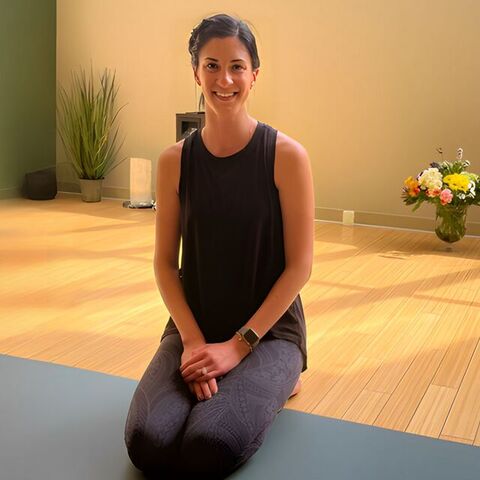
My name is Marie and welcome to Yin Yoga.
Today we're going to be having a pretty well-balanced yoga session in the Yin format.
So all these poses that we'll be practicing today are going to be a little different that one might be used to with a traditional yoga class.
In Yin Yoga we hold poses from anywhere to one to five minutes and you can decide on your own how long you'd like to hold simply by skipping ahead or kind of staying a little bit longer on these poses as you choose.
The reason we hold these poses for one to five minutes is because it takes a little while longer for our body to receive those signals from our brain to let go and really get into that deep tissue release that we look for in our Yin practice.
Today's class I like to use a wall so please go ahead and find yourself a space along the wall,
Preferably one where you're going to have enough space to the right,
Left,
And above you.
Preferably maybe an arm's length distance right and left and enough so that you can put your legs up the wall as well.
So make sure there aren't any pictures hanging there that you might accidentally knock away.
You can use your yoga mat and line it up perpendicular to the wall today or if you don't want to use a yoga mat find yourself a comfortable spot without.
We'll begin first by finding a space where we can sit right up next to the wall as if you're just sitting directly next with your hips touching.
Go ahead and move there now and then while swinging your legs up find your way onto your back and two legs up the wall.
Your back will be flat against the ground with your seat against the wall and legs straight up the wall.
Alright get yourself nice and comfortable and try to make sure there isn't much space between you and the wall.
Once you find yourself in this position go ahead and close your eyes.
Allow your hands to rest so more comfortable maybe even at your side with palms facing up.
Begin simply by letting all the air go and then take a nice big breath in one that begins low in the belly expanding the chest and ribs and let it go out of your mouth.
Wonderful.
Let's take another deep breath in this time through the nose and fully exhale out of the mouth.
We call this a cleansing breath.
I like to think of it as a reset breath and you can take one of these big breaths in and out anytime you'd like throughout today's session.
It's always a great way to kind of come back to the mindful noticing of the breath and just to kind of ground yourself where you are.
Continue to breathe nice and gently without having to force any sort of pattern or rhythm to the breath.
Begin to notice those little points of contact in your body to the ground such as the back of the head,
Neck,
Upper back and shoulders,
The backs of each arm and hand,
Upper back,
All the way down the spine to the lower back and hips.
At this time you probably begin to settle in like the wall.
Maybe even notice your leg bones kind of settling into their sockets.
If you're finding it difficult to hold your legs at the wall you can gently press into your heels,
Not very hard,
But it will just take a little bit of the active muscle use out of this pose.
In this class I'm going to leave moments of silence just to leave space for you to experience these poses fully as well as to experience those inner workings,
The things you're noticing in your body as you hold.
Yin yoga is equally as meditative as it is physical so while we are still here and legs at the wall I want you to start with stillness.
First of the body,
See if you can let go of the wiggles,
Make sure your body is still.
That can be hard for some of us so give yourself some grace if it takes a little time to get here.
And then once you feel like you're able to remain still that's when the inner work begins.
Meditation is not the act of not thinking.
In fact,
The brain wants to think,
It's what it does,
Right?
I like to think of it as the act of slowing things down,
Of making it simple.
So see if you can become the observer of your thoughts rather than the active participant in them.
Notice them coming and going without judgment.
If you find at any point through today's session that thoughts creep their way in as they like to do,
Just remind yourself,
That's just my brain doing what it does.
I'm going to let this thought go.
And rather than engaging in that thought,
Just see if you can watch it from afar.
Now begin to let your legs fall open into a wide V on the wall.
And allow the legs to open as far as they want to without feeling like you have to hold them up or press them away.
Allow the toes and feet to splay open.
They don't need to be pointed or flexed,
Just relax.
Gravity will take your legs down as far as your body allows them to.
And go further.
And this can feel pretty intense at first,
Like a lot all at once.
And that intensity is just part of that puzzle that makes up you.
So staying with that intensity for a moment,
Noticing how it feels.
That's your edge.
And throughout the rest of today's practice,
I want you to see if you can stay with your edge,
That feeling of intensity,
That you're going somewhere.
And you may begin to notice in some poses that the intensity will periodically slip away and become softer.
That's a sign that you're going deeper.
And in some poses,
You can kind of tiptoe after that intensity.
For example,
Widening your legs along the wall.
And I'll give you cues throughout the rest of today's practice.
There may be times where the pose is kind of going past your edge,
Past that intensity or sensation into pain.
And that's where you want to kind of dial things back.
One way to look at it is being near pain,
But definitely not in pain.
If you find that a pose edges on that sensation of being painful,
Take it a step back,
Lessen the degree of that pose.
Take care of your body first and foremost.
Let's check in with ourselves here.
Are we continuing to observe our thoughts?
Or are we being an active participant?
This is a great time to take a nice cleansing breath,
Fully in and fully out.
Give yourself some grace if your mind wanders it away.
That's its job.
It wants to do that.
It's a brain.
So give yourself grace if it does.
And return just to the noticing of the breath and how it feels in your body.
Perhaps at this point,
This pose has become less intense for you.
You're noticing those subtle changes that are taking place.
Maybe the muscles start to soften.
Occasionally,
You'll find that it softens and then becomes difficult again.
That's okay,
Too.
Your job is to notice the experience.
Begin to bring your legs back together at the wall,
Nice and slow.
You can even use your hands to press your thighs back together.
And then bend your knees.
You can hug them into your chest,
Wrapping your arms around and press your low back into the mat.
Perhaps even rocking side to side,
Releasing the low back,
Bringing the hips back into alignment.
Feel free to stay here as long as you need.
But when you're ready,
Take half pigeon on the wall.
So you can extend your left leg straight up the wall.
We're going to cross the right ankle over the left knee.
And when you're crossing your ankle,
You may want to look for that little place between your ankle bone and heel and cross that portion of your ankle over the leg.
That's a good indicator of where you should be.
And then right knee will open to the side.
You can stay here if you're feeling intensity already in your hips.
But if you need a little more,
Begin to bend into that left knee so that you can plant the left foot on the wall.
This will bring your ankle closer to you and your foot closer to you.
It should also intensify the pose.
So take that bend as deeply as you need here until you find your edge.
But make sure that you're keeping your low back against the mat.
As we get into our hip opener poses,
We're going to feel some different sensations,
Of course,
Especially in our right outer hip here.
Once you feel your body settle into this pose just a little,
See if you can consciously unclutch your glutes.
There's a lot of muscles in there underneath that large gluteus maximus.
And in order to get there,
We have to kind of let go of the outer layer to get to the inner layers.
This might become a little more intense at first.
And if it does,
That means you're getting there.
You're getting to the nitty gritty underneath it.
So stay with it.
Continue to breathe.
Continue to feel.
You're doing great.
You need to breathe and feel.
You're a little over halfway there now in this pose.
This is a great time to kind of evaluate if you're still at your edge or not.
And if you're finding that you need to tip to that edge,
You can bend more deeply into that left leg.
You're always welcome to take away from the edge too if you need it.
Sometimes we push ourselves a little too far past it.
And that's when you can begin to straighten that left leg to kind of ease back.
Just a few more moments here.
Begin to uncross your ankle,
Straightening both legs.
Sit first,
Maybe flexing and pointing your toes.
And once more,
I want you to hug your knees into your chest and press a little back into the mat,
Bringing those hips back together.
You're always welcome to rock back and forth as you press your low back into the mat,
If that feels good in your body.
When you're ready,
Begin to straighten both legs.
A little tap on the side of your head.
Half pigeon on the other side.
So this time we'll cross the left ankle over right knee.
And just as before,
Begin to bend into that right knee as much as you need,
Planting the right foot on the wall.
And it's important to understand that our hips are,
As they say,
Sisters,
Not twins.
It's going to feel different from right to left.
You might feel that you were able to take this into a deeper bend on the previous side than this side,
And that's okay.
Or you might find that this side is a bit easier to access,
A deeper fold,
And that's also okay.
Take what you need.
It doesn't have to be the same.
You're doing great.
Continue to breathe and always continue to feel the sensations in your body.
Now that you've been here for a moment,
Perhaps take a little time to consciously unclench the glute so we can get to all those layers underneath.
A few more moments here.
Checking in with your inner workings now.
Is your mind wandering?
Is it thinking?
Of course it's thinking.
Are you engaging?
If so,
Perhaps take a step back out of that thought.
See if you can look at it from a distance,
Perhaps as if you're way above looking down at it.
Being the observer takes practice.
Wonderful.
Begin to uncross your ankle,
Straightening both legs on the wall,
Flexing and pointing your ankles,
Toes,
And then bring both knees into your chest.
Once more,
Just wrapping your arms around so the hips would come back together in a natural way.
Now straightening both legs back up the wall.
We're going to allow the legs to fall together with straightened legs pose all the way down to the left side.
Your legs will fall first left,
Then the right together so that your legs are pressing against the wall.
Both knees are not bent.
Then we'll open the arms,
Open wide,
Straight arms like a wide T.
I want you to turn your head,
Your gaze over your right shoulder for a deep spinal twist.
You'll probably feel this pretty intensely at first.
We're twisting all the way from our cervical spine down to our lumbar spine.
And although it may feel intense at first,
Trust me,
Stay with it.
Your back will love you for it.
It's one of my favorite in poses when we wake up on the wrong side of the bed.
You know that feeling when your back isn't just right.
Once you feel your body settling,
I encourage you to take three full breaths in and out.
In and out.
Once more in,
Really opening up as you breathe into that side body and out.
Just a few more moments here.
You've probably noticed your body starting to settle,
Perhaps even to soften.
The resistance you may have felt in the beginning of this pose is probably waning.
Perhaps it's even starting to feel good.
Imagine that.
Now you're welcome to stay here as long as you want to or need to.
But when you're ready,
Begin to turn your gaze back to center.
We'll lift the legs up one at a time.
First the right,
Then the left.
Make any movements in between that you might need.
And then when you're ready,
Allow your legs to fall one at a time down to the ground on the right side.
The knees are not bent.
Legs are straight along the wall.
With the arms still out at that wide T,
We'll turn our gaze now to over the left shoulder,
Picking our spinal twist to the opposite side.
And again,
Once you feel your body begin to settle in,
Let's take three big,
Full breaths.
Breathing in and out.
Again,
And all the way out.
One more time,
Really breathing into that side body,
And let it go.
Wonderful.
You may notice that just like your hips,
Different sides of your back,
You probably feel different too.
A lot of times we are not aware,
But we are aware.
Everything in our body is connected.
So if one side hurts a bit,
Chances are the other side might feel a little bit different,
Or you might notice that pain kind of connects.
Our low back is deeply connected to our hips.
So you may have felt a lot of the same resistance in your hips as in your back in these twists and calf pigeons.
And continue to breathe and feel.
If you need to,
Take a moment to kind of check in with yourself.
Take a few of those full cleansing breaths.
Step back from your thoughts.
Remain still in your body.
You're welcome to stay here as always,
As long as you need.
But when you're ready,
Begin to bring your gaze back through center,
And then the legs come back up the wall one at a time.
We're going to take our stance along the one-two frog,
A wide stance.
So we'll step the feet out wide,
Further than your hips,
And turn your toes out,
The right and left at like a 45-degree angle,
Pointing out.
And then begin to bend deeply into the knee as if you're kind of squatting on the wall.
This can be one of those hip poses that you kind of love or hate,
And you'll find out very quickly which category you fall into.
Your edge might make itself apparent right away,
Or you may need to go pretty deeply into that bend to feel something.
So take it to the degree that you need in your body today.
Stay with that intensity.
It's okay.
Stay with it.
I like to think of the intensity as something we naturally want to push back against,
Right?
When we feel sensation intensity,
Our body and mind responds immediately with like,
No,
I'm not going to do that.
And by resisting the intensity,
We kind of give it a power over us.
If we're,
So to speak,
Making friends with it,
Leaning into the intensity,
We remove that power and embrace it for ourselves.
So make friends with the intensity here.
You've got this.
Just a few more moments.
Breathing and feeling.
You got it.
Almost there.
And to come out,
Gently begin to bring your legs back together,
Straightening them if you'd like,
Flexing and pointing the toes.
Then bend the knees,
Hug them into your chest,
Rock and roll side to side as you press your low back into the mat.
Feel those hips come back together.
A much more neutral state.
And just gently roll over onto your right side for fetal pose.
It's just like it sounds.
Knees curled into your chest.
You can make a little pillow for your head with your hand or arm.
Take pause here on your side.
Fetal pose is such a comforting,
Gentle posture.
It's kind of a natural form we find ourselves in when we sleep at night or when we're small kids.
Just pausing here for a moment.
And then when you're ready,
Make your way to your hands and knees.
You'll be facing away from the wall now.
Place your hands on the ground or mat under your shoulders,
Knees and toes.
The hips will take a few rounds of cats and cows.
As you take a breath in,
Drop your belly,
Lift your gaze,
Your tailbone,
Bring your shoulders up and back.
As you breathe out,
Take cow as you round your back and tuck the tailbone,
Tuck your head,
Arch your back,
Your calf.
Breathing out,
Inhaling again for cow,
Dropping the belly,
Lifting the gaze,
Tailbone,
Shoulders,
Exhaling and rounding through like a nice Halloween cat,
Arching your back.
If you need any other spinal movements now,
Feel free to take those.
That could be shifting your hips right and left,
Sometimes just taking your torso into little circles or semi-circles.
And then we'll take puppy pose from here.
So puppy pose or melting heart pose.
You're going to keep your knees here in this tabletop posture,
But you're going to walk your arms out long,
Just like a puppy taking a stretch.
And your arms and forearms and hands,
Those are going to be parallel to each other.
You're going to let your chest drop and you'll bring your forehead or maybe your chin to the mat,
Taking a pretty deep arch in your back.
See if you can gently press your fingertips,
Your knuckles,
Your palms into the mat.
Take some of the intensity out of the shoulder.
And try to soften your shoulders.
We won't be here very long.
I know that it can be a lot at once,
But it'll be brief.
Just see if you can make them soft for the next few moments.
Now to make it an easy transition,
We're just going to slither right onto our bellies and come to sphinx pose.
Sphinx pose,
You're going to prop yourself up on your elbows.
The elbows are going to be just in front of your shoulders,
Underneath your head.
With your forearms and hands still parallel,
You're going to drop your low back,
Your low belly.
You're going to make sure you're not slouching into those shoulders.
See if you can sit up nice and tall to elongate the neck.
Shoulders are down away from the ears.
And to add on a little juicy neck love here,
We're going to put our chin down to our chest.
And as you do,
Tug your shoulders back,
Bringing your shoulder blades closer together on your back.
Feel that extension.
Those muscles really get a nice love stretch,
Lovely stretch down the back of your neck and even down your back.
This is excellent for when you're feeling that tension in your neck and shoulders.
We walk around with a lot of tension up there,
From hunching,
From sitting at a desk,
Or just keeping all the stress from our days just right there.
You can even kind of semicircle your head right and left,
Bringing your right ear to the right shoulder,
And left ear to left shoulder,
Dropping through middle,
Right and left.
Perhaps lingering on one side or another if you need it.
Wonderful.
Now let's take a little bit of time to work on our shoulders and arms,
Get some of that tension released in other areas.
We're going to take bent wing pose first.
So keeping your left elbow where it is,
Propping you up,
You're going to take your right arm,
Palm facing up,
And thread it under your left armpit so that your chest is lying on your forearm or your upper arm.
You'll kind of want to wiggle around and find that sweet spot where you're feeling the opening around your shoulder,
Perhaps even onto your back.
But you want to make sure that it's not right under your neck.
You want to be able to breathe freely.
You can let your forearm come up,
Palm faces up,
Forehead or temple down to the mat,
Whatever is most comfortable.
We'll be here for just about a minute.
It's just about halfway there now.
Continuing in the stillness,
Just breath lifting us ever so slightly up and down.
Maintaining our position as the observer of our thoughts.
Begin to press the left hand and form into the mat so we can gently lift up a little,
Unwinding,
Unwrapping,
Bringing that right arm out all the way straight to the right side.
We're going to pause here just for a moment,
Allowing the circulation to return more fully to the arm.
Not just breathing forward,
Just noticing the sensation as it does.
Feeling the afterglow of the pose.
We're going to be doing this a couple more times,
Feeling that afterglow.
Now with that right arm still extended,
Palm facing down,
We're going to take prone scorpions.
So you're going to bring your left hand,
Palm down on the mat or ground under your left shoulder to push up,
Keeping your right arm out as you roll onto your side.
Left leg is going to come up and over like a little kickstand.
The left hand can stay there as a balancing point.
If you need it,
You can also let that forearm drop to the ground,
Whatever feels right.
And if you tiptoe your fingers upward with the arm going up,
You're going to intensify the sensation here.
If you tiptoe your fingers downward,
You're going to make it less intense.
This is something you're going to feel across the chest and shoulder.
Now if you're really tense or if you really just need a little more here,
You can take a 90 degree bend in that right hand,
Palms or arm,
Palm still facing down.
That's going to make this a little bit more juicy.
So find where you need,
Where you're feeling intensity,
But you're not in pain and stay there back to stillness.
As you hold a little longer,
It is normal for the arm to almost start to feel like it's falling asleep.
However,
As with any posture,
If you're feeling acute pain,
Sharp sensations,
You can always come out whenever you need to.
You're just about halfway there.
Staying with it,
The breath,
Letting your breath come and go naturally.
Maintaining your stance as the observer of your thoughts.
You're doing great.
Now once more to come out of the pose,
You're just going to roll back onto your belly.
Leave the arm extended for just a few moments.
We're looking for that afterglow,
That sensation as the blood returns,
Circulation returns to the hand and arm.
And when you're ready,
We'll begin to move to bent wing pose on all sides.
You're going to draw your right arm in,
Just pressing up onto the forearms so you can thread the left arm,
Palm facing up underneath,
And lie down on your upper arm right under your chest there.
You can extend the right arm and let your temple or forehead come down to the ground or mat.
Sifting here and there as you need to,
Just need to put your pose to find that sweet spot that only you can really identify.
But then becoming still once more.
Just a little longer here.
You're doing great.
Stay with the breath.
Feel the intensity.
Feel the sensations.
Now when you're ready,
We'll make our way out of this pose by drawing the extended arm back to press up on the forearm.
We'll unravel,
Unwind,
Bring that left arm outward into that wide stretching motion like you're reaching out to the side,
Palm facing down.
Take a moment to let your circulation return.
Let things kind of single back to normalcy.
And then when you're ready to move,
We'll take prone scorpion on the left side.
So keeping that left arm extended out,
Palm down.
You'll press your right palm under the right shoulder to roll over onto your side.
The right leg will come up and over,
Toes touching the ground behind you like a little kickstand.
And then we'll tiptoe the hand up or down with our arm outstretched to find that spot where we're able to stay,
Perhaps comfortably uncomfortable.
And just like before,
If you want a little more here,
You can take a 90 degree bend in your left elbow.
And now you might start to feel a little bit of tingling or perhaps even that sensation that your arm is falling asleep.
Again,
Unless you feel pain,
We're okay.
Just honor your body.
You know it better than anybody.
So you're always open to come out of any pose when something doesn't feel right.
We're just about halfway there.
So you can try to talk less and less to you as we continue deeper into our yin practice.
Know that we're still here,
Staying with it,
Just allowing space,
Holding it for yourself.
Slowly experience the stillness of the mind and body in your yin practice.
To come on out,
We're just going to roll back onto our belly,
Bring the right leg back up and over,
Allowing the left arm to stay on out extended for just a little while as we allow circulation to kind of return to normal.
Sitting with that sensation,
Noticing how it feels,
Looking for the subtle things as sensation changes.
It's very present in our practice,
Curious about ourselves,
Our body,
Mind,
The way things feel.
Now extend both arms out long in front of you,
Kind of like a little superman.
Take a nice big breath in as you reach through your fingers and toes.
And then we'll bring the palms back,
Pressing up under our shoulders,
So in the chest.
Come to hands and knees before sitting back at our heels,
Bring your forehead down to the mat,
And bring your arms behind you,
Palms facing up,
Taking a generous bend in the elbow as like a fetal child's poke.
Something's rocking right and left,
Just a little bit might feel good,
Bringing your back in that opposite direction.
And then you can shift your hips to the right or left as you press up to a seat,
Coming on to your rear and extend both legs out long in front of you.
If you're still close to the wall,
You can scooch back so that your back is nice and flat up against the wall from tailbone to the top of your head.
Sit up nice and tall,
Extending the legs long.
We're going to take caterpillar pose in a very passive forward fold.
Let's reach the arms all the way up and over the big breath in.
As you exhale,
Reach long fold down over your legs,
Allow your hands to fall wherever they reach without grounding onto anything.
You can rest your palms down on the ground on either side of your legs,
Let your chin fall to your chest.
This is a very passive forward fold,
Meaning we're not pulling ourselves deeper.
We're going to stay here and you'll notice as you stay here longer and longer that the pose kind of takes care of itself.
Sensations of the fold will stay.
We're going to stay here for just a little while,
Breathing,
Feeling.
So if you continue to stay,
You might notice the sensations changing subtly and they will be subtle,
But pay attention to those little changes as you hold in stillness.
Just about halfway there,
We're going to be here just a little while longer.
Now slowly begin to roll back up to a seat,
Nice and gently.
And then rest yourself away from the wall so you can scoot all the way onto your back,
Making sure you have plenty of space around you.
Then we'll draw the knees into the chest,
Take a nice big breath in,
And as you exhale,
Squeeze your knees into your chest,
Squeeze your chin into your chest,
Go into a tight little ball until all the air is squeezed out.
And then with your breath in,
Release your legs,
Let them go long and take Shavasana,
Perhaps stepping your feet apart,
Letting your arms come to your side,
Palms facing up.
Make yourself 10% more comfortable and take one more big breath in,
Open your mouth and let it go,
Shavasana.
You're welcome to stay here,
Soaking in your practice for as long as you like,
Enjoying the simple sensation of allowing yourself to be exactly as you are,
Nothing more,
To take rest and take care.