My name is Larissa.
We're going to practice together for about 15 minutes.
Just taking these first few moments to settle into your body.
Just finding any movement that might feel nice for you.
Just a gentle neck roll.
And something as gentle as squeezing your fists to notice if there's any tension.
So then you can release any tension.
You're welcome to close your eyes.
And that choice right there is a choice to soften something.
Letting your eyelids soften.
Letting the vigilance of your eyes soften.
And whether you set your gaze downward or let your eyelids close all the way,
It's an opportunity to turn your attention a bit more inward and just slow down a bit.
If I asked you to stand up and walk across the room,
But do it with your eyes closed,
You would immediately do so quite slowly,
Feeling around,
Making sure that you were being safe.
And so this invitation is to soften your external gaze.
And that alone is a way to start to tend to ourselves and to start to slow down.
But not make it a forceful slowing down.
Not a forceful slowing down.
Trying to go from waking to immediate attention.
Not trying to go from a very busy day to immediately slowing down and being still.
Giving yourself time to transition.
And as we settle into this slow time together,
I'll invite you just to start to notice your breathing.
Noticing the movement of your breath as it comes and goes.
The spaciousness and the softness that your breath creates.
And I'll invite us today to work with a particular kind of breathing.
We'll work with what's called alternate nostril breathing or Nadi Shadana.
And this alternate nostril breathing helps us with our concentration.
You might find you want to blow your nose before or after.
But it's this opportunity to create a bit of concentration.
There's no way to do this breath incorrectly.
And if you find that the way I'm calling the breath is a little too fast or a little too slow,
You just settle back into your natural rhythm of breathing.
And if you find that using your hands to modulate your breath doesn't quite feel right,
Just listen to the sounds of it and see if you can invite in imagining breathing into one nostril and then the other.
And this breath is essentially an arcing breath.
You might imagine a rainbow coming in through your right nostril and then out your left.
And then back in your left and out your right.
We're just creating this upward arc with breath.
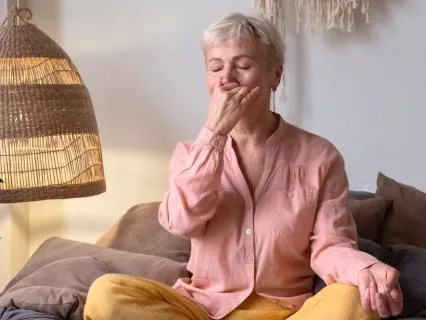
If you'd like to use your hands,
You can use one hand just resting a finger on your forehead and then using your thumb and one of your other fingers.
Or you might use both hands,
Just using a pointer finger on either side to help block a nostril.
Just remembering there's no right or wrong in this.
So to begin,
Just take a normal breath in.
Maybe it's a little deeper.
And allow your exhale to soften your whole body.
And do that again.
Just a full breath in.
Inviting in a softening as you exhale.
And then start to block your left nostril gently.
You don't have to squeeze tightly,
Just gently breathe in through your right nostril.
And then switch sides.
Gently block your right nostril as you breathe out through your left.
Keep that.
Breathe in through your left nostril.
And then switch sides,
Breathing out through your right nostril.
And keep that.
Breathe in through your right nostril.
Switch sides.
Breathe out through your left.
Keep that.
Breathe in through your left.
Switching sides again.
Breathing out through your right.
A few more rounds.
Breathe in through your right.
Switch sides.
Breathe out through your left.
Keep that.
Breathe in through your left.
And switch sides.
Breathe out through your right.
One more round.
Breathe in through your right.
And switch sides.
Breathe out through your left.
And then releasing your hands and breathing in.
And breathing out.
And you might continue imagining you're breathing in through your right here.
And breathing out through your left nostril,
Just letting your body soften.
Breathing in through your left nostril.
And breathing out through the right side.
And as you continue breathing,
You might continue imagining that arcing pattern from right to left and then from left to right.
And then eventually allowing that deeper concentration on your breath to soften.
And bring your attention back to your body again.
Just noticing what parts of your body move as you breathe in.
The invitation to soften your hands and even your feet as you exhale.
That style of breathing is an equalizing breath.
It's working with both hemispheres of our brain.
But in its simplest form,
It gives us a deep concentration.
Physiologically,
It shifts us as we breathe equally and in harmony.
And out of both nostrils.
Fun fact,
Our brain will change.
The ability for our sinuses to engage,
They actually expand and contract a bit throughout the day.
So we have a dominant nostril for a few hours and then it switches.
It's just something that's happening in the background throughout the day.
And this is a way to give your body rest,
Equalizing between each side.
And give your mind rest from all of the millions of things your mind is trying to figure out for you.
So that we can just be with breath.
And we'll spend a little bit of time here in silence.
You're welcome to maintain that particular focus on your breath.
Or just settle.
Allowing your body to soften.
And letting your concentration be a bit more open.
Instead of a flashlight on your breath.
It's like the warm sun coming in and you notice your whole body.
Your feet,
The parts of your legs,
The parts of your spine being supported by a chair or the earth.
And the spaciousness of your breath in.
Allowing one breath at a time.
And allowing your mind to rest,
Trusting that your body is taking care of you.
Awareness again of your body.
Notice your feet touching the earth.
And we can enhance our concentration by doing something as small as wiggling your toes.
Suddenly your awareness is there in your feet.
And same thing with our breath.
Just taking a big deep full breath.
Suddenly your attention is encompassed with your breath.
And on days where we need a little bit more attentional support.
Maybe we feel extra sleepy or a little extra agitated.
That alternate nostril breathing can be so supportive.
Just to help us come back to the present.
There are so many things happening in the world that can pull us out.
And our meditation is never to try to go inward and stick our head in the sand and be disconnected.
But to find support so when action is needed it can be wise action rather than reaction.
So that we can gently draw our hands back to our heart and fill ourselves back up when we feel depleted.
Your meditation can help open your already brilliant and beautiful heart.
And when our hearts are open,
Both joy and suffering can enter.
The more that we recognize suffering,
The more we need these moments of stillness with ourselves.
To be able to just take a breath.
Take a moment of regulation.
So that our action can be wise and compassionate to the best of our ability.
Just taking this breath right here,
Witnessing how much your body cares for you.
And the next exhale that you notice,
Invite your shoulders to soften.
And invite your mind to come rest in the warmth of your heart just for this moment.
I'm going to invite you to bring your hands into any of your closing habits or practices.
You can go palms together,
A symbol of gratitude,
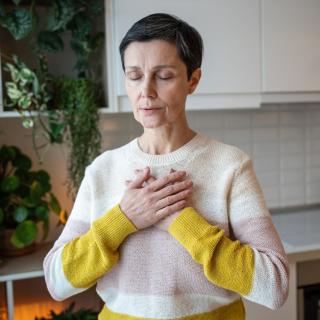
Or perhaps hands over your heart.
Both of these ways to contact not only your body,
Reminding yourself of your own support,
But these gestures,
These mudras,
Or seals,
To seal your practice in,
To remember to carry it with you.
And we'll end as we often do with a few loving kindness phrases.
It's repeating these offerings of well-wishing back to yourself.
May I remember the innate goodness of my breath.
May I remember my breath can shift me in any moment.
When things feel overwhelming,
May I come back to my breath.
When I need a moment of joy,
May I come back to my breath.
And when action is needed today,
May I choose to move with ease and peace.
And may the merits of our practice ripple out to benefit every single being.
And whenever you feel complete,
Go slow if you can.
Just take a moment to thank yourself first,
Just for showing up.
And start to find movement when you feel ready.
And as always,
Thank you for being here,
Supporting each other.