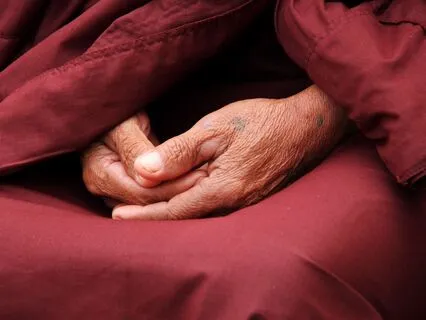
Relax yourself.
Observe your breath.
Feel the air going through your nostrils in and out.
In and out.
Feel the volume of your torso expanding and contracting.
In and out.
In and out.
Observe your stillness,
Your peace.
There you go.
Now you are a person who practices meditation.
So today we are talking about meditation and also your reactive,
Proactive and non-reactive mind.
Our goal is to find out when and how your reactive or impulsive mind can serve you and when your non-reactive or peaceful mind can serve you.
You will also gain clarity as to how much you should prepare in your life with your proactive mind.
We will find out how meditation actually affects your growth and your relationships with yourself and others.
Thich Nhat Hanh said,
Feelings come and go like clouds in windy sky.
Conscious breathing is my anchor.
Let's discover this anchor together.
There are two sentences in regards to today's topic that I came across in my life that I really like.
The first sentence is,
I'm endlessly patient but I don't wait for anything or anyone.
And the other sentence is,
Be patient for outcomes and impatient for actions.
Both sentences kind of say the same thing,
Which is to be aware of when to be non-reactive,
When to be proactive and when to be reactive.
Neither one of these three mindset is good or bad.
All of them can serve you at certain times in your life.
Let us begin with looking at being proactive.
The advantage of being proactive is that you're well prepared ahead of an action.
You're making sure that there is very little room for mistakes and accidents to happen,
Which is great.
Your plans and actions have most likely got a high standard because they're well thought through.
You look at something critically,
Analyze it and prepare for different outcomes.
And you will know the best reaction for anything that comes your way around that issue.
Now this is of course all great,
But there is a downside to being proactive.
Preparing potential reactions for different variabilities means you're preparing for a lot of options that never happen or manifest.
This means you're at least partially wasting a lot of time.
And with this time you could have been more productive in other areas.
This means that being proactive comes at a cost,
Which is time and energy.
So choose wisely when to be proactive,
When it is really worth it to be so prepared and when would you actually be able to deal with things on the spot and don't need to spend your time preparing.
It is for you to decide,
But try to become conscious of when being proactive is really worth it.
This brings me to the next mindset,
Which is being reactive.
Being reactive means you are handling a situation immediately,
The moment it arises.
This could be any type of situation,
A conversation,
A problem,
A work obstacle or anything else.
Something happens and you waste no time responding and react to the situation.
Now let us talk about the disadvantages of being reactive first.
The disadvantage is that you might become overwhelmed or emotional.
If the situation is complex,
No matter if it is private or professional,
You most likely don't take the time to look at it from all angles.
You then often can't make the absolute best quality responses and decisions.
This is why you have to be very careful to be reactive.
You risk being wrong to such an extent that you need to stop yourself.
You then need to acknowledge that you need more time to handle these situations properly.
Stopping yourself holds you back from making foolish and impulsive decisions that have a negative effect in the long run.
Being too reactive also means you risk becoming emotional and hypersensitive.
An immature person who is extremely reactive will constantly be offended and emotionally triggered in a way that is neither serving himself,
The situation nor his surroundings.
So only harvest the power of your reactive mind when you feel in balance and never let it become destructive.
Next,
I want to talk about the upsides of your reactive mind.
The biggest advantage is that you will live in the what-is and not in the what-if-modus.
The what-is-modus has a lot less chance of anxiety and a lot more chance of being productive.
Also,
The more you are in the what-is-modus,
The more you will learn to trust yourself.
You will learn that making small mistakes is not scary and actually worth it and that learning by doing advances you faster than any other method.
You will also be more present which means you will be able to deal with quick and immediate changes because you have less anxiety.
You will be able to deal with this fast-changing world a lot better because your mind will be trained to deal with anything coming your way on the spot.
Being reactive also allows you to be a lot more innovative and creative because your brain will get used to non-linear problem solving.
You will also be able to deal with problems before they become too big.
Often,
Anything that is left to the side without a reaction does not go away.
It will usually grow into a bigger problem.
By reacting immediately,
You avoid this.
So,
Use your reactive mind in a way that serves you.
Don't ask yourself if your reactive mind is good or bad.
Ask yourself when and where it serves you.
Next,
Let us talk about the non-reactive mind and the topic of meditation.
Meditation is being in a state of observation without reacting to anything,
Especially your own thoughts and feelings.
Meditation is a great tool and it does serve me personally.
So,
Let's look at the advantages but also the dangers of being in a non-reactive state.
Let's start with the disadvantages.
The first point I want to make here is that being non-reactive means that your life and your relationships are not developing.
You might develop as a person,
Become calmer and more centered,
But your project and relationships are not moving along.
So,
Make sure that being non-reactive does not disconnect you from the people close to you.
I've met many people who became so overly non-reactive that they thought being reactive was beneath them.
This immediately isolated them.
So,
The first point on being non-reactive is don't let it disconnect you.
The next point I want to make is that being non-reactive can make you lethargic and depressed.
You can misinterpret feeling depressed as feeling at peace.
The easiest way to make sure you're moving towards peace and not depression is to ask yourself,
Do I care?
If you're in a non-reactive peaceful state of mind,
You will still care a whole lot.
The last potential disadvantage of being non-reactive is that it can suppress your actual emotions.
You might start thinking that you're better than that and furthermore that other people have no chance of understanding you because you're advanced.
Not expressing emotions doesn't mean you're a mature person.
It means you're suppressing your emotions.
This will also be frustrating for other people around you as they can't tell how you feel about anything.
So,
Don't allow being non-reactive to suppress your emotions.
Now,
Let's talk about the upside of being non-reactive.
Being non-reactive and practicing meditation allows you to center yourself and live an overall peaceful and non-erratic life.
And that is absolutely great and worth exploring.
You will not waste your energy on things that have no value.
You will understand that not every impulse deserves an action and you will be able to be content in a light way.
Now,
I want to give a couple of examples where it is beneficial to be in a non-reactive state.
Imagine you're in a car and someone cuts you off.
Your impulse is to honk but you breathe deeply and let it go.
The action of honking would only have resulted in more anger for you and a potentially dangerous confrontation.
So,
Being non-reactive is a good choice.
Another example is being in a fight with your partner.
If you and your partner are becoming emotional and are not rationally discussing anymore,
Then it might be wise to become non-reactive for a time.
Fights with partners often become destructive when predominantly led by emotions.
A non-reactive mind allows you to take a break and come back to the discussion when you can communicate your wants and needs without getting emotional.
So,
Be non-reactive when the reaction has no or very little value.
And being able to be non-reactive comes from practicing meditation.
So,
Lastly,
How do you know when to use your reactive,
Proactive or non-reactive mind?
Here's a very simple formula to give you a first idea.
When you are nervous or anxious about decisions or events that have huge repercussions,
Then be proactive.
When you're an expert in a field or in a secure and positive environment,
Then allow yourself to be reactive.
When your action has very little value or when your urge to act comes out of negative emotional feelings,
Consider choosing to be non-reactive.
Of course,
This formula is not perfect but is something to give you a first framework and will allow you to build trust in yourself.
Now,
Let's talk about the practical exercises for this week.
I would like to invite you now to write down three different columns.
One for proactive,
One for reactive and one for non-reactive.
In these columns,
Write down 15 events or moments from your life that come to your mind.
Put each moment in one of the three columns.
How did you react to an event?
For example,
The grizzly bear in front of you or your phone vibrating while you had a conversation.
Any types of moments are fine.
Try and write at least five moments for each column.
Pause the course now and write down your observations.
So,
You wrote down your moments and the according types of reactions.
Now,
Write down the ideal type of reaction for the same moment.
What reaction would have served you the best in your moments?
Take the exact same moments and put them in what you think are their ideal columns.
Pause the course now and come back when you're finished.
Now,
During the next few days or during this week,
I would like you to practice meditation.
Maybe you already have a practice.
If so,
Great for you.
If you're not meditating yet,
Then start meditating.
This can be as small as observing three breaths every morning or it could be as big as doing a course,
Watching a video,
Getting a nap,
Signing up for Gönkö's Vipassana retreat.
Anything is fine.
But make a start in practicing meditation every single day this week.