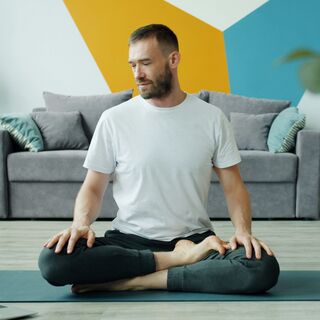
We are going to do a simple exercise to activate your vagus nerve and stimulate the body's natural relaxation and digestive response.
You're going to work on inhaling deep into her abdomen,
Activating the diaphragm,
Which will help stimulate the vagus nerve.
This will trigger the body's parasympathetic nervous system and ease the body.
We will use an optimal 10 second breath by inhaling for 4 seconds and exhaling for 6 seconds.
When trying to stimulate the vagus nerve,
It is crucial to make your exhales longer than your inhales.
Typically,
Diaphragmatic breathing is taught by focusing on expanding your belly,
But today we are going to take it a step further by focusing on expanding the entire 360 degrees of your lower torso.
We do this by pretending we have a belt wrapped around the area between our lower rib cage and our navel.
If you would like,
You can use a loose belt or exercise band around this area for feedback,
Trying to push into all points of the belt or band,
But do not make it too tight.
You can also put your hands on the side of your ribs for feedback.
We will inhale through our nose and exhale through our mouth.
Keep your shoulders and upper torso still when inhaling.
We will hold the breath for a brief moment at the top.
On the exhale,
Constrict the back of your throat and make the sound like you are trying to fog up a mirror.
Let's get into it.
If sitting up,
Keep your spine straight and your shoulders down from your ears to help your body start to relax.
Remember,
When you inhale,
Expand three-dimensionally all points of your torso.
Expand on the inhale,
Constrict on the exhale.
Expand on the inhale,
Constrict on the exhale.
Now,
Exhale all the air out your body and follow my lead.
Inhale for 1,
2,
3,
4.
Exhale for 1,
2,
3,
4,
5,
6.
Inhale for 1,
2,
3,
4.
Exhale for 1,
2,
3,
6.
Inhale for 1,
2,
3,
6.
Inhale for 1,
2,
3,
4.
Exhale for 1,
2,
3,
4,
5,
6.
Inhale for 1,
2,
3,
4.
Exhale for 1,
2,
3,
4,
5,
6.
Inhale for 1,
2,
3,
4.
Exhale for 1,
2,
3,
4,
5,
6.
Let it go.
Return back to regular breathing.
Take a second to see how your body feels.
Even in about one minute,
You should start to feel the body's natural relaxation response kick in.
This is a great practice after meals too to help regulate your digestion.
The longer you do this,
The more effects you will feel.
Thank you for joining me and thank you for listening.
Be well.