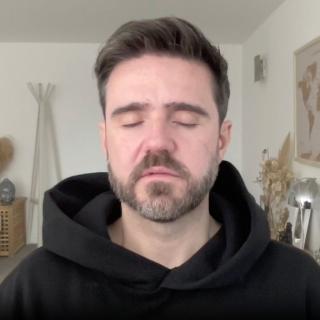
In this guided meditation,
We will be practicing Anapanasati,
Which is the Pali phrase for mindfulness of breathing.
And before we get into it,
I want to share something that will help you enjoy it.
Let's make a distinction between attention and awareness.
Think of your attention as a light that can shine onto things.
It can be used as a spotlight,
Illuminating something in a local way.
For example,
If you focus on the belly moving as you breathe.
Or your attention can be used more like a floodlight that,
For example,
Covers your entire body in a global way,
Feeling everything all at once.
You can move attention consciously and play with it.
Awareness is different.
Think of awareness as the field of presence that includes everything in your experience.
It's analogous to ambient light in a room that doesn't shine on anything specific,
But illuminates the entire room equally.
So you could be meditating by letting your attention rest on the gentle movement of the belly as you breathe,
While at the same time,
The sound of birds outside or cars driving past could be entering and leaving your awareness.
Visual images could be coming and going in the mind,
Along with bursts of mental talk.
And you have no control over what arises in awareness,
Which is the open field of presence in which everything in your experience comes and goes,
Whether you're paying attention to it or not.
So before we start,
Take a moment to remind yourself that whatever arises in awareness,
Whether it's outside of you,
Like the wind in the trees,
Or seemingly inside of you,
Like thoughts in the form of visual images or bursts of mental talk,
Whatever arises in awareness is absolutely allowed.
It's all just the flow of nature and it couldn't be any other way.
So there's no point in fighting anything.
It's all allowed to arise and pass,
Arise and pass.
Now,
With that said,
In this guided meditation,
We will choose to focus on the breath sensations,
But there should be no sense of strain or struggle,
Because this meditation isn't so much about staying with the breath as it is about letting everything else go.
I'll say that another way.
Most people struggle with mindfulness of breathing because they think they're screwing it up whenever they lose the breath sensations and become distracted.
Let's switch that thinking around and say that from now on,
The point of this practice isn't so much to stay with the breath,
But to notice when you've been captured by something other than the breath,
And then to see if you can let that go,
Whatever it is,
Thoughts,
Impulses,
Outside distractions,
Whatever.
You either let it go if you can,
Or if you can't,
You let it be there,
But it's in the background and the sensations associated with breathing,
You bring them into the foreground of experience,
And I'll show you how.
So you don't fight or struggle with anything in experience because everything is allowed,
But you are selectively choosing to focus on the breath.
Everything else can come and go in awareness,
And every time you notice you're not focusing on the breath and you do a course correction back to the breath,
That is a cause for celebration.
Noticing that your attention has wandered and then shifting it back to the breath is the point of this practice.
So it's a letting go exercise.
You can't really get it wrong.
So with that said,
Let's dive in.
Get yourself into a comfortable sitting position.
The eyes can be open,
Closed,
Or somewhere in between.
If your eyes are open,
Try to defocus the gaze.
Let's start by taking three deep breaths together,
And you can follow along with my instructions.
So big deep breath in through the nostrils.
Slowly breathing out.
And as you breathe out,
Allow the body to go relaxed and limp and loose.
Very good.
And again,
Nice big deep breath in through the nostrils.
Slowly breathing out.
Allow the body to go relaxed and limp and loose.
Very good.
And then one more time,
Nice big deep breath in through the nostrils.
Slowly breathing out.
Body goes relaxed and limp and loose.
Very good.
And now allow the breath to find its own natural rhythm.
You don't breathe,
The body breathes,
And you can simply rest.
The Buddha himself taught this meditation,
Mindfulness of breathing,
Because it's a simple and gentle practice.
It balances the mind and body and leads to insight.
So allow attention to drop down into the body.
Can you feel the gentle rise and fall of the belly and the chest as you breathe?
You don't need to strain or try too hard,
Just be gently aware of the movement of the abdomen as you breathe.
The gentle movement,
The sensations arising,
All happening around the abdomen,
Maybe the chest.
You don't need to consciously breathe or exaggerate the breath.
Allow it to be natural and notice how that feels.
Rest the mind with the breath.
Notice the expansion and contraction in the abdomen with each inhale and exhale.
Stay very close to the breath sensations.
Thoughts may arise in the form of visual images in the mind or bursts of mental talk.
That's all welcome.
Everything is welcome.
But see if you can allow that to be in the background of experience and bring the breathing sensations into the foreground of experience.
There might also be physical sensations,
Emotions or urges.
That's all welcome.
Everything is welcome.
But see if you can allow that to be in the background of experience and bring the breathing sensations into the foreground of experience.
Anything can arise and you allow it to be there,
But gently favor the breath sensations above everything else.
If you feel any tension or tightness in the body or the mind,
See if you can allow that to release on the exhale.
On the exhale there is a subtle letting go and you can use that to release tension if you wish.
If that works for you then great,
But if not,
If the tension stays,
That's okay too.
Give up the idea that things should be a certain way and embrace how things are.
Even if they're not perfect.
Allow the mind to gently rest with the breath.
Very simple.
And let everything else come and go.
Notice if the breath is fast or slow,
Short or long.
Free flowing or obstructed.
Don't try to analyze or tweak anything.
Just notice the breath as it is.
Stay very close to it.
What can you notice?
Be only interested in the breath.
For this short period of meditation,
Abandon interest in anything but the breath.
Notice the sensations that arise as the breath breathes itself.
Bring the breath into the foreground of experience and allow everything else to be in the background.
Just stay with the breath.
Ideas,
Memories,
Fantasies,
Planning.
They might all arise,
But when you notice,
Return to the breath sensations.
Desires,
Urges,
Reactions,
Wants and aversions.
They might arise,
But when you notice,
Return to the breath sensations.
Anything can arise and you allow it to be there,
But gently favor the breath above everything else.
Give up struggling against anything in experience.
Give up wishing things were different.
Allow everything to be as it is and rest attention with the breath.
Just the breath sensations.
Only the breath.
And now we will bring this meditation to a close.
But of course you can continue if you wish.