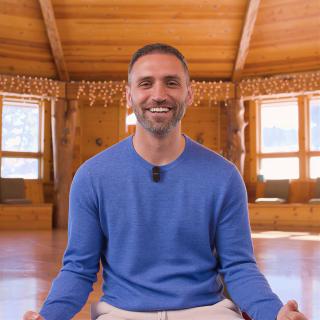
Good evening and welcome back to the Grounded Sleep Podcast.
As I was beginning to record tonight,
My cat,
Whose name is Imagine,
Kept scratching the door,
Meowing,
Wanting to come in and go to sleep with us.
So Imagine is here with us tonight for this sleep episode.
She's pretty adorable,
I call her Immie,
And she's about four years old.
And yeah,
She's here with us for sleep.
So welcome.
I hope you're in bed and you're ready to go to sleep.
And tonight's episode is on Zen for sleep,
And we're going to do some Zen stories.
When you're ready,
You can close your eyes and start to let yourself slowly drift away.
You have total license to fall asleep at any point.
You don't have to hear the end of any story.
And just allow the deep stillness of the night to take you whenever it's ready.
So let's start with some Zen stories for sleep.
And I want to begin by just sharing a little bit about where Zen originates from.
So the origins of Zen Buddhism really begin in the 5th or 6th century,
When a monk named Bodhidharma traveled from India to China,
Carrying with him some pretty profound teachings that would later become Zen,
Or as it was pronounced Chen,
In China.
And it came from the Sanskrit word dhyana,
Or dhyana,
Meaning meditation.
And when Buddhism first arrived in China through the Silk Road,
It encountered the wisdom of Taoism and Confucianism,
And it created a unique synthesis that emphasized direct experience over intellectual study.
And you'll see that theme again and again in Zen.
And maybe that's why I like it,
Because I wasn't the best student.
So the legend is that Bodhidharma met the Chinese Emperor Wu,
Who was boasting of his many good works building temples and supporting monks.
And Bodhidharma replied,
No merit at all.
And that response in Zen,
They say,
Pointed to something beyond conventional achievement.
And so the Emperor asked,
Then what's the highest meaning of the holy truths?
And the monk responded,
Vast emptiness,
Nothing holy.
When the Emperor pressed further and asked who is it that stands before me,
Bodhidharma replied,
I don't know.
And this very simple,
Humble approach to just being in this moment and not the ego of building temples or having achievements or even identifying with the ego is what Zen is about.
So from China,
This tradition of direct awakening spread to Japan,
It spread to Korea and to Vietnam.
And it really flowered over thousands of years.
And it produced some of the most profound spiritual teachers,
I think,
In human history.
And Zen is not a philosophy.
It really isn't an intellectual exercise.
It's a way of being that points directly to the peace that's already here inside each of us.
And as you fall asleep tonight,
You can even notice that in yourself,
There's a peace underneath all of the noise.
And Zen teaches us that awakening isn't something that we achieve through effort or accumulation or showing the world how many minutes we meditate.
But it's something we recognize by letting go and surrendering to this moment.
It's really the art of seeing clearly and of resting in what is.
So even as you fall asleep,
You're allowing yourself to just rest in what is.
And as I tell a few more stories,
You can let the stories just wash over you and help you find that inner peace.
If you don't understand the message of one of the stories,
Well,
That's Zen,
You just let it go.
And we're going to start with the story of a master named Bankei.
And he was a 7th century teacher in Japan.
And unlike many teachers of his time,
He didn't insist his students sit in formal meditation.
And he didn't insist they do difficult Zen koans,
Which are these contemplations that you do in Zen,
Like thinking about one hand clapping,
That are very difficult to comprehend.
And instead he taught what he called the unborn Buddha mind.
And Bankei had come to this understanding through a lot of suffering.
And it was during a brush with death that he realized the very mind he had been seeking through so much effort was already present,
That unborn Buddha mind.
And one day a student came to him agitated and said,
Master,
I have such a terrible temper.
No matter how hard I try to control it,
Anger keeps just arising.
Please help me get rid of it.
And so his master looked at him and said,
Show me this anger right now.
And the student paused and replied,
Well,
I'm not angry at this moment.
And so Bankei then says,
Where is the anger you want me to help you with?
And the student realized at that moment that anger only existed when he was actually angry.
And in this moment looking,
There was only peace.
And the master replied,
You see,
Your original mind is unborn and undying.
It's only when you pick up thoughts and carry them that you suffer.
Right now,
In this very moment,
You are already Buddha.
There is nothing to fix,
Nothing to achieve.
The Buddha mind is like a bright mirror that reflects everything without effort,
Without intention.
When something appears in front of it,
It reflects.
When it's gone,
It doesn't hold on to the image.
And so like this student,
You don't need to carry the day's worries into your sleep.
You can let them dissolve into the natural peace of this moment.
And let's go into another story.
Before we do,
Make sure you're breathing gently and just letting your body get a bit heavier and start to melt into the bed.
Let your muscles relax.
Let your breath be natural.
So the next teacher we're gonna talk about is Master Zhou Xu.
And he was a Chinese Zen master from the 9th century who lived,
Say,
To 119.
That would be nice.
And he was famous for his simple direct teachings and his ability to point to the essence of Zen through the most ordinary encounters.
And so one day,
Two monks came to study with him.
And he asked the first monk,
Have you been here before?
And that monk said,
No,
Master,
This is my first visit.
And Zhou Xu said,
Then go and have a cup of tea.
And then he asked the second monk the same question.
And that monk said,
Yes,
Master,
I have been here several times before.
And Zhou Xu says,
Then go and have a cup of tea.
The temple attendant,
Who was confused,
Approached Zhou Xu and said,
Master,
Why did you tell both monks to have tea regardless of whether they'd been here before?
And Zhou Xu looked at him and said,
You too,
Go have a cup of tea.
Later,
When asked about this exchange,
Zhou Xu explained that if you can understand the one word tea,
You can understand all of Buddhism.
If you cannot understand it,
Even reading all the sutras won't help you.
And Zhou Xu wasn't being cryptic.
He was pointing to the simple perfection of each moment,
Whether you're new to something or familiar with it,
Whether you're succeeding or struggling.
The invitation is always the same.
Be fully present to what's right in front of you.
And I have done tea ceremonies.
And there is a beauty in the simplicity and the presence of doing a tea ceremony.
And the tea ceremony would later develop in Japan,
And found its roots in this simple understanding.
So as we allow the night to become more peaceful,
Listening to these beautiful Zen stories,
You can let yourself begin to drift off into the night.
With that unborn Buddha mind,
That still mind.