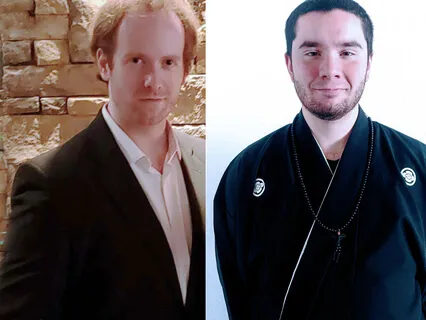
Well,
Hello there,
Daniel.
Hi,
Silas.
How are you?
I'm doing really good today,
Man.
I'm really happy to have you on here.
We've been talking for a long time,
And I think you offer a really good perspective,
And you're a fun guy overall that people should hear from more,
So I'm happy to be able to have you here in the hot seat,
I guess.
I appreciate it.
I think there's a lot to the traditions,
There's a lot to meditation practices,
And I think the modern day,
It's ubiquitous in use is on purpose,
Not just for some capitalistic dogma,
But also for the fact that you can adapt it so well to treatment vector,
You can adapt it to personal life.
The modern day,
It works extremely well,
Especially for the problems we now face.
Yeah,
We're in a bit of a pickle in the modern day,
That's for sure.
And the dogma seems to be helpful for a lot of people,
Which I appreciate.
So what I do in these talks is we like to get the story of people and kind of how they got started,
Where they come from,
Their origin story,
And how it helps them overall.
How would you say that you got introduced to the dharma?
My introduction to dharma,
So I was,
Since I was a child,
I'd been in martial arts classes,
And of course,
In a lot of those classes,
They roll in things like meditation and mindfulness as part of karate and kung fu and things like that when I was a kid,
And then as an adult,
I took Aikido.
And of course,
Aikido,
Morihei Ueshiba,
The founder of Aikido,
Also was for a long time a devout Buddhist.
He eventually left Buddhism itself,
But he retained a huge amount of that cultural and religious,
I don't want to use the word baggage,
But influence.
And that rolled into it very well.
How I became directly involved with dharma from a Buddhist perspective is I took classes in college,
As most people do in the West,
As you wouldn't really be exposed to it in most circumstances,
So you hit like,
College years is kind of the average.
And I went to college,
And I took some very basic classes,
And then I attended a retreat led by a Tibetan lama,
And I had what you could say is a conversion experience with that lama,
And I said,
This is something I have to have.
The thing that he has,
I think people need,
And I think I could,
And more or less what happened is I fell into practice to the point where I've attended several retreats,
And I have not just a background in the religious tradition of Vajrana Buddhism,
But I also have a secular background in both mindfulness,
Open monitoring,
And other kinds of meditation,
Loving kindness,
Formal Zen practice,
Both the secular and in the religious tradition.
And I more or less fell into it via practice that came from that retreat,
And it has influenced my life,
And it also led me to my current career choice.
So I work as a crisis counselor.
I'm a certified QMHP in my state.
I have a bachelor's degree in psychology,
A BSc in psychology,
And a BA in religious studies focusing on Buddhist and Indic tradition,
Which is what my concentration is.
Would you say that you were already interested in the clinical psychology aspect of it before you got introduced to the Dharma,
And Buddhism,
Or did that come after?
So the interest was always there,
But it became very stark when I really found out just how potent meditation was.
It became kind of like the difference between a passing interest and something that's like,
Oh,
This is really powerful.
This can be used as a treatment for people who really need it.
And that's something the historical Buddha Shakyamuni did as well.
There were many non-Buddhists,
Even within the earliest Pali,
That he taught how to meditate on purpose because it has many uses.
So I think that definitely has a purpose.
And I think the modern clinical community within dialectical behavioral therapy,
Which was pioneered via Marsha Linehan,
While most people don't know this,
She's a classically trained Zen priest.
So a lot of the modern clinical practices we have not only are borrowing from Buddhist tradition,
They're straight up taking it from Buddhist tradition without the religious intonation,
Of course,
Without offerings,
Without mantric prayer,
Without dedications of merit.
If you remove those things,
What you have left is the crux of Buddhist practicum,
Of Buddhist praxis,
Which I find very interesting.
So long story short,
Yes.
No worries.
What was the experience on that retreat that led to what you call the conversion experience?
Was it a particular meditative state?
Was it a particular meditative experience?
Was it just an essence or an error around what he was saying or teaching?
Dig into that a little bit.
So for him,
He was initially what I had considered with him is that I don't know how to describe this without it sounding hokey or woo.
But in my interactions with him,
He gave off an aura,
And it wasn't just him being a nice guy.
It was the sense of presence,
The sense of intention,
And it was something beyond what we would consider,
You know,
I know some secular folks might balk at it,
But the idea that there is a there's something else going on there.
There's something under the skin going on.
And it was like he gave off a sense of warmth,
A sense of intention,
A sense of understanding that I don't really know how to put into words.
And initially,
Upon meeting him,
I thought he was this cool guy.
So initially,
Of course,
I'm a psychology major.
I know exactly what cognitive bias is.
So when I felt that,
I said,
All right,
He's a cool guy.
In my head,
I'm kind of blowing it out of proportion.
He's just this chill dude.
I'm aggrandizing him in my own mind.
That's what I first said to myself,
And I put it aside.
And it was the fact that every time he entered a room,
Not only did you know he entered the room,
But you could feel it,
Kind of like a hand of a friend on your shoulder kind of thing.
And it was so obvious because people wouldn't even be facing him,
But he would enter and say nothing,
And every head in the room would turn because everyone knew instantly where he was.
It was amazing.
It was quite incredible.
And that plus the meditative states he led us through in and of itself was deeply experiential on a level that I can't quite put into words that would work.
That's one of the problems within Buddhism is that a lot of it is experiential.
Like if you're talking about the original Shakyamuni Buddha and the way he taught things,
You need to experience it for it to be real.
That's actually why I've heard some people scoff at the flower sermon for Zen Buddhists because that's how they trace their way back to Siddhartha Gautama,
The original Buddha,
Is through the wordless flower sermon.
And I've seen some scholars say,
Well,
There is no evidence of the flower sermon before the 9th century CE,
So it may not be factually true or historically true,
You might say,
But that doesn't separate it from,
I guess,
The impact of the story because the merit or the way in which the teaching is presented is relevant and present in many of the other Buddha's teachings.
And so if that's the story they want to tell themselves to track back to the original Buddha,
I'm perfectly fine with that,
You know?
Oh,
Yeah,
Absolutely.
And on top of that,
Most forms of lineage transmission in the modern day,
Like for example,
Let's take,
I think many people in the audience might be familiar with the Heart Sutra.
It's a primary sutra text that is defined by,
It is a stepping stone into the Mahayana,
And it is realized within all forms of Mahayana that I am personally aware of that it is built in.
Within Zen Buddhism,
The Heart Sutra is like front and center.
It's the dead center of the practice.
It's a thing you do at the beginning,
You chant at the beginning,
You go through the mantra recitation,
You go through the recitation of the verse itself,
And then you practice.
Within Tibetan canon,
Which is what I'm part of,
In Tibetan canon,
It's still there.
It's still honored as a primary teaching,
But it's not as stark.
However,
Every single Mahayana Buddhist,
When you look at the academic background,
Can see the background of the Heart Sutra is not an Indic text.
It's a Chinese text that later was translated into Sanskrit.
It did not start as a Sanskrit text.
And that's okay.
It's not necessarily that everything has to be the literal way that many people define it in the West,
Because there's a very obsession with.
.
.
How do I put this?
The historicity of something?
Yes,
There's an obsession with historicity.
And one of the problems with that kind of historicity is that you're going to hit points where major teachings you could look at and say,
These are ahistorical.
However,
That's not really how it's classically defined in Buddhism.
If you look at,
I think,
I believe offhand,
It was Dharmakirti.
Dharmakirti said,
And this is why in the Tibetan tradition they have what's called treasure revealers,
Is the idea that these are later teachings that were revealed at a later date.
The way they track historicity or historicity of a text is not whether it was historically accurate or not.
The way they track the text is does it lead to attainment?
Does it lead to good places?
Does it lead to the positive outcome and intention of a bodhisattva or a Buddha?
Is that what it leads to?
If it does not lead to that point,
It is discarded as inaccurate.
If it does lead to that point,
They say,
All right,
This is accurate,
We're going to keep it,
We're going to use it.
Its historicity is not important.
The point of it is that where does it get you to?
What end goal does it lead you to?
If it leads you to the right end goal,
It is the right answer.
Right.
There's a lot of things too where you can see influence once you know enough about the history of Buddhist doctrine where the Heart Sutra is clearly influenced by Nagarjuna and the writings of Madhyamaka and these things where you see,
Especially in early Mahayana,
The formations of Mahayana coming through that lead all the way up until modern day Zen practice.
It's like it may be removed historically and culturally from those instances,
But the influence is still present.
Oh,
Absolutely.
I mean,
Look at Bodhidharma.
So Bodhidharma is considered the main patriarch of the Zen lineage.
For those in the audience who don't know,
Chan is the Chinese version of Zen.
Soan is the Korean version.
And in Japan,
Zen is the Japanese version.
The word means the same thing.
It literally means to meditate or meditation.
That's what the word actually translates to.
However,
The initial patriarch from India into China for that transmission of the faith went from India,
Bodhidharma traveled to China and transmitted it into China,
Making Chan.
So that's how it translated across.
Go ahead,
Please.
So from that initial retreat,
From that initial experience,
Where do you go from there?
Like you come out of the retreat and then what is your inspiration?
What's your direction?
Where are you going with this newfound thing?
So that newfound thing,
This is an interesting discussion because initially while I kept studying Buddhism both as part of my academic background and part of my personal religious interest,
I wasn't fully sold on it until later.
And how I mean that is I would say approximately a year later after the retreat where I had this experience with this monk,
I filed it away in the back of my head as cognitive bias.
I said,
Okay,
This is just me being biased.
It's me seeing what I want to see or something cool,
Right,
Until a conversation happened around me.
Some people were hanging out and I was around them.
I wasn't talking to them.
And they had all been at the retreat.
And they were people I knew tangentially.
And they started talking about the exact thing I had experienced.
And they were all talking about it.
Every single one of them had felt it.
Every single person there had the exact same experience.
And it was a fascinating thing because at that moment I said,
Wait a minute.
So it wasn't just a fluke.
It wasn't just me in my head building him up to be this cool guy.
It was at least on some level it was real where the interactions of each person with this man interacted in such a way that everyone there felt the same thing.
And funnily enough,
That is a thing recounted in Buddhist history.
It is said that really skilled teachers are able to teach every person there by their means,
By their needs,
And to get good outcome from them,
A teacher can influence each person there as they need it.
And that's a thing recounted in all forms of Buddhism where if you're with a skilled teacher,
One that clicks with you,
One that has karmic ties with you,
All of a sudden it becomes a very potent and powerful thing that can change lives.
Yeah,
Pith instructions are kind of strange.
Oh,
Yeah.
For the listener,
A pith instruction is kind of where a teacher that you've been working with or a space that you've been interacting with,
It kind of,
I like to say,
Skips you forward a little bit in your meditative practice where,
Let's say,
You don't have any meditative practice whatsoever,
But you're with a very skilled teacher,
That skilled teacher,
Through their practice,
Is somehow,
I don't know the science behind it or if there is even any science behind it,
Pulled you into their level of practice,
Pull you close to their level of practice and understanding and allow you to experience it.
Would you say that you experienced kind of a group pith instruction in that way?
100 percent.
Absolutely.
And I think that that is a thing recounted.
I've had many non-Buddhists who have attended retreats tell me that happens.
As in,
I know people who've attended retreats and they said it blew their mind.
They're not Buddhists at all.
They were everything from Christian to Muslim to Norse heathen who attended a retreat with a Buddhist teacher,
A skilled meditative teacher,
And they had an experience that totally blew their minds because during the meditation,
The teacher was not only able to guide them,
But pull them in to that experience.
Kind of like if two different people or a group of people share the same dream.
It's absolutely fascinating.
It's a thing that happens with staggering regularity within that community.
And here's the thing.
So,
And for those secular minded here,
I'll give two answers.
There's the religious answer and then there's the secular answer.
The secular answer is that when you're with others in a group setting,
There's a natural kind of social contract that occurs.
The contract is that as I'm sitting practicing and you're sitting across from me practicing,
One of our jobs is to make things easier for one another.
We tend to try to focus better.
We tend to try to settle more.
Maybe if you want to shift,
You try not to.
You try to stay still.
You try not to swallow as much or cough as much because you're surrounded by people that are also practicing.
So you have this,
Even among non-meditators that I've personally taught,
This is true over a hundred plus clients I've worked with in person,
It's absolutely amazing that people who think they can't meditate at all,
In a group,
All of a sudden can.
And it's because they've either never tried or never had a proper teacher with them before.
And the religious answer is that when you have someone in the room that is skilled with proper intent and purpose,
That intent and purpose has an effect on everyone around them and can make you better at the thing you're doing because the person who's leading the group,
Their intent and purpose is correct.
You know,
That's really interesting even down to the practitioner level because I've gone on retreats before and there's one instance that I like to think about a lot where I was practicing with a fellow named Aditya and he was actually practicing Vajrayana tradition and he was,
You'll know the name of it,
But he was on the 15-year road to Rainbow Body or something like that.
He was fairly far down the line in terms of practice.
So he's probably at this point already taken samaya vows,
Already into guru and deity yoga,
And already probably working on either Dzogchen or Mahamudra.
Yeah,
He was working on the Dzogchen practice.
And I only sat next to him once,
But we weren't standing.
He did a lot of standing practice.
And I was like,
All right,
I'll go practice next to this guy for this session.
And I found it so intriguing how much his skill and his ability to go into particular states affected my ability to go into particular states,
Just being in his kind of like karmic or energetic closeness in that regard of when we were practicing together.
And I've seen this in other aspects too,
Where you can sit next to someone who,
Say they're really good at meta or they're really good at concentration or they may be very good at like insight,
And you will kind of catch a vibe off the person and be propelled a little bit in that direction.
Or you yourself can be that propeller where your skills,
Your abilities kind of help others around you in that regard to group practice.
Oh,
Absolutely.
I fully agree with that.
So,
OK,
Cards on the table.
I'm by no means an attained teacher or any of that such.
No.
But I've had experiences where when I'm with a client that I'm working with,
And especially when I've had a group of clients,
All of a sudden they'll settle in such a way that many of these people who have never meditated before will sink their breathing.
All of a sudden their bodies will start to work in rhythm with one another.
They'll settle into a level of understanding they've never felt before.
And part of that is that when you have someone who's skilled with you,
You will feel the effect.
Like this is whether you think of this as the secular answer,
As many would,
Or the religious answer as you or I would,
The answer there,
The result is kind of still the same.
It's just a good thing to have in general.
Whenever I like to have fun or I'm talking to someone in a more secular mindset,
I generally point them towards Carl Jung in terms of decent explanations or close approximations of this kind of thing.
And we start using words like collective consciousness.
Of course.
Of course.
So,
OK,
So where did you go after that point?
So you had this experience and you were later on and we have a lot of people,
Or I talk to a lot of people or a lot of listeners,
Maybe at the point where,
You know,
They've become interested in Buddhism.
They've had the experience or they've really started to want to get into meditation.
Where did you go from there?
How did you begin to do the study,
Do the practice rather than just on the academic level?
So,
So here's the thing about academia in the West.
When you go to an academic source,
If you go to a college and you meet a professor and that professor has a PhD in,
Insert religion here,
There is an almost 100 percent chance that that professor is of the religion they specialize in.
It is a very,
Very high percentage.
And especially in Dharmic traditions,
That is almost uniformly true from what I personally have seen.
My academic advisor was is a very,
Very formal practicing Buddhist.
He's an academic in the Tibetan and Asiatic studies.
And he's amazing at it.
And he,
Along with taking his classes,
I met with him personally a lot,
A great deal.
We became friends over time.
And he eventually became my practice instructor.
And he is one of the teachers within the Sangha that I am part of.
And he's not he's not the lead teacher.
He's not the guru,
But he's one of the lead teachers under the guru of the Sangha that I'm part of as part of the Vajrayana.
So what and that happened over that happened over time.
Was it just consistently interacting with that individual?
Do you think that finding a teacher is necessary?
Yes,
Absolutely.
Without question.
So in my own personal life,
When I've been teaching clients to meditate,
The number of clients I have had that have looked at me in person,
That is only in person,
I've never taught online before prior to this moment.
When when you sit with someone in person and you meditate with them,
The air is different.
And the number of people I've had that have looked at me and said,
Oh,
Man,
I tried meditation.
It's not for me.
I don't you know,
I don't think it works.
And I said,
Give me 15 minutes.
That's all I say.
Give me 15 minutes.
One chance.
The number of clients I have had that have taken up personal practices after working with me on a one to one basis or a group in a group is staggering.
Because when you have an in-person teacher,
I mean,
Think about it.
Historically,
How was it transmitted?
Orally,
Of course.
Orally and practical teaching in person,
One to one living teacher,
Living student breath of transmission.
That is how it was taught.
Do you think that someone can get a decent approximation of the experience?
The reading text?
No.
I think that texts are a wonderful guideline.
They're a baseline.
You can start from there,
But if you don't meditate,
You're not going to get it.
And that's the hard part for a lot of people.
You know,
The vast majority of Buddhists don't meditate.
But the fact of the matter is,
When you do,
It changes your perspective.
It changes your intention.
It changes your it changes who you are.
It changes your social relationships across the board.
If you don't meditate,
You're missing something that builds the crux of the tradition.
So you mentioned that you were in clinical practice.
How has the Dharma affected your clinical practice overall?
So overall,
So I've worked with a huge number of people.
This includes anxiety,
Depression,
Borderline personality,
Bipolar,
Schizophrenia.
And really,
If you point to something in the DSM,
I've probably seen something akin to it or the thing itself,
The diagnosis itself.
Herein lie the herein lie the I think a really good point is that the Dharma itself can be seen in some respects as a very,
I don't want to say humanistic,
But a very utilitarian,
Positive philosophy.
In that,
Outside of its religious context,
When looking at what it does,
It teaches you to be understanding.
It teaches you to see people equally.
It teaches you the concept of love in a very pure way.
It teaches you how to work around someone else's limitations.
Meet them where they are.
And that is the bottom line for most people.
If you're able to meet someone where they are,
All of a sudden that relationship,
Regardless of what it is,
Be it a personal relationship,
Be it a friendship,
Be it a romantic relationship,
Be it a personal professional relationship.
When you meet someone where they are,
Things become far more easy and clear.
Well,
I mean,
You've yet to diagnose me.
I'll get you on my couch soon enough.
Don't worry.
Oh yeah.
That would be – I don't know.
They've tried to help me and nothing's worked so far.
Well,
I think part of that is people assuming that – assuming that you've got a diagnosis to begin with and I don't believe that you have a disorder.
I think you're obsessive,
But I don't believe it's compulsive.
Well,
There we go.
That's decent.
I'll say that.
It's not a formal DSM-5,
My friend.
Well,
What is it?
Isn't there like one line in the DSM-5 about ecstatic religious experience?
Don't worry.
I'd be – I would be in the same rung as you in that regard.
It is something like – and it really is just like a singular line about meditation in the DSM-5 where it's like people who do meditative practices seem to be more prone to ecstatic religious experience or something like that.
The thing is that – one is that the definition of meditative experience under the DSM-5 definition is very poor because it includes everything from hyperreligiosity,
Which is like part and parcel of schizophrenia and schizoid personality type,
And then you look at something like from that,
Then you go into something like the interactions with a person who has had an experience that influenced their life.
But not every single experience is a diagnosable problem because the problem with the DSM-5,
Or I should say the public issue looking into psychology,
Is that the word disorder has a very specific use.
It's does it damage your life?
Does it hurt your life?
If that ecstatic religious experience has had nothing but good results,
Then it's not a problem by definition.
It's not a problem.
What would you say is the way in which the Dharma has helped interact within your personal life?
It's made my personal relationships better.
It has made my interactions with others much more even keel.
I'm a very high octane kind of guy,
As my sensei once told me.
I'm very ecstatic and exuberant often.
And the problem is,
Though,
Is that I can be very blunt and I can be very aggressive in getting my point across,
As you may have noticed here.
But the thing is,
Is that meditation evens that out.
It lowers – it kindles the flame,
But it lowers it a little bit.
It kind of makes it – instead of a raging inferno,
You get like a little campfire.
It has helped a great deal in my interactions with others.
It has helped in the way I see the world.
It's also helped me in the face of everything going on in the world stay quite positive.
And I think that in and of itself being able to – what's the old saying is have the wisdom to change what you can and to let go of things you can't change,
Right?
Right.
Don't – It's a very bad paraphrasing,
But you know what I mean.
Yeah,
Don't be an atlas and take all of the world's problems on your shoulders,
Because that's just ridiculous.
As – And that is – and I think that's also – taking the world's problem on your shoulders is a big problem within my field as well,
Because so many people bring home the problems of their clients.
Yeah.
Would you say that the Dharma helps to disconnect from that or separate it?
Oh yeah,
Absolutely.
It lets me look at someone and work through their suffering without taking their suffering onto myself and burn with it.
So where would you say that your speciality lies within the Dharma?
So mine is – if we're looking at something more direct and something appropriate to my line of work and also to my life,
The bodhisattva vow is very near and dear to my heart.
And one of the reasons for that is that the reason I found my academic advisor,
My now practice instructor,
Is because the word bodhisattva came up in a religion class I took.
It was a world religion class.
We covered Buddhism for like two weeks.
But one of the words that we studied – of course,
Two weeks is not enough to fully define dharmic conception of anything.
It's enough to barely get a baseline.
However,
The word bodhisattva clicked with me,
And I didn't understand why.
And after reading on it,
I was like,
This is something that feels right to me.
So I went to my – at the time,
My teacher,
My professor,
And I said,
Hey,
Who do I talk to about this?
Like who do I talk to about understanding this word and the things around it?
He said,
All right,
I'll introduce you to this guy.
And he introduced me to my academic advisor and my practice instructor.
And that was a big stepping stone.
The bodhisattva vow is something I hold very dear to me.
And there's a few reasons for that,
Is that we have quite a bit of suffering going on in the world as of right now.
As you might be aware,
And I think all of the other people in the audience might be aware,
That there's quite a bit of suffering going on right now.
And I think that the more people reach out altruistically to try and fix some of these problems,
I think that the world in itself will be in a better place.
And,
Of course,
That's obviously very altruistic in intention,
But it's also easier said than done,
Right?
Right.
But what if all I want to do is become a Buddha and check out?
Well,
You better – and the argument there within the Mahayana is that you won't be a Buddha unless you take the bodhisattva vow first.
Right.
That's always the difference that I like to talk about between the Theravada and the Mahayana is that within the Theravada,
If you were to look at like a scale of importance,
I would say that within the Theravada,
Wisdom realization is 1% more important than compassion realization.
Sure,
Yeah.
And within the Mahayana,
It's just flipped where compassion realization is 1% more important than wisdom realization.
Absolutely.
And I think because the audience here is more than likely a Western audience,
I can probably say this and most people will understand what I'm saying.
I had a conversation with a very devout Christian gentleman who talked to me about – he had studied the Buddhist tradition very,
Very well.
He had a decent understanding of it.
But he said to me that one of his problems with Buddhism is that the compassion aspect is not explicitly stated within the early tradition.
And he said within Buddhism,
And I said,
Well,
That's not necessarily true.
And I talked to him about the early tradition makes it very apparent that compassion is a component piece of the pie.
But in Mahayana and Vajrayana,
Compassion is almost the entire pie.
Like it's that combined with wisdom,
Which of course comes from meditation practices and experiential awareness.
But the thing about the Mahayana and Vajrayana state is that if you don't add altruistic intention,
If you don't add the altruistic action and intent to your repertoire,
You will not get where you're looking to go.
Because a Buddha,
By definition,
Is an altruistically intentioned being.
Therein lie the point.
And we're getting pretty heavy into dharma theory here,
But it is interesting.
I would even go so far to make the assumption that there is no such thing as a pratyakabuddha anymore.
So there's a different conversation.
There's a conversation to be had there.
So pratyakabuddhas are interesting.
I think that it is very,
Very possible they exist.
I believe that they do exist personally,
Because I think that you can get to that end goal and you cannot know what the path is.
I mean,
The Buddha Shakyamuni himself did it,
Right?
So other people must be capable of doing it.
It's rare,
But it can certainly happen.
However,
The more direct the path,
The better the result.
In this case,
As a shorthand example,
If you were to be a person that is very compassionate,
Very loving and very intentional,
That alone is very good.
That's a great start,
But you still need the wisdom aspect.
If you're a person that meditates all the time and you get some wisdom from that,
Some spiritual awareness from that,
The problem is that you still lack the altruistic compassion part.
Fix your intent,
Fix the altruism part,
And the rest will come.
Does that make sense?
Yeah,
Absolutely.
And within the early tradition,
Something that I've noticed that it can kind of sour people's perspective when approaching this topic is that the Pali word sila is often translated to mean morality,
Which carries a lot of baggage with it.
When I think that probably a more proper translation would be something like a virtue.
Yeah,
I would agree.
But morality is just a verbiage that may cause people to balk a little bit.
But I would say most people agree with some degree of moral compass.
Does that make sense?
Yeah,
Absolutely.
So within your life walking around right now,
How are you doing the practice?
How does the practice affect you?
And what would you say is something that if you were to point someone in a direction of practice,
Where would you point them?
So the first thing I would do with someone if I was working with someone who's suffering from this is I would set them up on a very short rounds of meditation,
Either daily or every other day.
So this is what I personally do.
I try to do daily or every other day,
Not daily.
I'm not going to say daily.
I'm not that good.
But I'm I try to get in a week,
15 minutes every other day,
If not longer.
Some end up being well over an hour.
It also depends on what I'm specifically doing.
If you are doing it for health reasons only,
For secular only reasons such as general wellness,
Mental health,
Depression,
Anxiety,
Then 12 to 15 minutes a day is the sweet spot.
That is what I normally teach people to do.
So I will normally run someone through a 15 minute meditation.
The reason I picked 15 minutes is specific,
Because in most formal clinical studies on mindfulness meditation practices,
You find that 12 minutes is the minimum for clinical benefit.
And what I do is I make that 15 minutes because most people will have trouble settling in the first couple of minutes.
So the first two to three minutes,
Give or take,
Is a moment of like,
Am I sitting right?
Am I doing this right?
Like,
Am I settling okay?
What's up with this?
And then eventually,
After a few minutes,
A person will settle into a breathing pattern,
Let their body start to relax,
And then they start the practice in earnest.
So what 15 minutes does is it gives the person 12 minutes of real,
Decent practice.
And that's enough for the average person walking down the street who doesn't want to dedicate their life to dharma.
That's perfectly fine.
There's nothing wrong with that.
And that provides a very solid foundation for them to work from for general well-being and mental health.
That's how I usually teach it.
You know,
The analogy that I often use is one of water.
Some people just want to sit in their hot tub for 15 minutes at the end of the day,
And then other people want to surf,
You know,
300 foot tall waves off the coast of Portugal.
Like,
Exactly.
Exactly.
They both have to deal with water,
But they're definitely different experiences.
Yeah,
Some people,
Some people love the taste of chocolate,
And some people adore it.
Some people eat the Hershey Kiss,
The others will eat the whole cake.
Exactly.
If someone is searching for a teacher,
What advice would you give them?
So in the modern day,
That's a wonderful question.
In the modern day,
It became easier than ever to find real teachers.
The first thing I would do is I'd go to Google and I would put in Buddhist teachers in your area.
And most states have a few hanging around.
If you're on the West Coast,
You're in luck.
They're all over the place.
If you're on the East Coast,
There's a few.
If you live near Colorado,
You're also in luck because they're all over Colorado because Tibetans went from one side of the earth and the mountains to the other side of the earth and the mountains.
It worked really well.
And so my advice would be my first piece of advice.
Go online,
Go to Google,
Go to or Bing,
Go to whatever your search engine of choice is and type in Buddhist teachers in insert area here near this area code.
And you will find groups in that area.
But there's usually also if you're less interested in the religious aspect and want the secular aspect.
There's also quite a few meditation teachers in most areas that help out that help out very well with learning in a more formal setting.
So both the secular and the religious benefit from this in many ways.
The other way is that if you're looking for a teacher,
Looking online is a great choice.
I have never met my teacher in person.
Unfortunately,
He lives in Seattle.
I live in Virginia.
That's a long that's a long way across.
So but I but many of his students and lead students and teachers are on this coast.
So I've had multiple interactions throughout the sangha and I've had multiple,
Multiple retreats and tons of sessions in every form of Buddhism.
You can imagine with students from the sangha and teachers from the sangha,
Just not the guru from the sangha who lives in who lives on the West Coast.
Right.
I'm lucky enough to only live about nine hours away from my teacher.
So that's very helpful.
That's an easy drive.
Oh,
Yeah.
Oh,
Yeah,
Absolutely.
So what are some experiences that you've had in practice that have helped to inspire,
Motivate,
Bolster,
Confound,
Confuse,
Any of the above?
Just things that you've experienced in practice and from the Dharma?
Well,
If you want to start with a comedy one,
There's one that I did my first seven day retreat in late 2020.
And I did it was seven days back to back to back eight hours a day for seven days.
And I was with I had my practice instructor there as well.
And I was going through a rigorous practice set of practice sessions.
It was for shamatha for basic mindfulness breathing.
And it was a rigorous set of teachings for that set of instructions.
And as I was doing it by the end of the third day,
So by the end of the twenty third,
Twenty fourth,
Maybe twenty fifth hour of meditation,
I went to my practice instructor and I said,
I am bored out of my mind.
And then he looked at me and said,
Good,
I want you to be bored.
Go keep practicing.
I went,
All right,
Then.
Great.
And that is how you learn.
One of the things that's taught in every tradition is that when you take something in,
Equanimity is a primary aspect of practice.
For those of you unaware,
Equanimity is when you take something and everything you see does not cause unease.
It does not.
It's not a problem.
Nothing you sense or see is innately problematic.
All of it is just something that is part of your experience.
The experience of meditating in a group where someone is coughing constantly,
The experience of,
Oh,
My foot hurts.
I need to move my foot.
The experience of there's some light over there shining through the window and it's bothering me.
Or the experience of this thing is really pleasant.
I like the state that I'm in or I'm thinking about my loved ones and what fun we had doing this thing.
All of those things are fundamentally equal in a meditative state.
And what I mean by that is that when you see it with equanimity,
None of that is innately problematic.
All of it is to some degree or another equal in importance.
So you know that that's a good bouncing off place.
So what's a non-comedic one that you've had?
Or that non-comedic one.
So I had a I had a situation once where I was meditating with a group at my place of work.
And I was meditating with a group of three people.
One of them was a woman.
Who is deeply stricken with anxiety.
And I do not mean normal anxiety.
I mean,
Crippling anxiety like stomach ulcers,
Potential stroke,
Heart attack problems,
Like anxiety to the point where you die from that kind of anxiety.
And I sat down and meditated in a group where she was in the group.
During the meditation practice,
She started having a panic attack.
And as we were going,
I looked at her.
I opened my eyes.
I started speaking to her.
And I guided her through the process.
While in a very deep state of meditation myself,
I never left that state of meditation.
I stayed at a deep level of samadhi,
A deep level of concentration as I was speaking to her,
Leading her through the process.
And then as this as this panic attack abated,
She settled back in.
And then I settled back in and I kept going.
And there's a couple different ways to look at this.
The first is obviously I'm a counselor.
I have a degree of authority.
When I was talking to her,
She listened to that authority and she relaxed.
But there's another version of this,
Where when you have someone with you with the right intention,
The right purpose,
And the right instruction,
It can lead you through a traumatic event,
A process.
It can lead you through pain,
Psychic or physical,
And you can come out better on the other side for it.
Are there any warnings or cautions that you'd have for someone that might want to get into meditation?
So the only warning,
The warning that I would have,
So Brown University has an enormous mindfulness division.
They have they're wonderful.
They have a huge division of neuroscientists and various other scientists that all they do is study mindfulness stuff.
And it's really cool.
Their publications are awesome.
Very high quality.
They offer a lot to the community,
Both clinical and secular,
And to a lesser extent religious in that in that field.
However,
They do have a section on the negative effects of meditation.
They can happen.
However,
The people who have negative effects from meditation is not like Johnny down the street is meditating for 15 minutes a day.
Oh,
No,
Johnny went psychotic.
That's not that's not even close to what happens.
In reality,
The people who have trouble with meditation are people who dive in so hard that they're hitting the bottom of the pool before their feet have even gone through the water.
Because they dive into they dive into meditation and this like there was one story I read,
Which was a gentleman who he went for meditating 20 minutes a day for like a week.
And then he went to a retreat that was seven days long,
Where it was 10 hours a day,
A day of meditation.
And that is an enormous jump.
That's like you going from I just ran a mile to I'm now going to partake in an Olympic event.
Like it's not safe.
It's not a good idea.
You stay away from that.
So you don't do that until one,
You have a teacher,
Preferably.
And two,
The standard meditation practices can take a long time to get up to snuff with that kind of meditation.
You don't want to jump right from 20 minutes into an hour or two hours or three hours or a day long or multiple day long retreat without former practice.
This is one reason that when you try to enter a retreat,
A lot of the time,
If the teachers are competent,
They'll ask you what your previous experiences are.
So,
For example,
If you try to enter a seven day retreat or a month long retreat and the longest retreat you ever did was a day,
They're likely going to tell you no,
Because it's not safe for you.
You know,
That was something that I was a part of that I found rather interesting.
And it was it was a really and I think probably the only good space that it was available in was I was on a very long retreat.
And.
The it was at a monastery and.
We were interacting with the monks and the nuns that were there.
And there were eight of us that were coming into the monastery for this retreat period,
And four of us were,
I would say,
Very,
Very familiar with meditation.
Right.
I would refer to us perhaps as a depth,
Or if you want to say,
And in a funnier way we were Dharma bums,
Which is just people familiarized with,
With the Dharma and meditation to a passing or a familiar extent.
But then there were a group of the other four people who two of them had never even meditated a day in their lives.
Oh,
Boy.
And it was interesting to watch them go through the experience of learning posture,
Learning how to sit.
And they did it in such a good way where the four of us that had greater experience would sit the same amount of time,
If not more than some of the monks and nuns that were there in our own particular area.
But these people that had never meditated before.
Their whole experience on the retreat was learning the basics of Dharma learning basics meditation and meditating only for 15 to 30 minute periods.
And that was just,
I think,
A very good thing because I'm fully in agreeance.
I don't think that you should sit down and just do five straight hours of meditation unless you have a little bit of familiarity around the practice itself already.
And I think that,
I think part of it is that one of the negative effects of deep,
Deep,
Long-term meditation can be psychosis.
So,
For example,
If you dive into this practice exceedingly hard,
All of a sudden you might experience something you're not supposed to experience yet.
You know,
It's not necessarily safe to go on those super long retreats unless you are,
You know what you're doing.
And I'm glad the monks and nuns were aware of that and were like,
Yeah,
We're giving you a,
You have different homework than these guys.
Yeah,
Exactly.
Well,
And,
You know,
Even in my own practice,
I've gone on solo retreats,
Even as someone who I would say is somewhat proficient in meditation,
If I can say that about myself.
And I struggle,
Especially on solo retreats,
Right,
Where you're just out there by yourself,
No contact with anyone else,
And you're simply doing practice.
It's a whole other world than in a group practice or your home practice setting.
And the experiences and the events and the emotions and the traumas and the internal things that you have within you that may be under the surface,
Meditation can bring about.
And you have to have the skills and the,
I don't want to say ethics,
But just the efficiency and the understanding and the wisdom and the compassion towards yourself to be able to work with those things correctly rather than just allowing yourself to spiral into a negative mental state.
Yep,
I would agree completely.
And I think that that's a trick.
There's also kind of a,
That's one of the problems in secular teaching is that,
And this is,
So this is a personal thing,
That secular teaching of Buddhist meditative practices are wonderful in some ways,
And they're problematic in others.
But one of those is that the reason that someone meditates in the Buddhist tradition is very different than the reason someone meditates in a secular background or in a secular way.
They're not the same thing.
And they have different results.
And that's one of the things with it is that they have different results,
And those different results might not necessarily be something you want to do unless you're ready for it.
So if you had a message for anyone,
Kind of in closing,
About meditation,
About the practice,
About the Dharma,
What would that message be?
So I think part of it is that have the right intent.
Go looking to do better for yourself and do better for others.
And then eventually what happens is you see that not only has your life improved,
The people around you,
Their lives have improved because of you.
And after that,
It becomes a,
After that it becomes much easier to not only see,
But also do better for yourself,
For others,
For loved ones,
For people you don't know.
That's the point of altruistic intention.
There you go.
Got to be altruistic.
Well,
Thank you for coming on today,
Daniel.
It's always a pleasure to talk to you.
I'm sure we will be talking again.
Oh yeah,
Absolutely.
Thank you so much.
Have a great day.
Thank you.
You too.