Hello and welcome to this episode of Confessions of a Mid-Centurion.
My name is Richard and I'll be your storyteller this evening.
And the title of tonight's episode is The Fist,
The Telegraph,
And Anticipating the Internet.
The Fist and the Telegraph and Anticipating the Internet.
And we're going to go back to 181 years ago in 1844 when Samuel Morris sent the first telegraphic message from a little telegraph system that he built running from Washington DC to Baltimore with some financial support of Congress.
And the first message that he sent was,
What hath God wrought?
And the telegraph system progressed slowly.
Many attempts failed to make the system work for the entire country of the United States back then.
And he slowly,
Mr.
Samuel Morris slowly continued to spread his invention,
Extended telegraph line all the way to New York.
And then of course other companies got involved with it.
And before you know it,
Other systems opened up around the country.
And Western Union was the corporate entity,
If you will,
That managed to thrive and build the first transcontinental telegraph line in 1861.
That was 17 years after the first message.
And he began working on his version of it in 1832.
But sending a signal across a wire goes all the way back to the 1700s back in France.
Samuel Morris was an NYU professor and he worked on the telegraph from 1832 and onward and onward.
And the telegraph is,
You know,
Morse code basically is just a set of beep beeps and dot dots.
It's just creating an interruption in a very simple signal on one single wire.
And that those interruptions corresponded to letters of the alphabet.
And that's what Morse code is.
Later on the military used semaphore,
Which is Morse code using flags,
I do believe.
I learned some of that as a Boy Scout,
But don't hold me to that because I don't remember any of it anymore.
Though I know I like the sound of the flags flapping when I used to do it though.
So anyhow,
If you take a look back at human history and how we communicated with one another in any kind of mass communication,
Not just family or friends or a congregation of a church,
They were really kind of like bulletin boards like,
You know,
Martin Luther's edict that he banged up onto the church wall back in that when he started the Protestant movement,
If you will.
And I believe even going back to Roman days,
There were poster signs put up for information to the masses from the ruling parties and stuff.
And then we had couriers and runners,
People getting on the horse and all that,
You know.
We have that at the Pony Express in the United States as well.
And then we had the printing press and the telegraph,
Which is what we're going to talk about.
The telegraph migrated into the radio and that migrated to telephone,
All as the main ways of mass communications in our society.
Then the telephone went to the TV and now the Internet is all of those things.
It's the television,
It's the telephone,
It's the radio,
It's the printing press,
It's bulletin boards,
Take your pick.
So the Internet has kind of created a unified mass communication system that we all kind of use,
Or most of us use anyway.
So we're going way back 181 years ago to the telegraph and when Samuel Morse made that first simple message communication from Washington DC to Baltimore,
The message was what have God wrought.
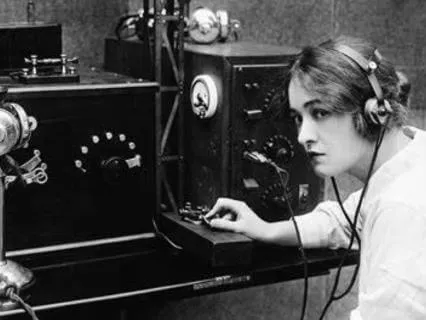
And it took a while for the telegraph system to develop and at first telegraph messages were transmitted by trained code users.
And that's where the fist comes into play,
Because trained code users who send messages back and forth amongst themselves,
You know,
Long before there was even a national system,
Even just locally,
They got to know each other's rhythm of tapping the messaging.
And the rhythm and the intensity and the timing and the sequencing of their messages became an individual style.
So coded messengers all recognized each other's tapping styles,
And that was called the fist.
So if you were a Morse code operator,
And you were said to have a good fist,
That means you were steady,
You were reliable,
You didn't stutter,
You didn't go backwards,
You didn't have light touches,
Everything was clear.
For the other part,
The receiver,
The coded trainer,
The coded message guy,
To receive it on the other end and understand exactly what was going on.
So if you were said to have a good fist,
You were good at what you did in terms of being a reliable,
Easy to understand coder,
And sending the Morse code.
And that kind of terminology,
The fist,
To me,
Is the rudiment of what we now call an algorithm for us,
Because we're all algorithms on the internet.
If you go to buy a blue sweater and look at a blue sweater,
You're going to see blue sweaters everywhere you go,
No matter what kind of filters you have on.
Because the internet is capturing everything you're thinking,
Seeing,
Saying,
And categorizing you,
And slicing and dicing you,
And you're an algorithm.
And the trained coders who had good fists,
That was their algorithm,
And that was their style,
And it was very,
Very recognizable.
And that kind of ties in a little bit into anticipating the internet as well.
And so at the end of the 19th century,
Demands for constraints on Western Union's power in Congress resulted in the passage of what they call the Mann-Elkins Act of 1910,
And that granted the Interstate Commerce Commission regulatory oversight,
And all of that started to happen.
Now prior to the telegraph,
As I mentioned before,
Communication in the 1830s was about the same as it had been in the years just after Gutenberg's invention of the printing press.
It took days or weeks or even months for messages to be sent from one location to a far-flung position.
After the telegraph cable was stretched from coast to coast in the 1850s,
Finally,
A message from London to New York could be sent in mere minutes,
And the world suddenly became much smaller.
Doesn't that sound familiar?
And that's in the 1850s,
Folks.
That's 175 years ago.
Things were shrinking.
So prior to the telegraph,
Politics and business were constrained by geography.
The world was divided in isolated regions,
Limited knowledge of national or international news,
And whatever was shared was generally already quite dated and out of date,
So you could never stay current on things.
Was that a good thing or bad thing?
I don't know.
Again,
Information overload sits on top of all of this.
I mean,
This podcast is part of the Internet,
And it's part of that legacy and that human experiential chain going back to Martin Luther banging up his edict on the wall of the church,
All the way up to this very moment.
So there's a continuity there.
Sometimes I think in modern times we think that everything we're doing is unique and exclusive,
And it's not.
Human society goes in a circle,
While technology goes in a straight line.
We're all running around the same circle,
And on the Internet we don't do anything differently than we've done ever before,
Anyway.
So anyhow,
By the 1850s,
The prediction about the impact of the new medium began to abound.
The telegraph altered business and politics.
It made the world much smaller,
Erased national rivalries,
And contributed to the establishment of world peace.
That was the hope.
It would make newspapers obsolete.
All the statements were made in the 1990s also by people who were wowed by the first blush potential of the Internet.
In 1838,
Francis O.
J.
Smith,
Who was a senator from Indiana,
Wrote,
This mode of instantaneous communication must inevitably become an instrument of immense power,
To be wielded for good or for evil,
As it shall be properly or improperly directed.
And when Morris demonstrated to Congress in 1842,
Senator Smith of Indiana said,
I watched his face closely to see if he was or was not deranged,
And I was assured by other senators after we left the room that they had no confidence in it.
So again,
That's a very vague senatorial statement.
A response is not always an answer,
As we see today in politics and probably in our own relationships as well.
Because you respond to an answer to a question,
Doesn't mean you've given them an answer.
You've just given them a response,
And they're not the same.
Responses are not answers.
Sometimes they are,
But not always.
So when Congress was asked to provide funds for a telegraph line between Baltimore and New York City,
Senator George McDuffie opposed it.
I don't know what state he was from,
But he explained why he was opposing it.
What was this telegraph supposed to do?
Would it transmit letters and newspapers?
Under what power in the Constitution did senators propose to erect this telegraph system?
I was not aware of any authority except under the clause for the establishment of post roads.
And besides,
A telegraph might be made extremely mischievous and secret information after communicated to the prejudice of the merchants or the people.
So the operation of the telegraph between Washington and Baltimore had not satisfied most of the people in Congress.
And at any rate,
They didn't know what the postage would be,
How much it would cost,
You know,
If it was going to be run by the government like we have postage stamps today,
Which is still in the news as well,
Even though it's constitutional and all that good stuff,
But we won't go there.
So then,
When the first transatlantic cable was built from England to the United States,
And President Buchanan at the time,
I was going to say Edgar Buchanan,
But he was from TV shows,
I believe,
Petticoat Junction,
And Queen Victoria exchanged messages in 1858.
A writer for the London Times absolutely raved,
And this is after Queen Victoria and U.
S.
President Buchanan exchanged messages in 1858,
Being the first transatlantic cable laid underneath the bottom of the ocean.
And this writer for the London Times said,
Tomorrow the hearts of the civilized world will beat in a single pulse,
And from that time forth forevermore the continental divisions of the earth will in a measure lose those conditions of time and distance which now mark their relations.
And then,
Author Charles Briggs wrote in his book in 1858,
The story of the telegraph.
And again,
These very contemporary analyses of this emerging telegraph technology are extremely analogous to what's going on in terms of how we're talking about the promise in the future of the Internet and the threats that the Internet exposed,
And all of that.
So anyhow,
Charles Briggs wrote in 1858,
Of all the marvelous achievements of modern science,
The electric telegraph is transcendentally the greatest and most serviceable to mankind.
The whole earth will be belted with the electric current palpitating with human thoughts and emotion.
How potent a power then is a telegraphic destined to become in the civilization of the world,
Exclamation point.
This binds together by a vital cord all the nations of the earth.
It is impossible that all prejudices and hostilities should longer exist,
While such an instrument has been created for an exchange of thought between all the nations of the earth.
1858,
Talking about the telegraph.
We could say that today about the Internet.
We could say that today about a lot of things.
And where does the fist come in?
And again,
Going back to the train coders,
Long before there was an automatic system which came in in the middle of World War I,
And was actually rapidly developed,
Like we tried to do with vaccines,
Etc.
,
In our country,
When things are in our face,
Because the fact that the fisting,
The fister,
The fist as a concept,
For a good coder was recognizable when an enemy on either side during World War I,
And throughout the entire Civil War in our country as well,
Took over a telegraph outpost or telegraph station,
And they tried to send a message that was false information,
Or to tell troops to move somewhere.
The other train coder receiving it could tell by the fist of the person sending the message whether it was the same person he always got from that station.
So the good guys could tell if the bad guys were starting to transmit something disguised as the good guy.
So espionage in the telegraph business started very,
Very early,
And was the reason they were able to come up with an electronic system for telegraph,
Without having to actually have a coder anymore tap every single letter out.
It was typed and then transcribed and automatically did it,
Did it,
Did it,
Did it,
Did it,
That kind of new sound that we knew in early medium on television and radio today,
You know,
Bulletin type sound,
Did it,
Did it,
Did it,
That kind of a thing,
And even in some rock and roll songs.
So be that as it may,
Modern times are not so unique,
Folks.
The things we're talking about are not so unique,
Folks.
We're part of the continuum of history,
How technology is going in a straight line,
A little jiggly sometimes,
But always going forward,
And our societies,
We go in a circle.
So with that said,
I wish you all a very wonderful weekend,
And this episode of Confessions of a Centurion about the fist,
The telegraph,
And anticipating the internet is over,
And more to come on Monday.
We're going to play this thing out,
And thank you.
Nothing new.
The more things change,
The more they stay the same.
I'm taking some risks to connect with you here.
Communicate.
Don't know how we got on this ship.
Have some discernment.
And laugh it up.
Have some fun.
It's only modern times today,
Folks.
It'll be the past soon.
See ya.
More on Monday.
Bye.