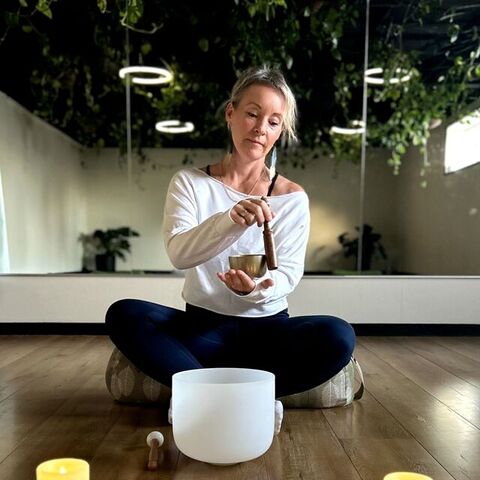
Hello my name is Bea,
I'm a health coach and I'm really looking forward to spending a few minutes breathing with you here today.
If this is your first time playing with breath,
Welcome.
It's a life-changing strategy and tool that I have seen change the lives of hundreds,
Literally hundreds of people including myself.
If you can lie down and get comfy while I just explain briefly that the way that I think about breath,
And there will be loads of ways that people come at this,
But the frame that I hold is one of changing what the state of your autonomic nervous system is.
So there are three branches to your autonomic nervous system,
But commonly we refer to two of them.
The sympathetic being fight,
Flight,
Freeze and fawn.
And the parasympathetic rest,
Digest,
Repair.
The parasympathetic is where your body is going to preferentially pay attention to things like digestion,
Hormones,
So you know is it the time to get pregnant,
How well is reproduction working,
Are you cycling healthily.
Immunity is your body actually paying attention to immune and all of those things are about future health.
They're about your body paying attention to mid to long-term projects.
When you're in sympathetic and you're a bit stressed out and you're all up in your head and you're a bit wound up and you're not breathing properly,
Your body will not be paying attention to future you because all of the signaling that's coming in or much of the signaling is telling your body this moment right here is the only one we might have.
And so it's going to draw blood away from your digestive system and it's not going to pay attention to the longer-term healing reproductive and digestive processes because if you end up being attacked by a lion those things won't matter.
As a framework that is how I come to breath.
I come to breath thinking of how many times through the day can we move away from sympathetic and come back to parasympathetic.
Even if you do it briefly but if you can do it many times through the day over time that will be the pathway that's easier to access.
And so when we're thinking of breathing for parasympathetic dominance we want to think of breathing deep into the belly,
Breathing through the nostrils if you have access to that and that's ideal and making sure that your exhale is longer than your inhale.
Those three things will chemically and structurally give the information to your brain that you're actually safe and there's no need to panic and we can prioritize long-term stuff here.
And so let's play around with your breath for just a few moments here as we introduce breath work into your life.
And so if you're laying down on your back just notice now snuggle in,
Notice where your body's landing,
Make sure your head is soft and relaxed,
That your shoulders are soft and away from your ears and your neck is soft and relaxed.
It's actually handy to keep one hand on your belly and one hand on your chest and ideally what we want to see is the chest is raising second to the tummy.
So tummy's raising up,
Ribs are opening out and then the chest follows.
We don't want the shoulders necessarily moving up either so just notice what happens through your torso as you bring breath in.
So let's begin now by emptying out a lovely big exhale,
Softening through the body and breathing in through the nose and soften out through the mouth or the nose for twice or three times as long as you breathed in.
Now I'm not going to count because each of us will have a different amount of access but what I'll ask you to do is continue to breathe now in through the nose noticing that you can get a little bit fuller and a little bit deeper each time and that each time you exhale you really feel that sinking in your body,
You feel the letting go and the opening in your body.
Continue to breathe in through your nose and empty out through your mouth or your nose nice and long as far as you can go.
It might even feel a little pinchy at the end here,
That's totally fine.
Once all the breath is out back in again,
Emptying out,
Make noise if you have noise to make.
Noise is totally fine.
Breathing in again through the nostrils and breathing out again and as you let your final breath out take a scan of your body.
Have you been able to notice any shift in an emotion or in a physical experience here?
How do you feel?
You can do breathing many times a day,
Any time,
Even one lovely breath in and a super long exhale while you're in the car,
While you're waiting on the phone for someone to pick up,
While you're boiling the kettle,
While you're standing in the lift.
You can do it anywhere and anchoring it to something you already do is a great way to remember to do it.
So enjoy your introduction to breath work,
There's more for you in the future.