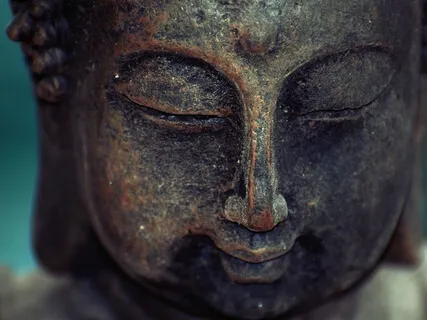
Fourth foundation of mindfulness meditation,
Mindfulness of dharmas.
Sit in a comfortable but attentive posture.
Feel your head balanced on your shoulders,
Allowing your face and jaw to relax with arms and hands resting in a comfortable position.
Be attentive to what's happening within your own awareness right here and right now without judgment.
As you sit,
Begin to notice the sensations of breath.
Pay attention for a moment to how your belly moves on each in-breath and each out-breath.
Noticing the movement of air through your nose and the slight movement of your chest and shoulders.
Find the spot in your body where the sensation of breathing is most vivid,
Whether it be your abdomen,
Your chest,
Or your shoulders,
Or perhaps the movement of air through your nose.
Try and keep your attention on that spot.
As you breathe in,
Be aware of the in-breath.
As you breathe out,
Be aware of the out-breath.
Simply observe the breath going in and the breath going out.
You may notice your attention shifting away from the breath from time to time.
It's perfectly normal for thoughts to wander into fantasies,
Memories,
Worries,
Or things you need to do.
When you notice your mind has wandered,
Try and meet it with a spirit of friendliness.
You don't need to do anything about it.
There's nothing to fix.
Rather than forcing it,
Try and allow yourself to become curious about what it's like to be breathing right now,
And you'll find that the attention is naturally drawn back to the physical sensations of breath as it moves through your body.
And again,
If your mind wanders,
Gently bring your attention back to the sensations of breathing.
After building a foundation of calm attention to the breath,
You may wish to expand your awareness to include the experience of the body.
Do you notice any sounds?
Are there any sights,
Even from behind closed eyes?
Are there any smells?
Are there tastes?
Are there physical sensations?
Are there any emotions?
Allow the sensations to arise as naturally as possible.
Stay with them gently and let them go as they pass.
There's no need to chase them or pursue them or fixate on them.
Simply notice how they change.
If at any point,
You find yourself being carried away by a particular experience,
Or you find yourself lost in thought,
Try and bring your attention back to the breath.
And then gently return to focusing on the flow of sensation.
As you pay attention to these changing sensations,
Try and be aware of the feeling tone of each experience.
Are the sensations and experiences pleasant?
Are they neutral?
Now,
Gently direct your attention to the experience of mind.
What is happening in the mind right now?
What is its attitude?
What is its energy?
Is desire present?
Are wanting or craving present?
Is there an experience of anger?
Are frustration or resistance present?
Is there a sense of distraction?
Or perhaps confusion?
Allowing your mind to be as open and relaxed as possible.
Notice how particular thoughts arise in the mind.
Try and allow the thoughts to occur naturally,
Without judgment.
Notice how thoughts themselves generate new and changing thoughts.
Observe the process of their coming and going.
There's no need to engage with the content or the stories in the thoughts.
Simply watch thinking happening.
Allowing your mind to be as open and relaxed as possible.
In this stage of practice,
We try to attend to our states of mind and being with particularly careful discernment.
The Buddha identified several clusters of mental phenomena or mental objects of which the practitioner should try to be fully aware.
These are often called dharmas.
In this meditation,
We attempt to apprehend the reality of these mental objects,
To experience these dharmas as they truly are.
By familiarizing ourselves with these objects,
By investigating them without judgment,
We learn how to cultivate what is helpful for us and to let go of what is not.
The hindrances are mental phenomena which can impede us and obstruct our development.
Right now,
Notice,
Is there an experience of desire?
Investigate its presence or its absence.
Is there an experience of aversion?
Is there an experience of sleepiness?
Investigate its presence or absence.
Is there an experience of agitation?
Investigate its presence or absence.
Is there an experience of doubt?
Investigate its presence or absence.
The aggregates of clinging are phenomena through which we can become attached to impermanent objects.
In this moment,
Is there awareness of material form?
Is there awareness of feeling,
Of sensation?
Is there awareness of sensation?
Is there awareness of perception?
Is there awareness of perception of identifying,
Labeling?
Is there awareness of feeling?
Is there awareness of mental activity,
The beginning of mental actions and reactions?
Is there awareness of feeling?
Is there awareness of consciousness,
Of discernment and discrimination?
The sense bases are the six organs and senses of Buddhist psychology to which we can become stuck or fettered.
In this moment,
Is there awareness of the eye and the visions of the eye?
Investigate how one could be restricted by the eye or by vision.
Is there awareness of the ear and the sounds heard by the ear?
Investigate how one could be restricted by the ear or by sound.
Is there awareness of the nose and the odors smelled by the nose?
Investigate how one could be restricted by the nose or by odor.
Is there awareness of the tongue and the tastes,
Taste by the tongue?
Investigate how one could be restricted by the tongue or by taste.
Is there awareness of the body and the touches felt by the body?
Investigate how one could be restricted by the body or by touch.
Is there awareness of the mind and the mind objects of the mind?
Investigate how one could be restricted by the mind or by mind objects.
The seven factors of awakening are phenomena that assist our development towards freedom.
In this moment,
Is the factor of mindfulness present to the mind?
What is the experience of mindfulness like?
Is the factor of investigation present to the mind?
What is the experience of investigation of phenomena?
Is the factor of energy present to the mind?
What is the experience of energy?
Is the factor of joy present to the mind?
Is the factor of tranquility present to the mind?
What is the experience of tranquility?
Is the factor of concentration present to the mind?
Is the factor of equanimity present to the mind?
What is the experience of equanimity?
The last of the dharmas to be investigated in this meditation are the four noble truths themselves.
In this moment,
Is there awareness of the truth of suffering?
Is there awareness of the truth of the cause of suffering?
Is there awareness that craving leads to suffering?
Is there awareness of the truth of an end to suffering?
Is there awareness of the truth of the path that leads to the end of suffering?
Is there awareness that cultivating the path will lead to the end of suffering?
Is there awareness that there is no end to suffering?
As this meditation comes to an end,
Recognize that you spent this time intentionally aware of your moment to moment experience,
Building the capacity for opening the senses to the vividness,
To the change,
To the vitality of the present moment,
Expanding your skill to be curious about and open to whatever presents itself without judgment.
Then,
Whenever you're ready,
Allow your eyes to open and gently bring your attention back to the space you're in.
.