Welcome to Learn Buddhism,
I'm Alan Pedow.
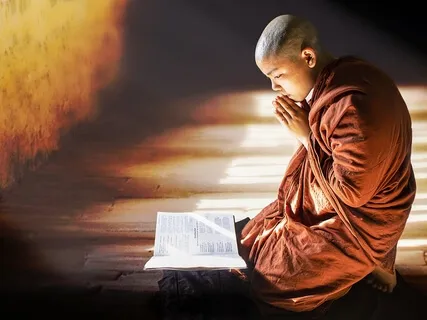
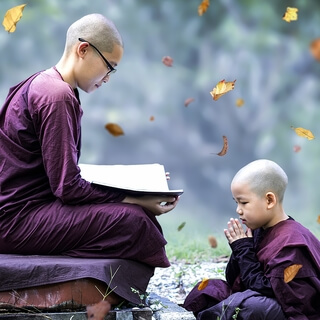
If you're new to Buddhism you likely want to start practicing Buddhism in addition to just learning about Buddhism but you're not sure exactly how to go about doing that.
That's because there's many different Buddhist traditions out there and they all practice Buddhism in different ways.
So in this episode I'm going to take you through constructing a daily Buddhist practice which is rooted in the different Buddhist traditions and teachings without being specific to any single one of them.
When you finally pick a tradition that you want to follow you can go ahead and switch over to whatever daily practice that they recommend.
But why are we practicing Buddhism on a daily basis anyways?
Well we can go back to what the Buddha talked about.
He basically said that is through your own effort and determination and insight that you're able to become enlightened,
That you're able to blow out the three fires of greed,
Anger,
And delusion which is causing a lot of suffering or dukkha in your life and realize your true peaceful calm natural state of nirvana which is the goal of all Buddhists.
So I like to kind of compare this to going to the gym.
Let's say you want to become healthier,
Prepare for particular events or maybe you want to become a bodybuilder or something like that.
You need to go to the gym and not just go to the gym but you need to be consistent about it.
You have to use the right technique and form and you also have to feed your body the right food and nutrients so that you can grow muscle so you can be healthy and you can continue on that effort that you're trying to achieve.
We can look at that with a daily Buddhist practice as well.
Well just imagine going back to my gym example you just want to watch videos about working out while you're sitting on a couch eating a pizza.
That's not exactly gonna work and it's the same thing for Buddhism.
You have to practice it.
It is a constant every day every moment effort.
So Buddhists around the world have many different ways they practice this as I mentioned all so that they can continue this effort.
It's almost like doing push-ups every single day.
You may not be great at it starting out but as you continue your effort your practice you'll get better and better and better and you'd be walking down this path that the Buddha helped us understand.
Now for Buddhists we can follow something called the threefold training.
This is based upon the Buddha's eightfold path which is the practice he gave to all of us.
So in a threefold training the noble eightfold path is grouped into three sections.
There's a wisdom category,
There's a morality conduct category,
And there's also a discipline category.
So when all three these are practiced it's a very whole Buddhist practice and so I'll be incorporating quite a bit of that here today.
So here's how our daily Buddhist practice is gonna look.
We're gonna start off by taking refuge in the triple gym.
So when someone becomes an official Buddhist they take refuge in the triple gym.
That's the official mark of their journey.
Now if you're just learning about Buddhism and want to start practicing it you probably haven't made the decision or commitment to actually become a Buddhist yet.
It's okay to go ahead and take refuge in a triple gym as part of the daily practice I'm giving you right now or you can go ahead and negate it for right now whichever you feel comfortable with.
Next we're gonna recite the five precepts.
So this is the minimum rules or guidance that we take far as morality stance as lay person Buddhist in our everyday lives.
This is a great reminder as we do it every day to what we should be striving towards as we encounter all these different situations and experiences out in the world.
Then we're gonna recite the five remembrances.
So the five remembrances is a great practice which kind of helps us understand about impermanence,
Dependent origination,
Ourself,
All these different things that were basically a temporary,
Impermanent,
Ever-changing,
Interconnected thing but we don't actually see that.
So the five remembrances will help us understand that.
Then we can go ahead and chant,
Recite,
Or read a sutra.
A sutra is going to be for example a sermon of the Buddha or one of his in line of followers.
This is a great practice to do because it really ties into that wisdom category of the threefold training.
Then we can meditate for ten minutes or longer so you don't always have to do sitting meditation.
There could be a variety of things you can do such as walking meditation and it also includes different things such as focusing on a Buddha and the qualities of a Buddha for example.
So there's different types of meditative concentration we can actually do.
What I'm going to explain here is going to be more of a sitting meditation one but there's different things you can actually do in that particular step.
Then at the end we're going to dedicate the merits of our practice.
So a Buddhist practice is very much a wholesome activity and we consider it wholesome in Buddhism because it's aligning ourselves with what the Buddha taught and with his path towards awakening and enlightenment and finally realizing nirvana.
So anything in that path is wholesome.
So what we do is dedicate merits of practice.
We're also giving essentially a very inspirational way.
We're giving the merits of our practice out to others.
We're not keeping it for ourselves because if you really think about it we want to be generating compassion and loving kindness for others and what better way than to dedicate the merits of your practice to others.
It feels very unusual a little bit for for most of us because we feel like we're giving away something that we worked hard for but if we really think about it it's never really ours to begin with.
It's a practice we're doing to transform ourselves.
The entire Buddhist practice is to transform ourselves to generate loving-kindness,
Compassion,
Generosity,
Gratitude.
We're trying to do these qualities,
Transform ourselves into these qualities but we're also trying to break down the idea of self inside us but not the self of you and me right now but the idea of a self that's permanent,
Unchanging,
And independent.
And the Buddha said that doesn't exist.
We are ever-changing,
We are impermanent,
And we are interdependent upon other things just to arise,
Sustain ourselves,
And eventually to cease.
And so it's very important in Buddhist practice to kind of break down that belief and the imagery I like to give you was that imagine you have a really dirty window or a dirty mirror.
You're unable to see out the window or see the reflection in the mirror.
So we start making assumptions,
Perceptions,
Ideas about what we think we're seeing or what's out there and as a result of that we can go right back to those three fires of great anger delusion.
We are making wrong decisions,
Basically unwholesome karma,
Unwholesome actions.
And so Buddhist practice is very much about polishing that mirror so we can eventually see our true nature or for the other imagery,
Cleaning that dirty window so we can eventually see out.
We can actually see what's actually occurring.
And that way we,
On either of these two examples,
We can't go back to creating greed,
Anger,
Or having delusion and thus creating karma.
We now understand how things actually occur,
The true reality of things,
And we can act and behave just like the Buddha's aligned followers because now we are enlightened.
We understand what's actually going on.
Right now we don't.
So Buddhist practice is all about helping us get to that particular point.
So before we begin you might be going,
Well where do I actually do my Buddhist practice?
Do I need to have special equipment?
Do I need a statue of the Buddha,
Etc.
?
Well at a very bare-bones minimum you just need to have a location that's quiet,
You won't be disturbed,
Just so you can be practicing in an uninterrupted fashion.
Now if you don't have that,
Maybe you want to do it maybe early in the morning before other people wake up or maybe in the evening or just when you have some quiet time or some place alone.
You don't need anything fancy like meditation cushions or a fancy Buddhist altar with a Buddha statue.
You don't really need any of that.
Buddhism can be practiced anywhere at any time.
Now all that being said,
A lot of people find those things are very helpful for them.
For example,
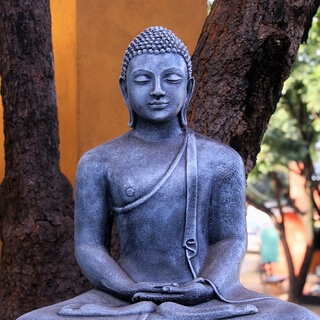
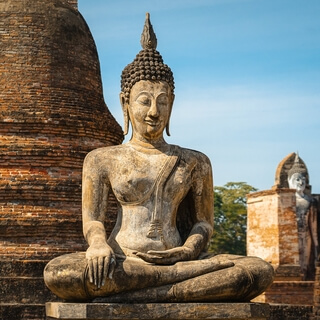
Having a Buddha statue in front of you can be very inspirational and help with your faith and determination because when you're looking at a statue of a Buddha,
You're really looking at a mirror.
There is Buddha nature already inside you.
There's already Buddha inside you.
You're already awakened,
Enlightened.
You just don't realize that.
And what I mean by that is not that you have to no longer work towards becoming awakened or enlightened,
But you already have your true nature inside you.
We are just creating all the waves and the discomfort of suffering based upon our actions.
So we just have to calm that down.
So looking at a statue of the Buddha,
We're looking basically at what's already inside us.
We just have to uncover that.
So it's very inspirational for a lot of Buddhists and it's a good way to also practice compassion and loving kindness and generosity when you have a statue of the Buddha in front of you.
And I'll talk more about that later.
Other people also like having specific meditation cushions.
You don't really need that,
But if you do,
That's great.
You could also use a chair.
You can also use like a pillow.
There's different things you can do to get yourself started without breaking the bank.
And you don't have to burn incense or anything else like that.
Again,
This helps in different ways for different people,
But one thing you could probably easily do,
Get like a little bowl or something and you can do offerings,
Maybe water or some food.
I'll talk more about that here in a second.
So just finding a place that's quiet and you won't be disturbed is a good way to start your daily Buddhist practice.
And you can also do this daily Buddhist practice as many times as you want to.
Maybe morning and evening,
Maybe also in the afternoon,
Many times as you want to.
But for most people,
They like to do it at a time that's most convenient to them.
Sometimes in the morning is better for them,
Maybe sometimes in the evening.
Either way will work.
Before you begin your daily practice,
You may want to start bowing to the statue or a picture of a Buddha.
Now this is always something that a lot of Westerners look at and sometimes scoff at or just don't truly understand because it looks very devotional.
But what you're doing is basically two to three different things here.
You are bowing by showing respect to our teacher,
Shakyamuni Buddha.
He has given us the past a way to free ourselves,
Liberation,
And we definitely show him respect in that regard.
A statue or a picture of the Buddha is also very illustrative of the Buddha that's inside of us.
So in another way,
We are bowing to the Buddha that's already inside of us.
And then finally,
We're also doing it to humble ourselves,
To basically break this ego,
This self love that we have for ourselves.
And so by bowing to the Buddha,
That's a fantastic way to do it because remember,
A big part of Buddhist practice is breaking down this idea of a permanent,
Unchanging,
Independent self.
Let's start our practice by taking refuge in the triple gem.
I take refuge in the Buddha wishing that all sentient beings understand the Dharma and make the supreme vow.
I take refuge in the Dharma wishing that all sentient beings study the sutras diligently and obtain an ocean of wisdom.
I take refuge in the Sangha wishing that all sentient beings lead the masses in harmony without obstruction.
So the Dharma is the teachings of the Buddha,
The Sangha is his monastic community.
So what we're doing here,
We are taking refuge in the Buddha as our teacher and also wishing that others will also follow him so they can be liberated.
We take refuge in the teachings of the Buddha that help us through his sutras,
The sermons of the Buddha,
That we are able to better understand,
Have that wisdom,
That we can become enlightened,
Become awakened.
And then finally we take refuge in his monastic community,
The Sangha,
Because they are helping others also walk that path but we also are showing them our support because they have made this,
Essentially this ultimate sacrifice by becoming homeless,
Essentially.
They've given up everything to follow the path of the Buddha.
Next we are going to recite the five precepts.
The five precepts are what lay persons follow.
Now that being said,
A lot of lay persons may take at the time of their triple gem refuge ceremony maybe one or a few of these precepts but most people will just take the triple gem to begin with and then later take the five precepts.
Either way is fine.
The precepts are not hard and fast rules that where if you break one of them you're going to be punished.
Everything we're doing in our Buddhist practice is to help us become awakened,
Enlightened,
And realize our true natural state,
Nirvana.
So the only punishment is really from our own actions and the precepts help us by not punishing ourselves,
By not having these repercussions.
Our first precept is I will refrain from killing,
Harming,
Or violating others.
The second is I will refrain from stealing or taking what is not mine.
The third is I will refrain from sexual misconduct.
The fourth is I will refrain from lying,
Gossip,
Or harsh speech.
And the fifth is I will refrain from intoxicants,
Stimulants,
Or legal drugs.
Now all of these are about us not violating others because in Buddhism part of this morality conduct,
Which is a very big part these five precepts,
We don't want to harm others because that's unwholesome karma,
Unwholesome actions of maybe the body,
Mind,
Speech,
Etc.
So by following these five precepts we are able to ensure that we are not violating others,
Not causing them harm,
Dukkha suffering.
Next we will recite the five reflections or five remembrances.
This is practiced by millions of Buddhists and while they may seem a little scary because they're really revealing to us the true nature of impermanence in ourselves,
They also have a historical aspect to them.
When the Buddha,
Back when he was Siddhartha Gautama,
Before he was a Buddha,
When he left his compound where he was living with his father,
He wanted to experience what he's been kept from by his father and we call this the four sites in Buddhism.
Now three of those sites is going to be part of these five reflections.
So what you're reflecting on here is also what really spurred Siddhartha Gautama on to become the Buddha.
So without this sort of four sites that he saw and how it's merged into these five reflections,
We're also going to be reflecting upon that and then hopefully spurring us to go,
Okay I understand more about impermanence,
I understand more about the true nature of different things and when we do that it also becomes empowering because the fifth remembrance is the empowering component and I'll let you hear all five of them first and you will see how it is.
The first is I am subject to aging,
There's no way to avoid aging.
The second is I am subject to ill health,
There's no way to avoid ill health.
The third is I am going to die,
There's no way to avoid death.
The fourth is everyone and everything that I love will change,
There is no way to escape being separated from them.
And then the fifth is my only true possessions are my actions,
I cannot escape their consequences.
So a very good quote from Venumatthik Nathana is my actions are the ground upon which I stand and you can see that right here especially with that fifth remembrance or fifth reflection.
So the first four is basically a lot of like what the Buddha saw when he was at Siddhartha Gautama.
He saw an old man,
He saw somebody who was sick and then saw someone who was dying and he really understood that we are ever-changing,
We are impermanent,
We're all gonna get sick,
We're all gonna die but this was all kept from him so for you and me we may understand that but not really at a fundamental level.
This prompted him,
Shocked him enough that it spurred him into action because the fourth sight that he saw was basically a holy person who was trying to eliminate suffering,
Become enlightened.
So that's what really spurred him.
Now that fifth portion there,
Your only true possessions are your actions,
They're talking about karma.
So most of the time we are generating,
Creating unwholesome karma due to the three fires of greed,
Anger,
And delusion.
So just like Venumatthik Nathana says,
Your actions are the ground upon which you stand,
That's what we want to accomplish in Buddhism.
In our practice we want to start generating wholesome karma that's aligned with the Buddhist path because then we're not violating others,
We are not doing things that are keeping us trapped in a cycle of rebirth,
We are doing things that are keeping us on the Buddha's eightfold path towards enlightenment.
Next we can chant,
Recite,
Or read a sutra and this is a great practice because what you're doing here,
You're reflecting and learning about what the Buddha preached or had his sermons about back when he was still teaching for over 40 years.
But you also can get it from the enlightened teachers or bodhisattvas or other Buddhas,
There's many different sutras depending upon the different tradition.
So which ones do you actually read?
Well again your tradition when you finally pick one will be giving you recommendations.
There could be sometimes just like one particular sutra that you will be chanting,
Reciting,
Or reading or maybe just a few.
So depending on the particular tradition this will become very important to you.
And you can also just right now you may be going,
Okay well what do I read if I don't have a particular tradition?
Well there's many different ones out there.
Mahayana is the biggest branch of Buddhism and there's many different ones there.
Some very popular ones are the Heart Sutra,
The Diamond Sutra,
And the Lotus Sutra.
So you might want to start for example with the Heart Sutra.
Now there there's also the Lotus Sutra and and there's also on the Pure Land side there's the Amitabha Sutras.
So which ones you follow or read will very much depend upon the tradition.
Some sermons of the Buddha that might be very applicable to what you want to read.
I'm gonna give you some examples right here.
The Fire Sermon is a very popular one just because it's very understandable to a lot of Westerners but it also can spur you into action because basically in that fire sermon the Buddha is saying all around us it's not necessarily fire like an actual fire but fire of the senses so your eyes,
Ears,
Nose,
Taste,
All that stuff you are actually ingesting your game burned by all these particular fires around you and I like to use my three fires analogy here but you get all these fires and you're allowing suffering to basically arise due to that so the Buddha always said we need to guard our senses and think about this way guard your senses against these fires that want to consume you so that's a great sermon right there you can also re-chant the setting the wheel of Dharma in motion that's another very popular one but there's many out there so you might want to refer to my website allanpeteau.
Com to see a list of the ones that I have there.
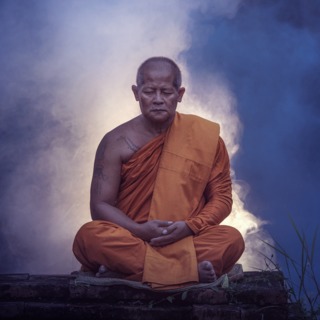
Then you can meditate for maybe five ten minutes or longer one thing you don't have to do is meditate for hours or days so especially just starting off do this where you have a consistent practice that's what we're doing here we want to have a consistent practice not in irregular practice so if you start practicing for hours a day you're probably gonna get burned out pretty quickly because you're trying to make all these massive gains going back to my gym analogy just imagine you're gonna work out with the heaviest weights there and you're just gonna work for hours and hours and hours at the gym you're likely gonna hurt yourself or your body's just gonna go that was way too much for me so you want to do the same thing with Buddhism you want to just be consistent so when we actually meditate different ways it could be sitting meditation you can do walking meditation different things you can do but here's some general guidelines on how to do sitting meditation and of course it will all depend upon different things such as your medical condition your prior medical history or injuries or anything else like that so the best way is actually really to have a teacher show you this instead of just over a podcast or a video but essentially you want to be sitting with your back straight and a good analogy of like what you want to do here just imagine a stack of quarters or coins and as you move those around you can see where if you just a little bit more on one side or another it may fall over right so just imagine just just like that is this going to be a straight up and down row of coins or quarters keep your back straight now if that's hard for you to do you can absolutely sit on a chair there are many Buddhists I've seen to do this so that's perfectly okay and especially as you get older it could be very difficult to be doing sitting on the ground for example you want to observe there's any tension in your body and relax that as your body starts relaxing you're gonna start paying attention to your breath this is a very natural thing that occurs because as you can more relaxed your breathing is a very constant effort now focus on that breath you may want to actually focus on the inside of your nostrils so it sounded very weird but as you're focusing on the breath going in and out you're trying to essentially calm yourself down you're trying to settle your body and specifically settle your mind and a great way of settling your mind is by focusing on the breath it's a very time-honored tradition and practice because the breath is constant it doesn't matter if it's irregular or or anything else like that you're just focusing on whatever the breath actually is next you want to just keep doing that until your body relaxes and you're gonna feel your body relax more and more and more but you don't want to have your back no longer straight or you're just now thinking about random things your goal here is continue focusing on that breath now what you want to do after this as your mind starts to calm down and your body's coming down you're able to focus on that breath in a very natural way remember you're not trying to control your breath or go I need to breathe in like this and breathe out like that you're just observing now it's a key word here observing the breath and as you're doing that that's where you want to be now this seems like a very basic practice and it is but it's also very challenging because your mind wants to take back control it wants to pop thoughts inside your brain so that you're just going to go ahead and follow it and that's what you don't want to do you want to train control master your mind now this may take a long time for you to actually master or get a hold of but in actual Buddhist meditation the goal is to develop insight so after we calm settle the mind we actually focus on gaining insight and this insight is this deep wisdom that we can gain from it and this is where for example the the Buddha or said heart to God's my when he was meditating became the Buddha he was able through this practice to be able to gain direct insight into the true nature of things but that should not be your goal right now your goal should be to focus on settling the mind and you can definitely use this breathing meditation as a way to do that and then finally we can dedicate our merits so after we're done we can go ahead and dedicate our merits so we're not actually doing something metaphysical so to speak we're not actually giving out like coins to somebody else this merry coins we're actually dedicating it out just to whomever and this is a very Buddhist practice because we're not trying to keep something for ourselves because remember we are impermanent and this whole life is a burden so we want to help others also be on the Buddhist practice and if you think about this way they are also dedicating their merits you're also sort of receiving it that way as well so this may seem very unusual to Westerners but it's a great way to break down that ego and to also show loving-kindness compassion and generosity so just a great way to do that because there's no need to hoard or keep whatever merits you make from your practice your practice is your reward and these wholesome merits you're getting out of it yeah absolutely spread it out so some ways that Buddhist do this they may dedicate it to deceased family members you may decide to dedicate to all sentient beings it's totally up to you so here's a nice way you can do that and this is a very short way that that I actually do it but depending on your tradition they have different ways as well for all sentient beings I dedicate the meritorious actions of this practice so that they may be guided and liberated from delusion and suffering with the light of the Buddhist Dharma that's a great way to do it it's nice and short but there's many other versions out there use whichever one speaks to you you could also far as your practice do something on Sunday so Sunday is also very traditional day of practice for Christians so you can do that as well because probably you may have it off or maybe that you're coming from a Christian background and so you're used to doing stuff on Sundays you can go ahead and pull up a YouTube video where there's a monastic actually doing a Dharma talk you can do a little bit longer on meditation maybe you want to do something extra absolutely there's many different ways you can actually do it you can also incorporate this into many different Buddhist holidays we have as well that was a very short way to start a daily Buddhist practice it shouldn't take you really that long it's so this will never go over an hour although if you want to do a little bit longer for your practice you absolutely can but keep it short and keep it consistent do you have any questions about starting a daily Buddhist practice I'd like to hear back from you you can go to my website alanpito.
Com to send me a message and I'll look forward to talking with you in the next episode